Land! Part 3 – Physically locating parcels of land

(Disclaimer: I am not a land surveyor, a registered civil engineer, a real estate agent, or a real estate lawyer. I bought land. I figured out where it was. This is what I learned, but I make absolutely no guarantees about the accuracy of the information I provide below. If you have questions, consult a professional, and do your own research.)

This is the long over-due Part 3 on my series about buying land (see Part 1, and Part 2). In this section, I’ll talk about how to physically locate parcels of land on the surface of the Earth (specifically, in the US). The fact that this topic warrants an entire blog post (and more!) might come as a surprise to some. After all, if you buy a house or a condo, physically locating it is usually the easiest part; just type the address into Google Maps, and follow the directions. Easy! The problem is, remote vacant land often won’t have street addresses that mapping services would recognize.

Wait. No street addresses? Then how is land described or identified? Glad you asked. Here are a few of the ways land can be described:

  • Driving directions – Real estate listings for land often will include directions you can follow to get to the land… or at least, close to it. As far as the real estate agent knows. Which might not be accurate. In any case, it’s usually of the “Go east on Highway 123, then turn left on county road 4 approximately 2 miles past the cafe in Tinytowne, drive roughly 10 miles until you see a dirt road (see attached picture)…” variety. Yeah. Fun. The problem is, when you’re talking about acres of land, getting there is only the beginning. You then want to know where the property boundaries are and such. So, directions like these, while useful, only give you a part of the picture. Instead, you should ask for…
  • Topo maps – Some of the more technically savvy realtors will use GIS software to plot the approximate property boundaries onto a topographical map. If you’re not familiar with topo maps, they’re detailed maps that show not only roads and such, but also represent the terrain, vegetation, bodies of water, and other useful information. I believe they are made by the USGS, and copies are available online (I’ve used Digital-Topo-Maps.com), or at BLM offices. If your realtor is savvy enough to use GIS, they should also be able to give you approximate GPS coordinates of the property corners. Sounds great, right? Well, note how I’ve used the word approximate a couple of times… Yeah. So, when I first got a topo map representing the property I ended up buying, they got it horribly wrong. If I’d gone by that, I’d think I owned tens of acres of someone else’s land, and thought I’d have road frontage when I didn’t. In most cases, they’ll be accurate to within, oh, tens of feet, but still, that could be quite significant, and to make matters worse, consumer-grade GPS units are often only accurate to within tens of feet, which means, combined, you could be off by 50-100ft!
  • Parcel maps – These are usually maps filed at the county recorder’s office, and contain less information than topo maps about the nature of the land, but more accurate information about the parcel’s borders. These are usually drawn up by Land Surveyors (LS) or Registered Civil Engineers (RCE), and might contain information such as the precise length of a border, the location of surveyor’s pins and other markers, and easements. Parcel maps come pretty close to being the source of truth, but, they are not the source of truth. They can be wrong, or outdated and superseded by newer parcel maps that for some reason your realtor isn’t aware of, but contains relevant (and potentially conflicting/overriding) information. Another big problem with parcel maps is that they don’t necessarily tell you where your property is on the surface of the planet. Take a look at the example map above. Given such a map, how would you find the property corners? There aren’t any GPS coordinates on the map, and it’s entirely likely that there aren’t any physical markers (fences, surveyor’s pins, etc) on the ground. I’ll describe how this works later in this post…
  • Legal description – The source of truth is actually what’s called the legal description. It is a textual description of a parcel of land written down on the deed. You might think you’re buying land, with trees, dirt, rocks… but no, actually, when you buy land, you’re buying a piece of paper with text on it. So, what does this text look like? I’m sure there are a wide variety of descriptions, but personally, I’m aware of four different patterns:
    • Parcel 3 in the map on Page 42, Book 78 filed in the County of Snarfle on January 25th, 1962.” (The precise language might sound more official or legalese, but you get the idea)
    • From the North West corner of Section 27 of Township 26 North, Range 6 West, Mount Diablo Meridian, go due south 2603.4ft to the starting point. Thence due East 2612ft, then due South 2609.2ft, due West 2611ft then due North 2605ft back to the starting point.” This description is based on the PLSS, which I’ll describe below. (Again, in reality, it’ll sound slightly more official and legal than that, but you get the idea.)
    • East half of South West Quarter of Section 27, T26N R6W, MDM” This is also based on PLSS.
    • beginning with a corner at the intersection of two stone walls near an apple tree on the north side of Muddy Creek road one mile above the junction of Muddy and Indian Creeks, north for 150 rods to the end of the stone wall bordering the road, then northwest along a line to a large standing rock on the corner of John Smith’s place, thence west 150 rods to the corner of a barn near a large oak tree, thence south to Muddy Creek road, thence down the side of the creek road to the starting point.“(src) This system uses an old British system called Metes and Bounds.
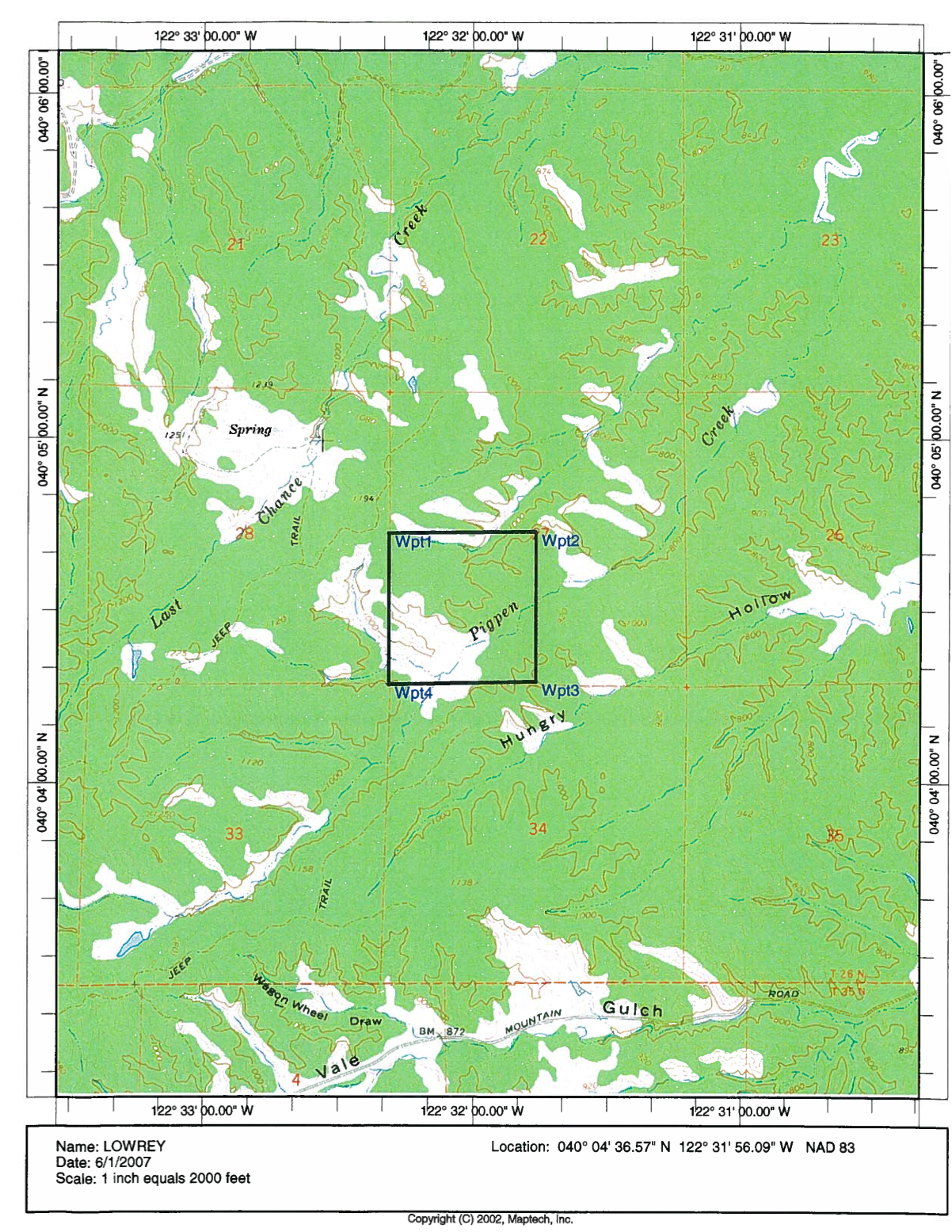
If you buy land, sooner or later, it’s likely you’ll end up with all of the above. Or, at least, I did. Then, you drive out there, put on your hiking boots, and you walk. And don’t forget to bring a snack and some water too, ’cause you might be out there for a while… But before you do that, it’ll help to understand how the aforementioned Public Land Survey System works, since most land in a large portion of the US (excepting large swaths on the East Coast, mostly in the original 13 Colonies) will have descriptions based on that system.

The Public Land Survey System

If you’re really interested, go read this page and skip my explanation. For those of you only mildly interested, I’ll try to summarize the basic idea:

So, the Brits, being ass-backwards as they are, used what’s known as Metes and Bounds. Their system basically used physical landmarks, directions and distances to describe land. So you’d start at a rock, then head towards that tree, then along this stream… so on and so forth. The problem is, these physical landmarks can move or disappear over time, creating ambiguity. But in the US, we had Thomas Jefferson. In case you didn’t know, Thomas Jefferson was pretty bad ass. He was like the Chuck Norris of his time. But smarter. Anyway, I digress… where was I? Right. Thomas Jefferson came up with a more rational system based on a grid. In the PLSS, most of the US is divided into a neat grid, of 6 mile by 6 mile boxes called Townships. Each Township is further divided into a 6 by 6 grid of Sections that are one mile square. Except, I lied. I said a grid, but in reality, there are many grids. Let’s look at the example I mentioned in one of the legal descriptions above: Township 26 North, Range 6 West, Mount Diablo Meridian or abbreviated T26N, R6W, MDM. What that basically says is, starting at the origin of the Mount Diablo Meridian grid (presumably somewhere near Mount Diablo in central California), you go North 26 townships, then West 6 townships, and that’s the one we’re talking about (columns of townships are called Ranges, hence Range 6 West). Within townships, sections are numbered left to right, top to bottom, so Section 27 would be 5 rows down, and 3 columns over.

So… ok, if you’re confused, go read the article I linked to in the first place. The illustrations there might do a better job than my rambling. Though it won’t tell you how kickass Thomas Jefferson was. Kickass, I say.

Incidentally, a Section, the one mile by one mile box at the lowest levels of the PLSS grid, is approximately 640 acres. A quarter of a Section is 160 acres. A quarter of a quarter of a Section is 40 acres. Ever heard the phrase “40 acres and a mule”? Yep. Now you know why it’s 40 acres and not 30 or 50 or a 100.

Finding Section Boundaries

If you’re buying large acreage (i.e. a multiple of 20), there’s a good chance you’ll be buying a neat fraction (half, quarter, etc) of a Section. In fact, your property may even be in the corner of a section, and have a legal description that originates at that section corner. If so, you might want to know where the section corners are. There are websites that’ll take Township, Range and Section codes and crank out GPS coordinates. But, really, the source of truth is a marker on the ground. If you’re unlucky, like me, your Township was last (and first) surveyed by the General Land Office in 1880. They conveniently erected a pile of volcanic rock to mark the section corner… in a field strewn with volcanic rocks. Do you know what a 130 year old pile of volcanic rocks in a field full of volcanic rocks looks like? I don’t. But, that’s why we have RCEs and LSs.

Finding Property Boundaries

So, I hope you enjoyed reading all that information above, because in reality, most of it is interesting but useless background knowledge. In reality, here’s how you locate a parcel of land:

  1. Get all relevant maps and legal descriptions from your realtor, or better, the county recorder’s office
  2. Look at all the maps of the parcel that have been filed at the county, which were drawn up by an LS or RCE. Look for indications of surveyor’s markers or pins (usually tiny circles).
  3. Go to the property, and look for those markers or pins. Usually they are numbered plastic or brass discs or tags attached to something permanent. They may be attached to trees, but I believe they are often on steel pipes pounded into the ground. However, they might only stick out of the ground about 6 inches, and unless you’re practically on top of it, you might not see it. But having approximate GPS coordinates will help you constrain your search area. At least, that’s how I found my markers (one of which is pictured to the right).
  4. If there is any ambiguity, consult a LS or RCE (though this may cost money)

And, really, that’s it. One thing to keep in mind is that fences are not a source of truth. There are fences between my property and neighboring public lands, but once I found all the surveyor’s pins marking my property corners, I realized that the fences are not actually on the boundaries. Now, if legal disputes were to ever arise, fences may mean something in court, especially if they’ve been there a while. But, I’m not a lawyer, and you should consult a real real estate lawyer about such issues.

My Path to Happiness

I used the word “happiness” in the title because it’s catchy, but happiness is an elusive concept. Instead, I’ll talk about contentment, which I think of as one kind of happiness. Specifically, to me, contentment is the general feeling of being well, for no particular reason. Unlike the kind of happiness that comes from being given a shiny gift, contentment can, and does, last a longer time, and has fewer dependencies on the external world. Recently, I’ve been feeling content more often and for long durations than ever in my life, despite the numerous challenges I face in being mostly homeless, unemployed and single, so I’d like to share some realizations that have helped me get there.

  • The path to contentment is subtractive, not additive. I believe that the state of contentment is achieved when we are free of all negative feelings, whether it be pain, anger, sadness, fear, guilt, shame, etc. As such, the path to contentment isn’t to add things to our lives, but rather to eliminate the sources of unhappiness. In some rare cases, you may need to add to your life to eliminate negative feelings. For instance, if the main cause of your pain is hunger, you need food. But, I believe there are only relatively few things that we truly need: water, food, warmth, hope and arguably, human contact. Everything else is icing on the cake, and like icing, might be as harmful as it is good, if not more so. If I am unhappy, I examine my life and my surroundings to identify the sources of my unhappiness. Then, I find ways to resolve the unhappiness, usually by addressing the issue at its source. The next step, of course, is to learn ways to resolve those issues. While there’s no single solution that’ll work in all cases, I found the next few points to be very helpful…
  • Accept the world, yourself, and others as is, without expectation. I found that frustration and anger often arise when there is a gap between the universe as is, and as one believes it ought to be. I used to get mad at myself, because I felt like I wasn’t who I ought to be. This stopped when I learned to accept myself for who I am. I used to get mad or frustrated at other people, because I wanted or expected them to be or behave a certain way. This stopped when I learned to accept people for who they are, or at least came to accept that people are infinitely complex, are unique in ways that I may not even understand, and have better things to do than to behave as I expect them to.
  • You can always walk away. Don’t like your job? You can walk away. Don’t like your boy/girlfriend? You can walk away. Is someone being annoying or hurtful? You can walk away. Does your apartment suck? You can walk away. Of course, walking away may have consequences, and should be a last resort. But it’s an option nonetheless, and simply knowing that that’s an option might help you feel better.
  • Nobody can give you something you can’t give yourself. I used to look to others to give me love and validation. I needed those around me to tell me that I deserved to live, and that I was a good person. And if I was feeling particularly low, I needed someone right then and there. Of course, this lead to a lot of unhappiness because none of my friends or girlfriends have the time or inclination to be my 24×7 Ryo Support Service. So, instead, I learned to love and accept myself. This happened, for me, at least, when I realized that…
  • Everybody deserves to live and be in this world. Yes, even me. And you. I used to think that I was only worth as much as my contribution to society, and that I had to do something great to be a worthy person. I have since rejected that notion. Even the CEO in a shiny suit and the star athlete on TV deserve to live, just as much as the stinky bum on the street.
  • It is ok to feel bad sometimes. Life isn’t always good. In fact, it sucks a lot of times, or at least, it’s impossible to be happy all the time. I used to get depressed simply because I wasn’t happy. I felt like something was wrong with me or my life, and that made me sad. But then, I thought about my life, and realized that it was ok to feel a little sad. I’d just gotten out of a relationship. I didn’t know where I was sleeping that night. Of course I was a little sad! Ironically, just realizing that made me feel much, much better.
  • It’ll be ok. If you find yourself or others worrying about some intractable life problem, and you don’t know the answer, just tell them (or yourself) that it’ll be ok. Life’s hard, but in most cases, it still some how works out. The only time life doesn’t work out is when you die, and well, then you’ll be too dead to worry.
  • You have to want to be happy to be happy. If you read the above points and went “bah, humbug”, ask yourself, do you actually want to be happy? I didn’t. I used to think that I could become a better person if I punished myself. I didn’t think I deserved to be happy. Then, I realized it wasn’t working. I was still making the same mistakes, and feeling bad about it. So I decided to try something different, and treat myself with love and compassion instead. I think that worked better. And even if it didn’t and I’m the same flawed person I used to be, I might as well be a flawed person who feels good rather than one who doesn’t.

Giving Thanks

In the course of my journeys over the past several months, I’ve come to see how blessed I am. That word, blessed, is one that is not often used by my friends, for it often implies the hand of a divine entity, whose existence most of my friends do not acknowledge, preferring instead to use a more neutral word like “lucky”, which merely implies chance. I too, am not religious, and do not claim to know whether God does, or does not, exist. But I feel the word blessed is appropriate for how I feel, because it reminds me that life often is influenced by circumstances other than random chance, and while these circumstances may not have divine sources, they still deserve gratitude nonetheless.

So, on this Thanksgiving Day, I would like to say thanks to all that I am grateful for.

For starters, I am grateful for my parents, for having me and raising me in this world, and whether by intent or accident, shaping me into who I am today.

I am also grateful for my few, but supportive friends who have provided me with incredible emotional and logistical support over these past several months. Specifically, I’m grateful to Nikki, for encouraging me to follow my dreams and passions. I am grateful to Harold, for collecting my mail all these months, and for lending me a couch on numerous occasions. I am grateful to Joyce, for letting me use her home as a giant mailbox and accepting a small mountain of materiél on my behalf. I am grateful to Josh, for his couch, for his advice, and also for his help raising my hut. I am grateful to Keith and Stephanie, for opening up their home to me, and offering me a home away from home. I am also tremendously grateful to my broader network of friends, who I have relied upon for emotional support during some of my darker moments in recent months.

Though it is easy to forget, living on vacant undeveloped land made me grateful for all the technology that we have available. I am grateful for the fact that I can own a vehicle that has allowed me to affordably travel tens of thousands of miles in several months. I am grateful for affordable solar power, for refrigeration, and for efficient battery-powered tools and appliances. I am grateful for the internet, which has allowed me to stay connected with friends and family, and for giving me a medium through which to share my story with a much bigger audience than I could in person.

Last but not least, I am grateful to this country, and to all the men and women who made this country what it is. While admittedly not without its faults, few countries, past or present, have ever offered the individual so many opportunities and freedoms. Close to 9 years ago, I landed at LAX, with nothing more than a couple of bags, a laptop, and less than $10,000 in cash. I started taking classes at a community college, then worked my way up to eventually get a degree from a world class institution, and a job at one of the most coveted companies in the industry, if not the world. This is a country where people come to fulfill their dreams. I came. I did.

While there is much to be grateful for, it is also important to acknowledge that there are many who are less fortunate, and that there is more work to do. Today, there are countless millions who suffer from lack of food, lack of shelter, lack opportunities and freedoms. We are closing our borders to those who wish to join our ranks of dreamers. Budget cuts affecting public education are increasingly closing doors to those who aspire for a better future. Lack of adequate health care threaten the well-being of many. Our disregard for the environment damages the world in which our children and grandchildren will live. So while we say thanks for all that we have, I hope we can take a moment to reflect on our obligations to our friends, our neighbors and our children, to help create a world in which they, too, can share in all that we are grateful for.

Finding a Home in the Urban Forest

As I indicated at the end of my last journal entry, I left Serenity Valley for the winter (rest assured, dear readers, my hut in the woods adventures will resume in a few months). The reason for leaving was almost entirely financial — I’d simply run out of cash… and credit. Without cash, I couldn’t prepare my hut for yet colder and wetter climates. Without cash, I’d have to choose between paying this month’s payment on the (small) loan I took out to buy the land, or health insurance. Not to mention, you know, car payments, food, gas, cell phone, and all those other recurring expenditures.

Yes, the reality is, even though I “lived” in the woods in a $600 hut, I was still not completely free. I still had shackles in the form of bills1

So, I came out of the woods, and headed back to Silicon Valley to start a short-term consulting gig I had waiting for me. The gig is part time, and I can work from pretty much anywhere, so in theory, I don’t have to “live” in Silicon Valley. But I want to. I lived here for 4 years before I moved away, and the roots I established during those years still remain here. I have friends here. My shooting club is here, as are shooting ranges. And, besides, if I’m working in tech again, it makes sense to be here. Oh, and it’s nice and warm here too 🙂

But there’s one problem. Having built a $600 hut in the woods, I’m having a hard time justifying paying for an apartment or room. For those of you not familiar with the area, a 1 bedroom apartment starts at around $1000 here. If I share a place, I might pay $600 instead. Per month. That’s a new hut I could be building every month.

I recently did some calculations, and realized that I’d paid somewhere in the neighborhood of $50,000 in rent during the 4 years I lived here. Some people will argue that that’s why it makes sense to buy a house. Sure, if you considered money to be the most important resource, then buying would likely save you a ton of money. But to me, money isn’t the most important resource; time is. And buying even a cheap condo in the area means taking out a huge mortgage, that would take 15, 20, 30 years to pay off. That’s 15, 20, 30 years of financial obligations. That, to me, sounds like a 15, 20, 30 year prison sentence. I’m not going to prison, just to put a roof over my head2.

So, I’m trying to find the equivalence of my $600 hut in this (sub)urban forest. I even considered buying land out here and, yes, building an actual hut. But that’s simply not feasible. Land around here is scarce and insanely expensive, and, not to mention, I’m pretty sure I’d have city inspectors swarming me the instant I erected a single two-by-four without a permit.

Rather, the same way my hut was an exercise in minimalism, I’m trying to apply the same idea here. That process starts by asking the question, “What do I need?” For starters, I need a place to sleep. I have that covered right now, since my “employer” has graciously offered to look the other way if he were to find me sleeping at the office. Then, what else do I need? I need to bathe, occasionally. Here’s a dirty (literally) little secret: I can go for days without showering before anyone notices. Last night I borrowed a friend’s shower. Perhaps I can keep rotating between various friends’ showers… Or maybe I’ll get a gym membership, to use the showers. What else do I need? I could use a kitchen, so that I don’t waste money eating out. Well, except, maybe I could live off of sandwiches, and eat out occasionally if I wanted a warm meal. Sandwiches don’t require a kitchen to make, and are cheap.

So I have all of the above covered, without paying rent. But there’s one thing missing: it’s that sense of home you get from having your own place. Partially, it’s about privacy. Partially, it’s about freedom. And partially, it’s purely psychological. Whatever it is, it’s somewhat unsettling to not have that. On the other hand, I’ve been practically homeless for the last 3 months, except for when I was living in my hut, and I’ve become accustomed to that feeling. At least, accustomed enough that I wonder if it’s worth paying hundreds of dollars a month to make it go away.

There are also smaller inconveniences. For instance, I went to the range yesterday, and then didn’t have anywhere I could go afterwards to clean my rifle. I probably could’ve done that at the office, especially since there’s nobody there, but there’s a bit of a resistance to bringing an AR-15 to a place of work. Along similar lines, I’ll eventually need a place to setup my reloading equipment. One of the last things I did before moving out of my apartment back in April was to load as much ammo as I could. Nikki and I loaded something like 700 rounds, in between packing up the apartment and hauling things to the storage unit, but now that I’m shooting again, I’ll probably go through that in a month or two. But I don’t need an apartment to clean a rifle or reload. Maybe I could rent a storage unit and setup my reloading bench in there — if I ignore that clause about no hazardous materials…

In any case, I’m still at that stage where I’m looking at various options, and weighing the pros and cons. I’ll keep y’all posted on how things pan out…

Footnotes:

  1. I should note that my total combined (non-cash) financial assets are still greater than my obligations. In other words, if I liquidated my non-cash assets, I could pay off all my debt, and thus “buy” my freedom.
  2. Comparing a mortgage to prison might be a little harsh, since you can get out of mortgages, either by selling your house, or by simply foreclosing. But I imagine there’s a huge mental barrier for that, and I’d rather not build a prison in my head either.

Breakdown of Hut Costs

The original plan had been to build a hut for under $300. That quickly proved to be unrealistic, but now that I’m done with the initial iteration, I thought I’d break down the costs so far. I’d like to note that the prices are approximate and/or rounded, and don’t include taxes. Some items I bought from different stores, so prices might’ve varied; I picked the higher price, or the average, in such cases. I also bought tools, which aren’t included here, neither are excess materials I purchased and didn’t use. So, yes, the actual cost has been much higher ($600+).

Item

Qty

Price

Total

cement blocks

6

$2.50

$15

2x4x8

12

$2

$24

2x4x92.5″ GDF

26

$1.50

$39

2x6x8

4

$3

$12

2x2x8

8

$3

$24

1x3x8

8

$2

$16

.451″ thick 4’x8′ OSB

6

$9

$54

.451″ thick pine 4’x8′ ply

6

$14

$86

nails + screws

$25

paint

1 gal.

$16

$16

painting supplies

$10

caulk

10

$2.50

$25

mylar 52″x100′

1 roll

$40

$40

bubblewrap 1’x175′

1 roll

$20

$20

asphalt saturated paper

1 roll

$27

$27

.220″ thick 18″ x 24″ plexiglas

3 sheets

$14

$42

door hardware

$20

weather proofing

$15

glue

1 tube

$4

$4

Total: $514

For the most part, I think I hit a decent price-performance point, even though I went way over my original budget. I’m pretty happy with the quality and durability of what I have, though I could use more/better insulation, and I’m a little concerned about the long-term durability of the plywood exterior. When I started, it made sense to set a lower initial budget since I wasn’t sure if I’d even be able to build something that wouldn’t collapse immediately. But now that I have something that seems viable, it makes sense to invest more money into it for improvements.

Start small, iterate. The lesson I learned in software engineering applies to huts too.

Tiny Stoves!

I found an article over on the Tiny House Blog about tiny heaters, exactly the kind that I need for my hut! I think one of the cute, tiny wood stoves would be perfect for my tiny hut…

Journal: November 13th, 2009

Yesterday morning, I woke up in winter wonder land. There was a fine silvery coat of snow on everything when I burst out of the hut at 9 in the morning, after one quick peek out the window. I love snow, especially in the woods. It was absolutely gorgeous, and almost made the cold worthwhile. Before long, the sun came up, and the snow melted away. I’m sure there will be more. I did manage to build a small snow ET using snow off of the food tent roof…

I spent the rest of the day working on the front windows. It’s a traditional looking two-pane window, with a wooden frame, and fills up most of the right half of the front of the hut. Now that the window is there, my hut basically looks like a platonic house; the kind that I used to draw in kindergarden. Pitched roof, a door, a window. I guess all I need now is a chimney.

As good as it looks from the outside, it didn’t take me long to realize my mistake. The plexiglas I use for my windows provide less insulation than plywood. Which means I actually managed to make my hut less insulated than before. I tried to make up for it by putting up bubble-wrap and mylar on sections of the interior, but I’m not sure it really makes a difference. Mylar reflects radiant heat, but I’m losing most of my heat to conduction, and I don’t think mylar prevents conductive heat loss.

Since today was my last full day here (assuming I actually manage to get out tomorrow), I did a bunch of small tasks to finish up the hut. The first was to build a table-type thing under the window, so I can put my stove on an elevated surface. With the stove there, it made sense to hammer in a couple of nails on the wall to hang my pots and skillet. Then it made sense to line up my spices on the windowsill too, and with the oil lamp that was already there, that corner suddenly looked really homely.

Another minor task I did today was to frame the door. To be honest, this was almost entirely cosmetic, though, it does help seal the door somewhat. I also put in some molding (I think that’s what they’re called –pieces of wood that go where the walls and floor meet), and stapled roofing paper all around the hut, to cover up the “foundation.” The exterior has remained surprisingly dry through the last week of rain and snow, but I think that’s mostly because it hasn’t been very windy. Hopefully the tar paper skirt will help keep things relatively dry.

Tomorrow, I’m packing up camp, and heading out. I’m working under the assumption that I might not come back until Spring. I do hope I can come back for a couple of short stays in between, but it’s going to start snowing for real soon, and the roads might get a little too treacherous for the little Ryomobile.

To be honest, I’m ready to get out of here. That’s not to say that I’m unhappy with the state of the hut, or my camp. I’ve managed to stay on my property well into November, and have stayed relatively comfortable despite rain, snow, and freezing temperatures. If I hadn’t built this hut, this past week would’ve been unbearable. And I’m rather proud of the fact that I’ve broken my endurance record despite the weather; I came here Tuesday the 3rd, and will be leaving on the 14th, which means I will have spent 11 nights here. My previous longest continuous stay was 6 or 7 nights, and that was when it was much warmer too.

The reality, though, is that life’s not quite comfortable enough here yet to be able to stay indefinitely. For me to stay longer, I’d need more/better heating in the hut. I’d also need to figure out a way to bathe, even when there isn’t enough sun to warm up my solar shower (probably a gas powered shower will do). I’ve also been having issues keeping my laptop charged/running, though I mostly only use it to play music.

And, I’ll admit, I miss civilization, and its creature comforts; the warm showers, the warm beds, being able to get up at night to pee without freezing. I also miss my friends. I miss the feeling of being connected, to people and to the world.

I’ve spent a lot of time thinking about solitude, and my isolation. It’s clear to me that I’m not a true hermit. No doubt, I’m introverted, and I enjoy solitude and isolation. In fact, I need it. But I miss the touch, the embrace, the smile, the voice of a loved one. It’s the kind of warmth that is lacking out here, no matter how warm my hut may be. I realized that as the days went by, I spent more and more time thinking about people I care about, and thinking about time I’ve spent with them.

Over the last two weeks, I found that while I set out to build a hut, a temporary shelter, I was actually building myself a home. I’m almost there. In the sense that this is a place I can always return to, this is a home. It may be the only home in the world that I have. But there’s another kind of home; a home that you share with someone you love, regardless of its physical shape, form or location. That is the home I need to seek now, now that I have a place that I can call home.

Journal: November 10th, 2009

Yesterday, I got up in the morning, and decided I needed to get away. It was a cloudy morning, and I felt miserable. I wanted to be dry and warm. I also didn’t have much work I could do on the hut, because I was out of lumber (again) and with the clouds threatening rain, I couldn’t paint either. So I went to Redding.

I got there around lunch time, and gorged myself on some Chinese buffet, then waddled over to the hardware store and gorged myself on lumber. Since I had a bunch of photos to upload, I headed to a Starbucks near the hardware store to use the wifi connection. Dressed the way I am, I didn’t feel particularly out of place at the hardware store, but I definitely felt weird at Starbucks, especially in contrast to the clean-looking cute barista who took my order. She had dark wavy hair, and a dimple in her radiant smile. It made me realize how isolated I’ve been. Waiting for my tall decaf mocha, I felt uncomfortably warm, so I took off the outer most layer: a Google hoodie, polka dotted with caulk and paint, and bleached reddish by some mysterious substance in the woods. The next layer wasn’t much of an improvement: a long sleeve flannel shirt. I considered taking that off, but underneath that was a long sleeve orange t-shirt, a size too large. I gave up, and since there weren’t any seats open with power outlets anyway, I left after picking up my coffee, and headed across the parking lot to the Safeway, where there’s also wifi and power, but fewer laptop users.

As I went about doing internet things, I realized that I was actually running a slight fever. My head felt fuzzy, and I felt clammy. This was rather inconvenient, since I was an hour and a half away from my land. I can’t honestly say that going back to my cold hut and spending another night in my 24″ wide loft, constrained in my sleeping bag, probably with freezing toes, particularly seemed appealing to me. But I knew that’s exactly what I would do. I chose to do this. It would take more than a slight fever to make me give up.

I decided to try the old family remedy for mild illnesses: tons of food. Chinese buffet for lunch was a good start. I decided to top it off with a burrito for dinner, downed with a bottle of vitamin water. It was around 8:30 or 9 by the time I got back to my hut, but fortunately, it was much, much warmer than on previous nights. The thermometers registered around 32F outside, 46F inside, with my kerosene lamp and new propane lamp I’d picked up in Redding providing some additional heat.

I have a wide variety of lighting devices in my hut. The most basic form of lighting is candles. I have 3 of them lit right now, and I like the soft warm glow they give off. A few days ago, I got an oil lamp at the local hardware store. It’s only about as bright as a candle, but probably much cheaper in the long run, since a $8 bottle of oil will probably last a month or so. Then, there’s the propane lamp I got yesterday. Even at its lowest setting, it gives off tons of light, but propane canisters are heavy and bulky, so I’m a little weary of burning through them too quickly. Lastly, I have an assortment of electric lamps that run off of AA or AAA batteries. Since I charge AA and AAA batteries from my deep cycle battery that in turn is charged by my solar panels, electricity is by far the greenest form of energy on my land. I have a virtually infinite supply, generated on my property. But, truth be told, keeping all these batteries recharged is an annoying chore.

I felt about as miserable this morning, as I did yesterday morning, despite the sunny weather. I felt lonely and isolated. My fever seemed to have gone away, but I was still cold and felt oddly empty. I got up briefly at 8:30 to pee (which, for me, means climbing down from my loft and going outside to the nearest tree), then climbed back into my sleeping bag. I didn’t come out again until 10:30, and just puttered around my camp in a daze. At one point, I found myself mindlessly eating honey roasted peanuts from a can I’d bought at a Girl Scout sale at the local grocery store.

Oddly enough, taking a dump made me feel better. There’s something about crouching in the open field, in the sun, with my pants off, boots on, over a shallow hole, that gives me perspective. I have a hut in the woods. Sure, there are things I don’t have that I long for, but I have a lot that other people don’t have. Most importantly, I have freedom. I focused on that, and thought about all the adventures I could go on. It made me feel much better.

I decided to utilize the good weather to do some painting, before bad weather returned. I spent most of the afternoon applying a second coat of paint, focusing particularly on the lower parts, where it was more likely to get wet. I then duct taped the paint roller to an 8-foot section of two-by-two to get the gables, which I’d missed the first time around. By the time the sun set, my hut was, for the first time, fully painted.

Using what little light I had, I gathered firewood for the evening, then headed down to the car to bring up some of the lumber I bought yesterday, in case I decided to do some work after dark. On the way down to the car, I thought about what work I had left. I decided to just leave the tarp over the roof until I could get some help putting on the roofing paper. I’ve also been concerned about how weather proof the plywood exterior would be. The cheap crappy ply I got is already starting to warp and crack in places. Would it survive the winter? Other than paint, what can I do to make it more weatherproof? A couple of weeks ago, I tacked on some of the roofing tar paper around the bottom half of the hut, sort of like a skirt, as a temporary measure. Perhaps I could do that, more permanently. But then I started thinking, why not use tar paper as siding? Why not cover up the whole hut in that stuff? I certainly had enough, and if I wasn’t going to use it for the roof, I might as well use it for something. And if I’m going to wrap up the whole thing in tar paper, why not also put my mylar-bubbewrap insulation on the exterior too, underneath the tar paper? Putting insulation on the outside is easier because all the columns and studs won’t get in the way, and it’ll also help protect the plywood. I also happen to like the exposed wood on the interior. Thoreau says “New ideas for new people, old ideas for old people.”

I ended up taking the evening off. I cooked myself a nice dinner of grilled chicken seasoned with salt, pepper and thyme, with a side of saute’d onions and rice. The rest of the evening was spent sitting by the fire, occasionally reading some Walden. It seems like it’ll be another reasonably warm evening. Last I checked, it was right around 32F outside. Inside, it is a balmy 46F.

Q&A: Electricity

In response to Episode 5, Nina asked:

One question about your freezer: you say that it’s been a real challenge getting enough power for it. How have you been coping with that? Do you just have to shut off the freezer every couple days, or have you found a solution? And could you explain why the solar generated power isn’t enough? Is it because you lose power in the transition? You threw out some #s of demand/supply of energy, and I thought that the freezer demand # (30?) was way smaller than the solar supply # (130? or something?), but maybe I missed a difference in units (30 per hour vs 130 per day)?

I decided to write a whole post about it, because I figured some additional information might be of interest to… well, people in addition to Nina. I think there are two questions in there, so let me split them out.

you say that it’s been a real challenge getting enough power for it. How have you been coping with that?

I’ve since gotten my generator back, and it’s been working perfectly, so I no longer have a power shortage. But when I didn’t have the generator, I resorted to hauling one of my batteries down to my car, hooking it up to my car battery in parallel using jumper cables (like when you jump-start a car) and running the engine. The engine turns the alternator, which charges the car battery, and since the deep cycle battery is hooked up to it in parallel, some of the current also goes to that as well. It’s a crude and inefficient solution, and one that’s also potentially harmful to the battery, but it worked.

could you explain why the solar generated power isn’t enough?

The solar panels I have output 60 Watts under ideal conditions (i.e. there’s good direct sunlight, and the panels are pointed at the sun). Theoretically, if I have 7 hours of good sunlight, and manage to have my panels pointed at the sun continuously, I can get 60 Watts x 7 hours = 430 Watt-Hours of electricity. My freezer, on the other hand, continuously draws 30 Watts, which translates to 30 Watts x 24 hours = 720 Watt-Hours per day. So already I have a 310 Watt-Hour deficit. In reality, since my panels are stationary and don’t track the sun, they don’t generate anywhere near the theoretical maximum, even on a sunny day. Additionally, trees cast shadows on the panels for at least some parts of the day, which further decrease the amount of power generated. On top of that, if there are any clouds obscuring the sun, output can go down to 10 Watts or lower, even if it seems like a sunny day.

So, there you have it. Thanks for asking Nina, and I hope that answers your question!

Journal: November 9th, 2009

I got a lot done today, almost all of it after dark. My plan for the day was to finish the first coat of paint, install a window, and build the loft/cot thing. After installing a support column for the loft, I moved on to the window, which, being underneath the loft, I needed to do first. But after drilling holes for the corners, I realized I had the wrong blades for the jigsaw. I even asked someone at Lowes for help, but I still got the wrong ones. Figures. I decided to make a run to the local hardware store, but before what would inevitably become a 2 hour trip (it takes about an hour just to get there and back), I decided to finish painting. But when I went to retrieve my roller and brush, I found them solidly frozen into the tray of water I left them to soak in last night. With my painting supplies frozen (the paint was also frozen), my jigsaw inoperable, I did the only thing I could: I caulked. Every seam in the hut needs to be caulked, and there are lots of seams…

After an hour or so of caulking, I made myself a sandwich, using up all the alfalfa sprouts, which had also frozen over night, and headed down to the car. At the hardware store I got a gallon of “ruby slippers” red (the color card looked like the kind of red barns are painted in, but I doubt the actual barn red color would be called “ruby slippers”) and a couple of thermometers. For once, I didn’t spend too much time online; I stayed only long enough to check my email and post yesterday’s journal entry.

It was 3:30pm by the time I got back to the camp, and the sun was starting to set. I had just enough sun to finish painting, then I gathered some firewood and got a fire going outside the hut. This gave me enough warmth and light, and energy to do work inside the hut.

It’s 12:22am as I write this. The fire is dying, but I’m going to try sleeping in the hut tonight. Since sun down, I’ve managed to install a window, and build the loft. I broke a screw driver bit, no doubt the freezing temperature contributed to the bit’s brittleness, and ran down both cordless drill batteries, so I had to resort to hammering nails at the end. I still have some big gaps I need to try and seal up, but the loft is done and hopefully good enough to sleep on. I guess we’ll see. I’m tired. The thermometer outside reads 20F. The one inside was hovering at right around 32F, but is now down to 30F. I’m not sure the hut will be warmer than the tent. But we’ll see.