Burning Man Notes: A Letter

The following started off as a letter, but then was converted into a blog post in letter form. Who the “you” is is not important; I used the format of a letter as a literary device, to bring out a certain tone that was direct and focused, without the distractions of flowery descriptive prose. The words below are for you, the readers of this blog, not “you”, the addressee of this “letter”.

When we parted, you said you thought I looked smaller. The people we respect always look bigger, so if I looked smaller to you, maybe I lost your respect. I thought about that, then laughed out loud. I laughed because you have no idea what it was like for me to be at Burning Man, alone. The truth is, I am exceedingly proud of myself for all that I’ve accomplished this week.

For starters, I am proud of the fact that in less than a week, I planned, assembled, tested and acquired all the gear and supplies I needed to be a self-sufficient one-person camp, but with a compact enough footprint to fit in my little car, without having ever been to Burning Man, and only found myself missing two items during the entire week. I am proud of the fact that I designed my shade structure on the fly at a Home Depot, picking up necessary supplies as I planned each aspect of the structure in my head. I am proud of the fact that, despite never having built the actual structure other than in my head, it turned out exactly as I’d envisioned, and that it only took me half an hour to build, alone. I am proud of the fact that the shade structure withstood a week of constant pounding from the winds gusting across the playa, with very minimal damage and no repairs in the interim. I am proud of the fact that I struck camp entirely alone, pulling rebar stakes driven deep into the ground using nothing but a length of para-cord, a piece of two-by-two, and my own two arms. I am proud of all this, because I personally don’t know of very many people who could’ve done what I did.

And that was the easy part.

You have no idea how terrified I was when I arrived, alone, and surrounded in a strange environment unlike anything I’d ever seen before. You have no idea how, as an introvert, every new sight, sound, smell, or person felt like a threat to me, and the abject terror I experienced while being bombarded with a constant barrage of threatening encounters without a single friend in sight. You have no idea how dejected and distraught I felt when I asked to join the safety of you and our friends’ camp, and you threw me out, and sent me off to go alone or go home. You have no idea what went through my head as I sat in my car, trying to decide which it was going to be: to remain in this terrifying space alone, or to retreat to the relative comfort of the open road.

You have no idea how much courage it took to decide to stay, to put up that shade structure, to pound those stakes into the ground, to commit myself despite immense trepidation and doubt. But I did stay, and for that I am proud.

You have no idea how much courage it took me to decide that in order to enjoy Burning Man, I had to change. That I had to doff my armor of introversion that has protected me for so long, and open myself up to new experiences and people, and actively engage this unfamiliar world with open arms. But I did open up and engage, and for that I am proud.

I used to be afraid of talking to strangers. At Burning Man, I introduced myself to girls I didn’t know, for the first time in my life. I helped a lady carry ice down the street, instead of simply watching her struggle. When on my daily morning stroll, I said “good morning” to people I passed. When invited off the streets to take a drink, I never said no. These are all things that I used to be terrified of doing, but I overcame my fear, and for that I am proud.

I used to be so afraid of dancing that I would intentionally, with great effort, walk off beat when in the presence of music, lest I be seen “dancing.” At Burning Man, I overcame this fear, and went dancing for the first time in my life, and for that I am proud.

I used to be terrified of eye contact. I went to an eye contact workshop and stared at several strangers in their eyes for minutes at a time, opening myself up to them completely, trying to fill myself with compassion because when you stare someone in the eye, they feel what you feel. It was uncomfortable and scary, but I did this, and for that I am proud.

I never thought I’d find an inner peace, a feeling of wholeness and compassion for the world around me while in the midst of strangers. But I found all that, as fleeing as it was, and for that I am proud.

I climbed the fire truck ladder, despite the wind, and for that I am proud. I went down the big slide, four times, even though people were around watching and it looked kinda scary, and for that I am proud. I woke up every morning at 7:30am, staying out until well past midnight almost every night, making each day count, and for that I am proud.

I began the process of healing my deepest, darkest and most persistent emotional woes, by examining the darkest moments of my past, and for that I am proud.

Me, smaller? Hardly. I’ve never been bigger. So I’m sure you were referring to the 8 pounds of weight that I’d lost that week.

Those of you who know me may recognize the addressee of this letter as being my ex-girlfriend Nikki. While she is portrayed antagonistically here, she ultimately deserves credit in the transformation I achieved at Burning Man. It was she, who, nearly two years ago when we began dating, set me on a path of rigorous introspection and self discovery. Without that gift, I would not be on the journey I am on today, nor would I have found the courage to do all I did at Burning Man. The antagonism in the letter arose from my disappointment in not having been able to share with her the cumulation of what we started together. Nonetheless, even as we now go our separate ways, I will forever be grateful for having been shown a way, which I may never have discovered on my own.

Burning Man Notes: Arrival

For me, Burning Man started in a Wal-Mart parking lot in Reno, which happened to be a major supply depot for the thousands of Burners headed to the desert. There were cases of water everywhere, and the parking lot crowded with vehicles of every description jam packed with equipment, furniture, bikes, supplies and people. The Burners were easy to spot, for the most part. If the cases of water and booze piled in their shopping carts didn’t give them away, their dress, or something about the way they looked did. This was the first time I realized that Burners were somehow different.

From the Wal-Mart parking lot, the trip to Black Rock City rapidly turns into a bona fide pilgrimage. Going East on I-80, even a casual observer will notice the unusual concentration of RVs and vehicles with bikes strapped onto them. These vehicles then stream off on exit 43 onto Route 447, which becomes saturated with Burner-mobiles. As Gerlach, the nearest permanent town to Black Rock City approaches, this line of car comes to a halt. Ahead, an endless snake of red tail lights. To the rear, a winding trail of bright white headlights. Off in the distance, glittering dances of light indicated the location of the promised land. The congestion was such that people put their cars into park, shut off their engines, and walked around, chatting with neighbors. I had a nice conversation with the fellow behind me, a butcher from Oakland; my first of many conversations with a fellow Burner.

By the time I reached the gates, it was 4:30am. Being a first timer (a “virgin” as they call you), I dutifully performed my rite of passage by ringing a bell with all my might, and shouting “I am no longer a virgin”. Of course, I was alone, and I don’t think anybody really cared.

Once I entered the playa proper, excitement quickly turned into confusion, then disorientation and panic. It was still pitch dark, and with few camps set up, the streets were hard to discern from the camp sites. I’d seen maps, but I hadn’t anticipated the enormity of the “city.” In the darkness, I had no sense of scale. The concentric roads seemingly spiraled into chaos, the dust obscuring their edges, fueling my disorientation. I knew my friends were planning on camping at around 8:30 and D. They had been ahead of me on I-80, but without cellphone reception, I had no way of contacting them. I drove around, trying to spot the dark suburban they were in, but it was simply too dark to identify cars, much less any specific one. I eventually pulled into an area that seemed relatively empty and quiet, then dismounted.

With a water bottle, flashlight, and GPS in hand, I began a search for my friends. To make sure I could return to my car, my only base in this foreign place, I saved a marker on my GPS. It was dusk, and the world around me emerged, ever clearly, as the minutes ticked by. But the light only added to my disorientation. Sometime during the night, I had been transported into a vast flat empty dried lakebed, where something resembling the cross between a refugee camp, frat house, and art gallery was assembling. There was nothing about the place that felt familiar, especially after my weeks alone on the road. As I walked, I reflected upon my own introversion, realizing with dread that everything was strange and new and therefore threatening and frightening. I walked with my senses alert, every new encounter evoking a fight-or-flight reaction. I desperately wished for safety, to take refuge among familiar faces.

I walked for hours, starting with 8:30 & D and gradually spiraled outwards. The rigor of walking kept me sane, focusing my hightened senses on spotting and identifying tents and cars that looked familiar. I’d lent them my yellow Coleman tent, of which there were a couple of instances. None of them had the dark colored Suburban or any familiar bikes parked nearby, but I marked their location on my GPS and walked on, to confirm later.

It wasn’t until around 8am that I spotted my friends, only a few hundred yards away from where I’d parked. They had taken a wrong turn and had been delayed. I ran towards them, relief spreading through my body. I was safe.

I pulled Nikki aside and told her how afraid I was, and asked her to reconsider letting me camp with them. When I decided to go to Burning Man at the last minute, I’d volunteered to camp separately, and Nikki had urged me earlier in Reno to camp separately as well. But now, actually on the playa, I was as frightened as a 3 year old separated from his mother in an unfamiliar mall. I wanted to be near friendly faces, where I could feel safe. There was no way I could survive out here on my own. But Nikki wouldn’t budge. She didn’t want me around her camp; I could either camp alone, or go home. I stormed back to my car, frustrated that someone I considered a friend wouldn’t grant me a safe harbor at a time of distress. I retreated to the relative safety of my car.

I sat for a long time, considering my options. I could stay, and potentially be scared and miserable for a week, or I could go home. Except I have no home. I felt like I couldn’t leave, but I couldn’t start unpacking because I wasn’t sure how long I would want to stay. Why unpack if I might decide to leave in a few hours? Out of desperation, I headed back to my friends’ camp.

At their camp, I helped improvise a shade structure out of scavenged materiel originally intended to be a hammock structure. That was something I could do. I can build things. Helping Igor build that structure calmed me enough, that I was then able to head back to my car, and start pulling out lumber to build my own shade structure. It appeared that I would be staying, at least for a little while.

End of a road trip, preparing for the next

I got back to the Bay Area on Monday night, 3440 miles and 10 days after leaving Chicago. I forgot to check the odometer on the Ryomobile when we left the Bay Area in April so I don’t know the total mileage of this entire trip across the country, but I think it comes out to about 9000 miles. The route I took from Chicago is approximated in the Google Map embedded above, and as you can see, I took the “scenic” route. The return trip was, in many ways, more enjoyable than the trip to Chicago. Unlike in April, the weather was much warmer, and I was able to camp every single night, except for that one night in Salt Lake City that I spent in my car in a Wal-Mart parking lot. I also stayed off the interstate highways for the vast majority of the trip, spending most of the time on nice two-lane roads where I often had the entire road all to myself for as far as the eye could see. And nothing beats the complete freedom of traveling alone; of being able to stop when and where I wanted, or to push on as long as I wanted, to see what I wanted to see. I saw quite a bit of history, that gave me much to ponder. I was surrounded by gorgeous scenery pretty much the entire way, and there was just enough variation that it never got old. Every single day, as the sun gradually sank towards the western horizon ahead of me, I would look at the scenery around me being lit in that magical glow, and think to myself with a grin on my face, “man, this is awesome.”

On my way through California, I made a slight detour to my land to drop off some supplies, and explore a bit more. I tried driving the Ryomobile into the back of my property using a dirt road that cuts through some neighboring land, and found the path to be too rough for my little city car. I tried inching along, clearing big boulders away by hand and shoveling in dips, but after my car nearly got stuck in the soft dirt, retreated back to the paved road. Unfortunately, this throws a pretty big monkey wrench into my plans. I definitely want to set up camp in the back of my property, where it’s farther from the paved road, has better scenery, is closer to places where I can shoot, and is also closer to a new source of water I discovered. But I’ll have to find some way to get my 600+ pounds of supplies from the paved road to my property. I’m debating between buying a cargo trailer and towing it on to my property with a rental truck, or leaving my car near the road and hauling my supplies to my camp by myself.

On a more positive note, though, I was able to verify a spring or pond about 200 yards west of my property, on Government land. It’s just a little pool of mirky greenish liquids, but teeming with signs of life, both visible, and invisible. It is almost certainly a cesspool of nasty bacteria that could probably kill me, though with proper treatment, I may be able to draw drinkable water from there. At the very least, the water should be good enough for irrigation, and with some sanitation, maybe even bathing.

After discovering that I still had more logistical issues to work out, and after hearing about my friends preparing for Burning Man, I had a change of heart and decided to go to Burning Man next week instead of going straight to my land. After all, I’d prepared to go live in the middle of nowhere for an extended period of time, which means I’m definitely prepared for a week in Black Rock City. In fact, planning for Burning Man is, in some ways, easier than what I’ve been planning, because it only lasts a week, and I don’t have to think about shooting (so I can leave my guns and shooting supplies behind), or making improvements (so I can leave some of my tools behind).

That’s not to say that the last couple of days have been easy… I have a pile of stuff to pick up in Sunnyvale, but my car was packed full of stuff from my trip back from Chicago (which included, for instance, my miter saw that I took with me for Scav Hunt), but my storage unit is completely full as well. It’s hard to shuffle things around when you don’t have any buffer space. I started tackling this problem by picking up my roof rack, then driving to the East Bay to buy a used cargo basket. Today, I moved some of my stuff into the basket, threw some stuff in my car into my storage unit, and built a cot to be installed in my car. Now that I’m done with construction, I can put my miter saw away, which further frees up space in my car. It’s like those brain teasers you sometimes get in job interviews, but doing it in real life requires a lot of work, as it turns out.

In any case, hopefully tomorrow, I can pick up all my stuff, pack my car, and head out of town. I’m not sure where I’m going yet. I might go to my land, or maybe camp somewhere for a couple of days until Sunday, then head to Nevada (again). After Burning Man, I have about a week and a half to kill before my parents are coming to visit. I’m planing on spending a week-ish with them, then I might finally be able to head to my land for real (although I might head up there for the week and a half between Burning Man and parents too). In any case, the adventures continue…

Journal: 8/19-8/22

Continuation of my road trip journal. Disclaimer still applies: these entries are raw and unedited.

August 19th

I woke up to unbearable heat, and clawed my way out of the tent into the cool morning air. The tent had been turned into a demonstration of the greenhouse effect.

I gave myself a nice slow morning. I made some instant coffee and instant oat meal for breakfast, then sat down to write (most of the previous days’ entries were written this morning). At around 11, I finished packing up, made a couple of sandwiches for lunch, then hit the road, continuing back West.

One of the fun things about going on a road trip without any particular plan, is that you make serendipitous discoveries. This trip has been no exception, for instance, stumbling upon Fort Robinson was purely accidental. Today’s discovery was Scott’s Bluff. A towering geological curiosity that also happened to be a landmark on the Oregon Trail. The bluff is actually a cousin of the Badlands, in that geologically, they were formed in a similar manner. Once upon a time, the Great Plains were at a much higher altitude than now. Wind and water eroded those plains, down to the level they’re at now, but at places like Scott’s Bluff or the Badlands, one can still see the old plains eroding into the new plains today.

About half an hour West from Scott’s Bluff was Fort Laramie. I decided to make a stop there as well, since I’d read about it at Fort Robinson. Fort Laramie was a major re-supply station on the Oregon, California and Mormon Trails, and also played a key role in the conflict between whites and Native Americans. Many treaties were signed there, and of course, when they were broken (mostly by the whites) it was also from there the army rode out to suppress the Native American “rebellion” (or on rare occasions, to enforce treaties that weren’t yet broken).

Before the wagons arrived in the area though, the first whites to venture that far west were fur traders. At first, they were beaver fur traders, mostly independent. Apparently relations with Native Americans for these solitary fur traders were mostly amicable. It wasn’t until the fur trading corporations arrived that the trouble started. Interestingly enough, demand for beaver fell when beaver fur hats fell out of fashion in favor of silk. The next fad, though, was buffalo fur coats. In other words, to some degree, Westward expansion of the US was driven by fashion fads. And that still hasn’t changed much. In Silicon Valley, whenever there’s a successful startup, people wonder if it’s just a fad. Is Facebook a fad? Is Twitter a fad? The irony, of course, is that everything out there is a fad. In 50 years, a hundred years, how many of these tech companies will people remember? How many Hollywood stars will be remembered? In the East, I think people have more of a sense of permanence, whether they’re into banking or politics. Say what you will about politicians, but they all know that what they say and do will be recorded and, if successful, be memorialized for ever. Although, technically, the Silicon Valley mentality might be closer to that held by gold miners. Success is measured in millions of dollars, but I don’t think anybody really thinks, or cares, about whether or not they, or their work, will be remembered a century from now.

I stopped for the night in Eastern Wyoming, in a State Park just outside a little town called Gurney. Hidden behind some hills is a river, a dam, and a lake. There were a number of campsites along the lake, but, with the sun setting quickly beyond the canyon walls, I chose the campsite closes to the entrance. Yet again, I had a whole campground all to myself.

August 20th

I slept in, on the account of having left my only clock, my iPhone, in my car overnight. When I’m camping, the sun usually wakes me up long before my intended wake up time, though I usually snooze for a while. This morning was no different. Eventually, I stuck my head out of the tent, looked at some shadows, and guessed it to be around 9am, and crawled out of the tent for good. My mornings are so much more pleasant when I’m camping, than when I’m living in an apartment. In an apartment, it doesn’t really seem to matter how late I sleep in or how many hours of sleep I get, it’s about equally difficult to haul myself out of bed. When I sleep out, I have no problems getting up at a reasonable hour. I think it’s just that I need sunlight to wake up. Next time I get an apartment, I should make sure the bedroom faces the East.

Since I had a big dinner last night, I skipped breakfast tea/coffee, and packed up quickly to hit the road. I was barely out of the State Park when I realized that I hadn’t taken a picture of my campsite. I’ve been trying to take a picture every place I stop, and this was a particularly beautiful site too. The thought gnawed on me, until I turned around. Turning around only cost me half an hour; not doing so might’ve tainted my memory of the site for good, or at least, bugged me for the rest of the day. I have a tendency to mull on such things. I wish I didn’t, but I do, and sometimes the best recourse for me is to right whatever wrong happens to be tormenting me. The easier cases are the ones that are as simple as turning a car around and driving a few extra miles…

With a picture of my site taken, I decided to head back East briefly to check out some site purporting to contain visible remnants of the Actual Oregon Trail. I figured I might regret it if I don’t check it out, and again, a little detour was a low cost to pay, even if just to rest my mind. The site turned out to be nothing more than wagon-width grooves cut into stone. Sure enough, it looked like a wagon trail. Whelps, at least I can claim to have seen (and stood in) the Actual Oregon Trail, in Real Life.

To be honest, though, I was more intrigued by a couple of bullet holes in a nearby sign. Since there’s a military base close by, I thought maybe the holes were caused by stray bullets from the base. Unlikely, but it wouldn’t be unheard of for soldiers at the range to shoot in random directions. But by looking through the holes, I determined that someone had sat on a nearby bench and shot at the signs. The holes looked pretty big though, maybe .45 caliber.

The rest of the day was spent covering mileage in a North Westerly direction. The only major stop of the day was in Casper. I got an oil change, and got online at a Safeway to take care of some stuff (mostly checking on the status of orders gear to take to my land). Conveniently enough, my dad called me while I was in a Wal-Mart parking lot, and we talked briefly about their visit next month.

Speaking of Wal-Mart, I’ve been stopping at every Wal-Mart I see. I’ve lost count of how many, but I’ve stopped at at least half a dozen just on this trip (and a few more on my DC trip). I’m not a big Wal-Mart fan or anything, but they happen to have the best deals on ammo, if they have any in stock. So far I’ve scored plenty of .22, but I haven’t seen a single Wal-Mart that stocked 9mm ammo in the last several months. That dry streak was finally broken today in Cody, where I scored a 250-round value pack for about $50.

The drive from Casper to Cody was quite beautiful, though not the kind of beauty that stirs my heart the way Nebraska did. In the intervening miles since Nebraska, it’s gotten much drier, and the terrain has more of a blondish hue, with an occasional green tint. It was definitely the green grass in Nebraska that captured my heart. Wyoming is also much rockier, with nice canyons and buttes punctuating the landscape.

Driving through scarcely populated and undeveloped landscapes fills me with happiness. There were places in today’s drive, where if I ignored the telephone poles, electric lines, and the road, I could imagine what the place might’ve looked like before we showed up. I don’t know why this appeals to me so much. I’m human. Yet I love the wilderness with minimal human impact. Is it self loathing? I don’t know. I’m also fully aware of the hypocrisy. There I am, in a one-ton metal and plastic machine, burning processed fossil fuels, traveling at unnatural speeds on an unnatural surface, marveling at the relatively untouched natural beauty. But, nonetheless, it fills me with happiness that I can do this. I have the technological, financial, and social ability to roam the entire continent as if it were my backyard. I wonder what those pioneers in their ox-drawn carts would think about that. They’d probably think it was pretty cool. I think it’s pretty cool too.

August 21st

Last night, I camped by a lake right outside Cody. Buffalo Bill Reservoir, I think is what it’s called. If you’re around Cody and you’re not sure what it’s called, just tack on “Buffalo Bill” and you’ll probably be right. Buffalo Bill Dam. Buffalo Bill State Park. It was dark by the time I pulled into the campground, and it was quite full, mostly with RVs. After having spent several nights in a row in practically empty campgrounds, it felt a little crowded, especially when my neighbor was running his generator. It was a Honda 2000i.

After a slowish morning, I headed back towards Cody again. I got a shitty car wash, which left most of my car about as dirty as it was. Then I made another stop at Wal-Mart to buy some supplies, and by supplies, I mean ammo and alfalfa sprouts. I’ve been eating turkey and alfalfa sprouts for lunch every day, and had finally run out of the alfalfa that I’d bought at Hyde Park Produce.

Just out of town is Buffalo Bill Dam. The “Buffalo Bill” in this case supposedly isn’t completely frivolous; apparently Buffalo Bill Cody played an active role in brining irrigation to the area. Who knew. The dam, built in the early 1900s, was also the tallest at the time, and at 200 or so feet tall, the view down from the bridge atop the dam is quite disorienting.

There’s a squirrel yelling at me from a nearby branch. It’s going “chirp! chirp!” and when it does so, its entire body shakes. It’s as if it’s mustering all the energy in its little body to make the loudest chirp possible. I hope whatever it’s doing that for is worth the energy expenditure. That reminds me of a beast pretty common around here, that makes this rattling, clicking sound. It took me a while to figure out what was making the sound, but it turned out to be a moth or similarly winged insect, which appears to be clapping its wings with sufficient force to make these loud clicking noises as it flies. It seems like a huge waste of energy, but I’m sure it serves some kind of purpose; likely to either scare predators away, or to attract mates.

Let me back up. I’m currently at Yellowstone. After a short visit at the dam, I drove the 50 miles or so West into Yellowstone. Yellowstone was the first National Park, designated as such by Roosevelt (I think) when he established the National Park system (Edit: see comment below). It is of course home to Old Faithful, the geyser, and that’s what I was here to see. I checked into a campsite since the park seemed pretty busy, then headed to Ol’ Faithful.

Contrary to how the pictures you’ve seen might make it appear, Ol’ Faithful is in the parking lot of a Wal-Mart. Ok, not really, but there are a couple of huge parking lots nearby, along with a couple of large buildings with hotels, grocery stores, restaurants, gift shops, and tons of people. There’s a paved ring that goes all the way around the periodically erupting cavity, and rangers put up signs predicting the next one. I was there about an hour early, so I got an ice cream cone, and walked around some of the smaller geysers nearby. They’re mostly holes in the grounds with water bubbling out of them, and judging by the smell, apparently filled with rotten eggs (actually it’s sulfur, I think).

At 4:38, almost to the second, Old Faithful blew her load as the rangers had predicted. It was impressive and disappointing at the same time, which I guess applies for just about any famous tourist attraction. I think that’s why I prefer the less well known and serendipitously discovered spots I’ve stopped along the way.

Back at my campsite, I invented a new dish for dinner, or rather a re-creation of a Japanese dish. Basically, you cook some rice, but instead of just rice and water, you put other stuff in the pot as well. I put some chicken, onions, and mushrooms, along with soy sauce, salt, and sugar for seasoning. The rest is the same as if you’re cooking rice. Bring the whole concoction to a boil, after some time (depending on the type of rice), lower the heat and let simmer for another 10-15 minutes, and let sit for another 5-10 minutes with the heat off after that, according to preference. Open the pot, and eat its contents, if edible.

August 22nd

Today’s goal was mostly to cove mileage. The last of my supplies should be arriving in Sunnyvale on Monday, so I’m hoping to get back to the Bay Area around then as well. The route I picked took me out of Yellowstone from the South entrance, through Grand Teton National Park. From there, I continued in a South-Westerly direction, cutting across the South-Eastern corner of Idaho, skirting Bear Lake, then into Utah. All in all, a very beautiful route.

Something I saw in one of the forts I stopped in has stuck in my mind. It was about the conflict between Indians and white Americans, and how it was a cultural conflict as much as a fight for resources. The Native Americans, nomadic hunters unfamiliar with property ownership, clashing with whites who are all about sedentary lifestyles and property ownership. Today, we recognize that the US Government’s actions destroyed the way of life for an entire people, but back then, I’m sure at least some whites saw the government’s action as a more or less benevolent one. The government was simply trying to upgrade the Native Americans, you see. Teach them how to farm like modern people. Teach their kids to dress and act like white kids, speak English, learn the Good Book. Undoubtedly, some people scratched their heads when the Native Americans rebelled against assimilation.

I can’t help but see numerous parallels between the conflict with Native Americans, and our conflict with the Muslim world today. Like then, our involvement in the middle east is at least partially about territory and resources (gold and fur then, oil today). But, perhaps more so than that, it is a war of ideas and cultures. What are we trying to achieve in Iraq and Afghanistan? Why, we’re trying to upgrade them. Teach them about Capitalism and Democracy. We’re trying to show them how to be a Good Modern Nation. Yet they keep trying to blow us up. What’s going on?

What’s going on is that we’re meddling. We’re trying to “improve” a culture that hasn’t necessarily asked to be “improved.” At least, they don’t want to become like us, and that’s what they’re telling us with their bullets and bombs. If I understand correctly, Osama Bin Laden’s original beef with the US was our presence on their holy lands. I don’t think he wants to destroy America; he just wants us out of there. What do Iraqi insurgents want? They probably just want us out of there. What do the Afghan insurgents want? Probably the same thing.

It’s not surprising that Democracy is struggling in Iraq and Afghanistan. It shouldn’t come as a surprise that Democracy, a bottom-up approach to governance, fails to work when it is introduced in a top-down fashion. But that’s what we’re doing. We went in, toppled pre-existing regimes, and said, “here, you are now a Democracy.” And then we scratch our heads when it doesn’t work, and when some people resist our attempts to tell them how to run their country.

Campgrounds in Utah are filled with crazy people. In every other state I’ve driven through, public campgrounds are mostly empty, and the few occupants are friendly campers from afar. But in Utah, the campgrounds are filled, swarming, with locals. There are at least 3 cars in each camp site, in addition to an RV, and at least 18 kids, running around a roaring fire that shoots devilish flames 8ft high. I drove through a couple of campgrounds looking for a site for the night, but the look these people gave me as I drove by made me fear for my safety, should I be foolish enough to stop the car and step out of my vehicle.

I gave up on camping in Utah, and drove on. Unfortunately, my route put me on an Interstate, after dark, which is not a happy place to be, especially after getting used to the leisurely pace on two-lane highways. I thought about staying in a motel, but after spending between $10-20 a night to sleep in the woods, the thought of spending $50-70 a night in a crappy motel didn’t appeal to me.

So I decided to spend a night in a Wal-Mart parking lot instead. I’d heard for some time that Wal-Mart, unlike many other retail stores, let people spend the night in their parking lots. I decided to give this a shot, mostly as an experiment.

The experiment really was comprised of two components. Experiment 1 was spending the night in a Wal-Mart parking lot. Experiment 2 was spending a night in my car; something I’d never done before. Of the two, the former experiment turned out to be the less challenging. The bright lights in the lot certainly were annoying, and getting attacked by shopping carts in the middle of the night was unexpected, but it was the discomfort of being cramped in my car that kept me up longer. I foolishly assumed that sleeping in my car wouldn’t be all that different to sleeping in an economy class airplane seat. But, it is. I’m not sure how or why, but I just couldn’t get comfortable. Eventually, it occurred to me that the stuff piled in the back of my car almost offered a flat surface, so I crawled back there. My body spanned a cardboard box, a plastic container, and an assortment of soft stuff crammed in between. My head was inches from the rear window, and my feet dangled in the space between the two front seats, but at least I wasn’t folded up like a shrimp. I fell asleep in this configuration, and slept until well past 8am.

Another night survived.

Journal: 8/15-8/18

I’ve been keeping a journal during my road trip from Chicago to SF. The material is raw, unedited, hammered out on a picnic table or inside my tent at night, but I’m posting it anyway. As they say, if a Ryo writes in the woods and nobody reads it, did Ryo really write?

August 15th,

I didn’t leave until after 4pm. I thought I’d loaded most of my stuff into the Ryomobile the previous night and just had “some stuff around the apartment”. I’ve moved well over a dozen times in the last several years, yet I still succumb to this illusion that there is less stuff than reality. I have a hard time dealing with lots of odd bits and pieces lying around. I get distracted too easily, and find myself wandering around with Widget X in one hand, Widget Y in the other, thinking about how Widget Z should actually be in that box in the car with Widget A.

In any case, after several hours, everything was finally in the car, and I headed towards Open Produce to do some grocery shopping and say bye to Nikki. I bought about 10 packs of ready-to-eat Indian food, several cans of Mediterranean food, and some fruit. Nikki rang me up, we hugged, and said bye. I focused mostly on adventures that lie ahead, and tried my best not to think too much about the last couple of months that we spent together in that dark, claustrophobic hole of an apartment.

I made a brief stop in Kimbark to buy some alfalfa sprouts from Hyde Park Produce, and dinner of Sesame Chicken from Nicky’s. I’d been meaning to get some Nicky’s all sumer and never did, so this was my last chance. I ate the chicken, or whatever it really is, in the car, then hit the road. I headed East down 53rd, North on Lake Park to 47th, then on to Lake Shore Drive.

From Lake Shore Drive, I got onto I-55 until I was out of Chicagoland, then got on US-6 and started heading West in earnest.

I didn’t get too far before the sun started hanging precariously low over the horizon, signaling to me that I better find a place to camp soon. I have an atlas that shows little tent symbols for public camping sites, but the map’s resolution is such that the tent icons usually are about a square mile. In other words, it might look like there’s a campsite right by the highway, but it could also be a mile or two away. You never know.

The first campground the map indicated turned out to be a bunch of places one may camp, along some canal. I stopped at the visitor center, closed on Saturdays, and read a little bit about the canal. Supposedly it was supposed to be a faster/cheaper route from Chicago to the Mississippi, but by the time it was completed, rail had become cheap enough or some such that the canal was never used for its intended purpose. Today it is a state park, with grassy banks, on which one may camp.

I found that to be all too confusing, so I got back on US-6.

The next camp icon on my Atlas was a mile, or maybe 5, off of the highway. I took what appeared to be the nearest local road, and headed South. For miles, all I saw on either side was corn fields, which had me concerned. Do I keep going? How far should I go? But just about when I thought about turning around, the road went over a little hill, and once over the hill, I saw some nice wooded areas to the left. That must be it.

The campsite was in an artificial forest, perhaps planted by the CCC in the last Depression; pine trees stood at attention, in perfect rows. I picked an undeveloped site away from the pavement, although with trees evenly spaced apart, you could see the next site over as if they were camping in a school hallway, lined by lockers of trees. At least it was cheap, at $8 a night.

With Nicky’s still lingering in my tummy, I boiled some water, made tea, drank it, and went to bed.

August 16th

For breakfast, I had a cinnamon roll from the Med Bakery that Nikki had set aside fro me the day before, which I picked up on my way out, along with a hot cup of coffee. I packed up my tent, made a sandwich (turkey and alfalfa) for the road, and headed out.

I continued West on US-6, into Iowa. An uneventful drive until I hit Des Moines.

At first, I considered circumventing Des Moines, but then just as I thought I was successful, it occurred to me that I might never come through this way again (I mean, it’s Iowa), so I turned around to check out the city that I’ve read so much about in Bill Bryson’s books.

Downtown Iowa is clean, gleaming with modern looking buildings, and empty. I drove down some major looking road that headed straight towards the Iowa State Capitol, then veered off. Along the way, though, I was informed by lamp-post signs that the Iowa State Fair was currently on. Bill Bryson talks about the fair, or at least how he could never seem to get into a peep show of some sort, as a teenager. I had to check it out.

The fair was far more crowded than expected, or perhaps it seemed that way after seeing how empty downtown Des Moines was. In fact, there were more people there than I would’ve guessed lived in the entire state of Iowa.

Other than all the expensive heart-destroying foods on sale, and the bovine humanoids consuming such foods in large quantities (which is also the only quantity in which such foods are served), the most exciting exhibit must’ve been the show put on by some “cowboy.” He did it all. He taught kids how to spin a rope, cracked a whip like a little kid with a cap gun, cut straws out of spectator’s hands with the whip, demonstrated fast draws, shooting water balloons out of the air, and made his horse do things you’d never think a horse would do. And to top it all, he was quite a motivational speaker, occasionally putting in a quip about how to succeed in life. Not sure if he thought of himself as a model of success, but nonetheless, I was quite impressed and amused by the show.

Feeling sick after consuming ice cream, a pork chop on a stick, a egg on a stick, and big cup of soda, I rolled myself out of the fairgrounds, and back into the car. Form Des Moines, I got onto Route 44, which parallels I-80 a few miles to the north and cuts through endless miles of cornfields. I like these smaller roads than the big interstates though. You pass through dilapidated small towns, past pristine front lawns of picturesque farm houses, and you can see the oddly scientific looking labels placed in front of experimental strains of corn, planted in tight neat rows. You see real people, living real lives. Some will wave at you when you pass them on two lane roads. Old men sitting on porches will stare as you pass. You see them. They see you. This is all vastly more interesting and human than what you see on big Interstates, which is usually nothing but the blur of green and yellow of the countryside, punctuated by giant billboards advertising the next McDonalds, 10 Miles Ahead on Exit 29, and the only towns you see consist solely of fast food chains and gas stations.

I spent the night at Prairie Rose State Park, which had a real shower.

August 17th

I continued West on Route 44, then onto US-30 into Nebraska. I decided to pass by Omaha, and continued onto US-275 in the North-Westerly direction. I’m planning on seeing Yellowstone, thus the somewhat Northerly route.

Nebraska is absolutely gorgeous. On our journey from SF to Chicago, we passed through South Dakota, which is also pretty similar, but having driven across the county, I have a better appreciation of how unique the Great Plains are. To the West of it is the towering Rockies, covered in pine trees. To the East is the lush woodlands, and heavy, moist air. To the South is the dessert. To the North is the taiga. The Great Plains, before humans, may have also been covered in trees, but today, it is a vast grassland, with rippling green swells for as far as the eye can see. I love it. I’m still trying to understand why I’m so drawn to this terrain, but I think it’s the combination of the dry air, the inviting openness of the place, and the solid green and blue colors. I feel more free, more unencumbered than anywhere I can imagine. I feel like there’s nothing that can stop me, that I can go for miles and miles, unbothered. As tacky and cliche as it may sound, I can’t help but feel a certain kindred with the Native Americans who once roamed freely on these lands.

I camped for the night at Fort Robinson, a surprisingly large complex in such an empty region. The girl at the inn who assigned me a campsite noticed that I’d written down “San Francisco” as my home city, and said she was moving to Palo Alto. I asked if she was going to Stanford, and indeed, she said she was. She’s originally from Wyoming, but working in Fort Robinson for the summer. I told her I used to live in Mountain View, and she nodded knowingly. Noticing the wedding ring, I asked if she was going to gradschool. She hesitated for a moment, then said “no, freshman.” I can’t imagine what it’s like to be married before even going to college. Or maybe she just had the ring to ward off us single men.

I got a site with electricity, so that I can keep my freezer plugged in over night. I keep my freezer plugged into my car, but it only runs when the car’s running. It turns out that’s not sufficient freezing capacity to generate enough ice to keep my ice chest chilled. Having this extra capacity at night will surely help.

For the first time on this trip, I built a fire and cooked a proper dinner. I saute’d some onions and mushrooms in a new cast iron skillet I bought. I also grilled up some chicken sausages, to make hot dogs.

In addition to the skillet, I also bought a machete, which was useful in hacking off some kindling from the thick pieces of firewood I had. It also makes a handy poking stick for the fire, and of course, when I’m on my land, I’ll use it to clear paths through dense shrubbery. Not to mention, it makes a good defensive weapon. You don’t mess with a guy with a machete.

August 18th

I took a tour of the Fort in the morning, and learned about its colorful history. Preceding Fort Robinson was Camp Robinson, an army garrison intended to protect the employees and supplies of Red Cloud Indian Agency. The Agency was part of a treaty with the Sioux people, in which they gave up land, and settled near the Agency where food and supplies would be doled out. In other words, instead of being free self-sufficient people, they became static and dependent on Uncle Sam. Some of the Indians were understandably unhappy with the arrangement, hence the army garrison, which was established after a employee for the Agency was killed. You might think Fort Robinson was named after him, but actually it was named after Lt. Robinson who was killed around the same time in neighboring Wyoming. Go figure.

It was also at Fort Robinson that Crazy Horse was killed. Throughout the fort, there were signs saying that he was bayonetted by a private, after resisting arrest. But in the museum, there was a report written some time ago in which Little Big Man claims Crazy Horse accidentally wounded himself while the former attempted to wrestle him into submission. I guess the truth will never be known, and I reflected on how fickle our understanding of history really is.

After the Indians were finally beaten into submission, the fort became barracks for cavalry, infantry and artillery units. Around WW1, it was the biggest supply for war horses, with up to 12,000 of them on the premises. It was also there that the US Equestrian Olympic team trained during the 30s.

During WW2 it became a K-9 training camp, as well as a POW camp for German prisoners. From all I could tell, the Germans were treated well. They were fed and clothed well, and given enough freedom to form bands and theater troupes. It appears that at least some of those prisoners later opted to remain in the US. In the museum was a letter of recommendation for a prisoner written by one of the officers in charge. In it, he writes: “I do not hesitate to recommend him as being honest, intelligent, industrious, and worthy of any position.” and that he had been successfully “de-nazified”. Contrast this with prisoners held in Gitmo today. We treated Nazi bastards better than we treat suspected terrorists. Why? Is it because the Nazis believed in the same God as we do? It is because they weren’t brown skinned? Or maybe it’s the beard that’s condemning those in Gitmo. Why aren’t we de-extremizing them? If we are truly righteous, then we should believe in our ways, and show that our way is better than theirs not through violence or brutality, but through generosity and understanding. How we treat our enemies is a reflection of our selves. It is sad to think, that some time in the last 60 years, we have become brutal, torturing, unforgiving bastards with no sense of respect for others, or for ourselves.

After leaving the museum, I stopped by the cafe for a BBQ Buffalo burger. I don’t eat factory grown beef, but do eat grass fed beef, and I assume buffalo are raised in pastures. Maybe that’s not necessarily true, but I’d like to think that buffalo are the kind of creatures who would not survive in a closed pen. While chewing on buffalo meat, I mulled over where to head next. My natural trajectory would take me further North West towards Yellowstone. But I like Nebraska so much, and what’s the hurry? Most of my supplies haven’t arrived in Sunnyvale yet, and probably won’t until next week, so even if I get there sooner, I won’t be able to head to my land any sooner.

So I decided to enjoy Nebraska some more, and headed South, then East. Route 61 in Nebraska must be the most beautiful drive I’ve ever done. Just miles upon miles of the green seas that I love so much. There were hardly any other cars, just me, the road, the green grasslands, the sky, clouds, cows and windmills.

I eventually got down to Lake xxx where the atlas told me was a cluster of campgrounds. It was still too early to setup camp, and I needed to mail some checks, so I shot past the lake and into town. I bought some supplies at the local Safeway (also to get cash). While at the checkout line, a local behind me gazed out the window and noticed the wind had picked up and was pushing a storm our way. Sure enough, when I headed out, I saw dark clouds off in the distance, and the wind was blowing steadily.

I hit the road, heading back towards where some campgrounds supposedly were, while eyeing the storms brewing in the distance. There were three campgrounds in the area, and I picked a route that would take me past all three. I drove into, but back out of the first two campsites, mostly to kill time. I wanted to give the storm a little more time to see where, when and how hard it would hit. Depending on how bad the storm was, I might want to head on to the next town and stay in a motel.

My delaying tactics could last only so long. I eventually made it to the 3rd campground. I would have to make a decision here. If I didn’t stay here, the next campground would be a couple of hours down the road. Unlike the first two campgrounds, though, this campground was empty. There was an old camper, but no sign of any occupants. What made it especially eery was that this was the biggest campground of all three. There must’ve been over a hundred sites, split up into multiple areas. There were two playgrounds, with old, empty swing sets, rocking gently in the wind. An unattended sprinkler system went “thuck thuck thuck”. Under the orange glow of the lone lamp, an old telephone booth. The lights in the bathroom were on, for whom, one may only guess. I could’ve sworn I’d walked onto the set of some gory horror flick.

The skies continued to darken, the wind now howling, as I contemplated whether I would be able to ward off the black-clad hockey-mask-wearing psycho-killer I assumed was lurking behind one of the bushes. I saw lightening in the looming darkness, and realized that I was on high ground, with trees all around me. I knew the psycho-killer was an irrational fear, but fear of lightening on high ground with trees — that was rational. I decided to wait it out in my car, its rubber tires and metal shell offering protection from all contingencies. I pulled out the book I’ve been reading, ironically about the world after humans. I occasionally walked out to check on the status of the storm. The wind was blowing from the South, and West, depending on altitude. The darkest of clouds were to the South-West, but I could also see rain to the South. Depending on prevailing winds, I could get the storm, or the rain, or both.

The worst of the storms passed me to the West, and continued to my North and North West. I saw spectacular flashes of lightening spanning the entire horizon to my North. Then came the rain. Slow drops at first, then a constant hammering on my car roof. But that, too, passed. Then the stars came out. I pitched my tent, on the dry sandy soil that had sucked up all the rain, and turned in for the night. Now, I would only have the psycho-killer to contend with.

I slept with my machete at my side.

Electrical System

Preparations for my vacant-land-living adventure are coming along nicely. While there are open questions still remaining, I have a pretty good idea of what I’m bringing with me, and have purchased a small mountain of equipment and supplies, which is currently accumulating in a friend’s garage in Sunnyvale.

The one thing that took me the longest to make a decision on, was the electrical system. It was a particularly complex problem to optimize because I had to consider a number of factors simultaneously. I knew I would draw most of my power from a deep-cycle 12 Volt battery, but how would I charge the battery? What kind of appliances do I want to run? What are my logistical and financial constraints?

My initial plan was to bring all my power tools, including a miter saw and circular saw. Since the miter saw is rated at 15 Amps (1800 Watts @ 120V), I would need an electrical system capable of peaks of at least double that (3.6kW). The cheapest way to get 3.6kW is with a gas generator, which can be relatively cheap (around $500). The problem is, these generators are rather large; they weigh 150lb or more, and take up several cubic feet of space. So, in order to bring my miter saw, and a generator to support it, I would need a new car and probably a trailer (the Ryomobile has a 850lb cargo limit, and can’t tow anything). Of course, this seemed rather excessive, so I asked myself whether it was really worth getting a new car and a trailer, just to be able to use a miter saw. The answer, of course, was “no”.

Next, I swung in the opposite extreme. I started looking at minimizing my electrical needs so that I could run everything off of solar panels. The only appliance I plan on having plugged in full time is a portable freezer, which is rated at 2.5Amps at 12V (30 Watts). Over 24 hours, it would draw 60 Amp Hours of power. Instead of my power-hungry miter saw, I can compromise and shell out $200 for a battery powered saw, but those batteries would also need to be charged. Factor in an average of 20 Amp Hours a day for charging various batteries, and that comes out to 80 Amp Hours total. The cheapest solar panels I could find that were of manageable size generated 6.5 Amps. Estimating actual output from solar panels is hard, but if they averaged 60% efficiency during 10 hours of sunlight, that would be about 40 Amp Hours. Then factor in a 30% loss in the charging process, and we’re looking at 28 Amp Hours of actually usable power pumped into the deep-cycle battery per day. To get 80 Amp Hours per day, I’d need 3 of those panels at a total cost of about $1000.

While going solar appeals to my inner hippie, it’s not the most reliable option. For starters, if the actual output from my panels is lower than estimated or my usage is greater, I’m screwed. Although not a concern this time of year in California, solar panels also generate significantly less power when it’s cloudy. Most people who rely on solar also have a gas generator for backup, so even if I get most of my power from the sun, I’d still need a generator after all. Also, while solar panels are lighter and more compact than big honking generators, they are fragile and rather unwieldy.

My final solution was to get a small, low-wattage (and therefore quiet and fuel efficient) generator. After doing research on small generators, I settled on the Honeywell 1000i generator, which has a peak rating of only 1kW, but also weighs less than 40 pounds and costs $400 shipped. Since I still plan on using battery powered tools, I only need the generator to charge my deep-cycle 12V AGM battery. The charge controller I got sends 40 Amps of power, which should replenish a day’s usage in 2-3 hours, while drawing about 600 Watts from the generator. The downside is that I have to run a generator for 2-3 hours a day, but maybe that’ll encourage me to lower my electricity usage.

Just as an academic exercise, I tried comparing the long term costs of gas vs solar. My gas setup turned out to be cheaper by $500, which is equivalent to 167 gallons of gas (at $3/gallon), which in turn will run my generator for 1000 hours, sending 40,000 Amp Hours of power to my battery; enough for 500 days of expected usage. Solar would eventually be cheaper if I were thinking of long-term settlement, but for a month or two, gas is definitely cheaper. Besides, as I mentioned earlier, it’s good to have a generator for backup anyway, so it’s a worthy investment. I can still gradually add solar panels and lower my reliance on gas, but I won’t have to worry about running out of power.

Having written all that, I’m quite surprised by how much thought and research I had to put into getting enough electricity to run what would be the equivalent of roughly half a 60 Watt incandescent light bulb. It was also interesting to actually have to run the numbers and compare gas vs solar, and I have to say, what I learned was a bit surprising. Solar may seem like the ideal sustainable energy solution, and it may be, but it’s still prohibitively expensive for many, and not compact, efficient, or reliable enough to be depended upon as one’s sole energy source. One alternative that I didn’t consider is wind, mostly because I’m not sure how much wind I get on my property. In any case, I have a feeling I will be thinking about electricity yet for some time to come, and that my electrical system will continue to evolve.

Roadtrip Part 2

I got back from my roadtrip on Friday night (Google Map embedded above — if you don’t see it, go here). Some highlights:

The Weight of History

Now that I drove to the Atlantic Ocean and can claim to have driven coast to coast, I’m heading back west. I should be back in Chicago tomorrow, and California some time next month… I’m spending the night in a cheap smelly motel somewhere in Pennsylvania, but just wanted to jot down some raw thoughts from this trip.

The East Coast, especially the DC area, feels so much heavier than California and Silicon Valley. By heavy, I partially mean it literally. Great people, their words, the stories of their achievements and sacrifices, are immortalized in marble, housed in great granite structures, forged in bronze. The stories that are told hold so much more weight too. Being in a place with so much history, while reading my usual blogs that cover news from Silicon Valley made me realize how trivial that world is. In Silicon Valley, people like Steve Jobs, Sergey & Larry, Gates, Ellison are revered as if they are Gods. They founded multi-billion dollar corporations. Great. Guess what Thomas Jefferson, James Madison, et al did? They founded a friggin country, in a world where the “evil empire” wasn’t some corporation in Redmond, WA, but a mighty nation ruled by a monarch in London, who responded not by launching another version of Windows, but by sending a grand army and armada to crush this new startup called the United States of America. Then I flip to Reader, and people are going gaga about Yahoo and Microsoft’s search deal. Meh. Who’s going to remember that in a century (or even 10 years)? Who cares?

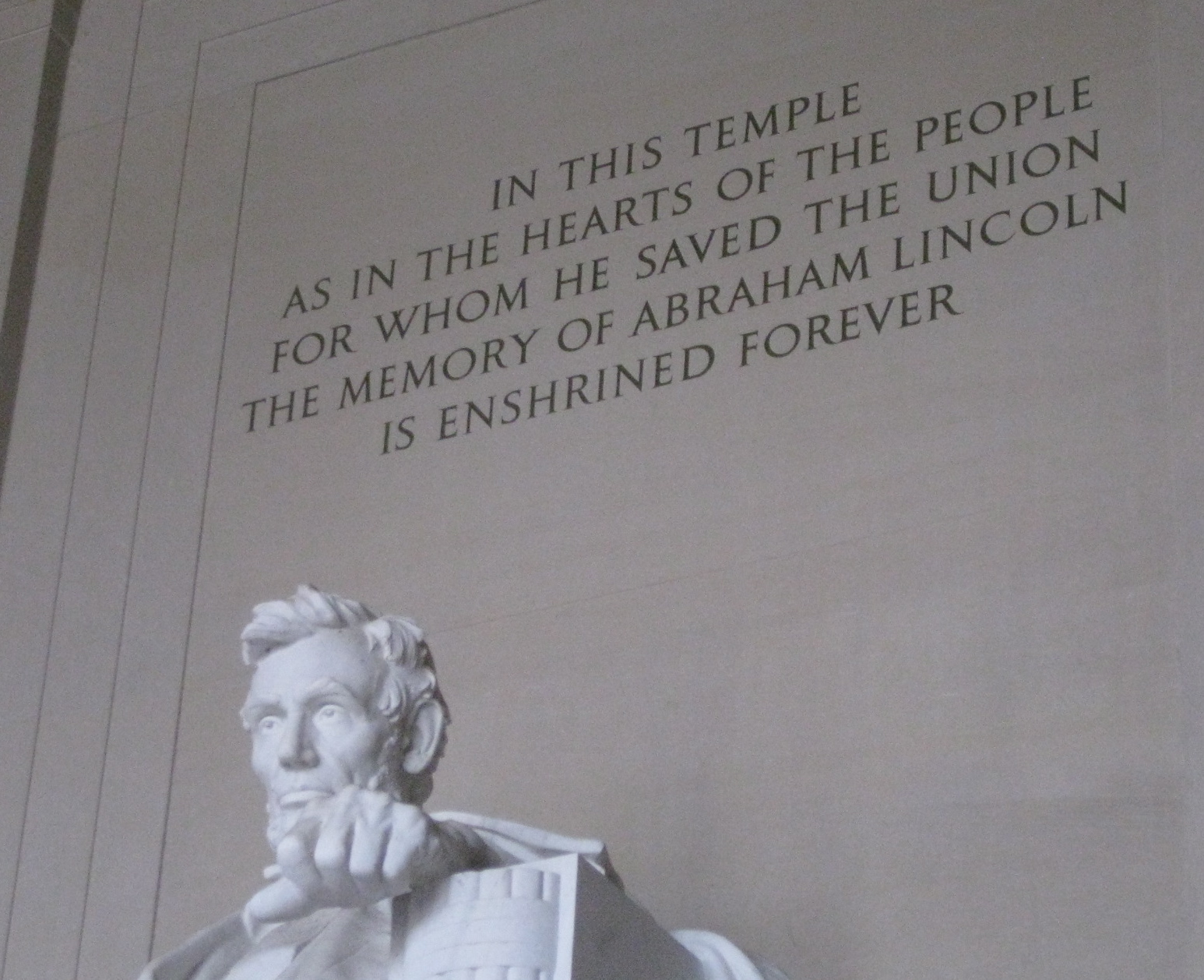
Today, I was at Gettysburg. In a three day battle, over fifty thousand Americans died. For the last week or so, people supposedly have been complaining about Obama meddling in local politics. Well, you know who else meddled? How ’bout Abe Fucking Lincoln. A bunch of states seceded, and he said “fuck you, I’m going to p0wn your ass and roll you back into the Union.” And he did. Six-hundred thousand Americans (2% of the population) died in the process, but he did it, and we have one big bickering country rather than two bickering little countries. In the Lincoln Memorial in DC, behind the big ass statue of Lincoln are engraved the words:
lincoln

If you ask me, he deserves to be enshrined forever. Next to his statue, there’s another engraving dedicated to those who died in the Civil War. Many of them died after getting hit by a musket (or minie, or cannon) ball while walking, in a line, up-right, without armor, into volleys of incoming fire. They too deserve to be remembered, even if only for having the guts to do such a thing. In comparison, our generation feels like a bunch of sissies. I used to fear that little of our generation would remain centuries from now, when the silicon on which our digital lives reside return to dust. But hell, maybe nothing we do will be remembered because we haven’t done anything worth remembering. We don’t have statues and shrines ’cause we haven’t done shit.

What I’m feeling is a strange mixture of guilt and gratitude. Guilt because, while the people memorialized here dedicated their lives (and deaths) to some greater ideal, I can only say that I serve myself. But gratitude because I believe that’s what the people we remember wanted us to have. They wanted us to enjoy our freedoms, security and wealth, not to wallow in guilt or live dull lives. A few great men and women and countless ordinary people founded this country, then protected it and improved it all these years, so that we can live better lives than they did. So we owe it to them to live better lives, to fulfill more of our dreams than they did, to fill our lives with more joy than they could.

When I go off to my land and fulfill one of my childhood dreams, I’ll do it with gratitude to those who came before me, and as an example for those who will come after me; to prove that in this society, with a little luck and a little work, we can fulfill our dreams.

Quick update from DC

A quick update for those of you who don’t follow me on Twitter

My land purchase finally closed on Friday, so that land I’ve talking about is officially now recorded in my name. Whee!

I then left Chicago on yet another road trip, continuing my journey East. I’ve always wanted to drive coast to coast, and having driven most of the way across to Chicago, I couldn’t not go the rest of the way. On Satruday, I drove nearly 700 miles over 11 hours to just outside DC, where I’m crashing at @nevermindtheend‘s. We went to Monticello (Thomas Jefferson’s house) today. Tomorrow, I’m heading in to DC it self. The last time I was in DC was when I was seven years old, so I look forward to seeing the place with my own grown up eyes.

I’m not sure what else is on my plate for this trip. I’m going to try and meet up with another friend in Baltimore, and of course, I actually need to make it to the coast it self. I’m also hoping to make stops at a couple of battlefields, probably Gettysburg and Antietam since I’ve heard of those two and are pretty close by. I think I still have at least a day or two still unscheduled, so leave a comment if you can think of anything/anyone else I should see.

Next Tuesday, I’m flying off to England for a wedding. Then, after I get back from England, I’m driving back to California then off to my land, and I still have lots of preparation to do for that (mostly buying tools and supplies).

The fun continues…

Things I think about…

I’ve been trying to get back into coding, but I was feeling unmotivated, uninspired and unimaginative in the dark confines of our little apartment, so I went for a walk. About an hour later, I was by the lake, and I suddenly realized that I hardly ever spend any time thinking about code any more. I don’t know if this is common, but when I’m into a programming project, I actually do a lot of my coding away from the computer. Most of the thinking behind creating, defining, and solving problems happens while I’m walking, in the shower, eating dinner, trying to sleep, driving, hanging out with friends, etc. But not any more. So no wonder I felt like I was blocked.

Instead, I’m spending a lot of time thinking about my next adventure: to go to my (well, soon-to-be my) property and spend a month or two on it. Why am I going out into the middle of nowhere? I have a few reasons. First of all, I want to get to know and enjoy this thing I blew my savings on, and also work on some improvements. Secondly, ever since I was a kid, I dreamed of living in a corner of the woods that I could call my own, and you never turn down a chance to fulfill a childhood dream. And, lastly, as I mentioned previously in this blog, I want to focus on shooting for a bit, and there’s no better place to do that than on my own personal shooting range.

In planning for this adventure, the overarching theme is “minimalist comfort.” It might seem oxymoronic, since we often associate “comfort” with “excess” and “lavishness”; not minimalism. But comfort is subjective, and I believe that my personal flavor of comfort can be achieved through a minimalist approach. That is, rather than assume some pre-conceived notion of comfort (a home, a bed, hot showers on-demand, etc) with its built-in excesses, I’m going to start from nothing, and build up until I’ve reached a comfortable level.

So, the first step is to figure out what “minimalist comfort” means to me, which is in itself an interesting thought problem. The main challenge lies in the fact that I have to define “comfort” myself; there is no pre-made model to simply adopt. I can’t treat this like a backpacking expedition into the wilderness, because my parameters are different (for instance, I don’t have to try and haul everything on my back). It’s different to camping too, because while campers typically seek some comfort, they do so in campgrounds with infrastructure already in place. My aesthetics and goals are also different to homesteaders, who might care more about long-term self sufficiency than I do (at this point). Similarly, I won’t shun technology the way the Amish and luddites do.

Having said that, I do have to start somewhere, so I’m taking my experiences from backpacking in the desert, and gradually adding things that I think make me comfortable. It’s a good place to start because there’s nothing in the desert, so the list of things to think about is similar; just with different parameters and restrictions. In any case, here’s a laundry list of things I think about all day:

  • Food – I may eventually plant a garden (once I have water) on the property, but for now, there’s nothing there, so I’ll have to buy food. I also don’t want to live off of canned or freeze-dried foods for extended periods of time, so I’ll need some fresh food. Fortunately, there’s a market about half an hour’s drive away. In general, I plan on buying raw ingredients and cooking as much as possible.
  • Food Storage – Since I don’t want to go grocery shopping all the time, I’ll need to store fresh foods for a week or more. This is one area where technology has given us a blessing in the form of refrigeration. Right now, I’m leaning towards a energy efficient freezer so that I can freeze some meat, for example, but also freeze ice (or ice packs) that I can then use to chill stuff in a cooler1. Also see, Electricity.
  • Food Preparation – I’ll bring my camping stove, but for the most part, I can probably cook over an open fire. There’s plenty of wood to burn, so I’ll just need to build a fire pit and put a grill over it. I’ve cooked some elaborate meals for myself over a camp fire, so I’m pretty comfortable about general cooking. However, I’d like to figure out how to bake, so that I don’t have to buy bread. Humans have been baking far longer than we’ve been doing most things, so this seems like a solved problem. I just need to research the solution.
  • Toilets – Whatever I eat will come out, eventually. Fortunately, I’m a dude and I can pee anywhere I want (actually, I’ll probably start a compost heap and pee on it to add nitrogen). Solid wastes are slightly more problematic, but I’ll probably do what the park services tell me I should do when I’m backpacking on their land: dig a hole at least 6 inches deep and burry my crap. Crouching to take a dump out in the open is surprisingly refreshing, but I do like toilet seats. So I’ll probably bring a toilet seat (just the ring part) and rig a chair out of it for better comfort.
  • Bathing/washing – Ironically, I don’t bathe too often when I’m in civilization, but I do like to bathe frequently when I’m outdoors and getting all sweaty and dirty. Actually, there’s nothing ironic about that: I want to bathe when I get dirty. The problem with bathing is water (see Water). Assuming I have water, I may want to heat the water, but that can be done easily in a large pot over a fire. If I get creative, I also may build a solar water heater, which isn’t hard especially in CA where there’s plenty of sun. Then, once I have warm water, I’ll probably need a bathtub or something. That shouldn’t be hard to find. I can also wash clothes in a bath tub. Then, when I’m done, I’ll need to figure out how to dispose of gray water. If I use biodegradable soaps and detergents (which they generally are), I can just dump the water, although I also want to look into recycling/reusing the water.
  • Sewage – So, it looks like I’ve found a solution for sewage. My shit goes in the ground, gray water also goes to the ground. No problem. Except, it might technically be illegal. In the long run, if I were to build a permanent structure of some sort, I’ll probably get a composting toilet so that I’m not just burying my shit. The laws might still require septic, but at least nobody can claim it’s dangerous or harmful.
  • Water – The biggest issue is water, since my land doesn’t have a well and drilling a well may cost more than I’m willing to pay right now. Given my short timeframe for this particular endeavor, I can probably steal drinking water from nearby campgrounds in 5 gallon jerry cans. If I use 1.5 gallons a day2, I can get by for 10 days with only 3 cans. Making a trip out once every week and a half to get water doesn’t sound too bad. But that’s just drinking water.

    If I want to bathe, I’ll need considerably more water, so I’ve been looking at DIY water well options. A small affordable drilling rig might allow me to drill a well myself, assuming the water table isn’t much deeper than a few hundred feet and I don’t have to bore through rock. If the water table is shallower, I can even essentially hammer a pipe into the ground. My land is pretty rocky, so I’m not sure either of these options will work well. A third option is to collect precipitation in a cistern, which is cheap and feasible, but won’t actually yield water until this winter. So, for now, how I’m going to get enough water to bathe is an open question.

  • Communication – I don’t need internet or anything, but I’d like to be able to call for help if I get hurt. I can get cell reception in the valley beyond some hills from my property, so I’m hopeful that if I could get an antenna above the hills, I can get cell reception. For that, a relatively inexpensive wireless signal booster like this one or this one may do the trick. Unfortunately, until I try it, I won’t know. More reliable, but potentially more expensive alternatives include satellite internet (then VoIP, or SOS-over-Twitter) and satellite phone.
  • Electricity – My power needs will be fairly modest. The only things I’ll have plugged in all the time are a fridge or freezer and possibly a cell signal repeater or wifi base station. Other than that, I might want to run power tools occasionally, and charge various batteries (laptop, cordless drill, phone, lamps, dry-cell for flashlights, etc). I’m still looking at various options, but a couple of deep cycle 12 volt batteries charged with a portable gas generator seems like the cheapest way to go. Since batteries are finicky about charging, I’ll need an inverter/charger or charge controller. If I plan on using a lot of stuff off of AC, an inverter/charger makes more sense, but if I don’t need a lot of AC ’cause my stuff runs on DC3, I might get by with the cheap inverter I have plugged into my car’s cigarette lighter. When I run power tools, I can just plug it directly into the generator. Either way, I’m spending a lot of time right now doing research in this area.
  • Shelter – Since I’m planning on being out there in the summer when it doesn’t rain and the temperature stays pretty comfortable, I won’t need much shelter. I’m thinking it’d be fun to use white oak found on the property to build a little structure with a roof and no walls, and hang a hammock inside. Or maybe I’d prefer to sleep on a cot. And maybe it’d be nice to have some sort of netting to keep the bugs out.
  • Fencing – The property doesn’t really have fences or signs, so one of the first things I’ll need to do is put up signs and fences. Plastic signs are relatively cheap (50-75 cents each) but how many do I need? My property has a perimeter of around 7000ft. If I put a sign every 100ft, that’s 70 signs. Is that enough? Maybe I want to use more to make sure people will see them. Or maybe I can use fewer, since there are only a few realistic avenues of ingress. Fencing is another problem. Barbed wire fencing is the cheapest, but again, 7000ft is a long ways to go. Even if placed 10ft apart, I’d need 700 fence posts, which isn’t going to be cheap. Then I’d need over 21,000ft of barbed wire if I want 3 levels of wires. Yikes. Even then, barbed wire fences are suboptimal since they don’t keep out determined humans, but do keep out wildlife (which I don’t want to do). So maybe it’s not worth the money and effort it’d require. Right now, I’m thinking of a more symbolic fence that humans will understand but animals won’t.
  • Tools – I also spend a lot of time thinking about tools I’ll need. There are a couple of hardware stores nearby, so I don’t need to absolutely bring everything I’d need, but it would be annoying to have to make frequent trips to town (since it’d take at least an hour round trip). I’ll need a shovel, ax, post hole digger, chainsaw, jigsaw, machete, chisel…
  • Ryomobile 2.0 – The Ryomobile has served me well these past few years, but the requirements of a city-dwelling Ryo and a rural-living Ryo are different. So, it’s time to look for Ryomobile 2.0. I’ll need an AWD vehicle with enough horsepower to tow a flatbed trailer, and hopefully get decent gas mileage. Options right now are a Toyota Venza, Subaru Forrester, or a beaten up old truck (which won’t get good gas mileage, but might have lower TCO).
  • Shooting – I plan getting a lot of target shooting practice on my property, which comes with its own set of logistical requirements. I’ll need to bring a sufficient quantity of ammunition and ammunition components, spare parts, and targets. I need to figure out how to accurately measure 100, 200, and 300 yards so that I’m shooting at the correct distances for my discipline (and use the correct targets). I also need to think about where on the property I can shoot safely, and how to prepare the impact area to reduce risks ricochet and fire. I also might need to think about lead pollution.
  • Forestry – By buying this piece of land, I will become a steward for hundreds (thousands?) of trees, which, in this day and age, is a responsibility not to be taken lightly. Not that they need me to survive or anything, but I might be able to help them along. I’ll need to learn to identify all the species of plants on my property, and figure out how to best help them grow. There are some nice white oak trees, but I feel like they might be over crowded, so some thinning might be in order. I’ll need to do more research or I might end up doing more harm than good.
  • The Future – Naturally, I think about where all this is heading. Maybe I’ll go out there, and realize that I can’t stand being in the middle of nowhere by myself, and I’ll come back out. Since I consider this endeavor an experiment, that’s a perfectly valid outcome. Although, I am more concerned about the opposite scenario, where I go out there for “a month” and decide I don’t want to leave. There’s nothing inherently wrong with that outcome, although it may not be feasible in the long run. Eventually, I’ll run out of money, and you can’t make money being a hermit. I might be forced to rejoin the ranks of the gainfully employed, but how? Doing what? Where? Can I really go back to being a suburban cooperate coder? Or maybe I can strike a balance. Maybe I can settle down in one of the nearby cities, where I can find a job but still make frequent trips out to my property. Maybe I can find a different occupation. Who knows.

So… yeah, as it turns out, there’s a lot to think about, and there’s yet more research to be done. Then, of course, I have to make it out there before the summer ends.

Footnotes
1 – Actually, that’s what people used to do before refrigerators. They’d harvest ice in the winter, then burry big chunks of ice in saw dust until the warmer seasons, when they’d take out the ice to put them in ice boxes.
2 – 1.5 gallons a day might not sound like a lot, but when we went backpacking, we used less than 2 liters (a little over half a gallon) a day per person, so I know it’s doable.
3 – I’m starting to realize how inefficient this whole AC/DC thing is. For example, if I were to plug in my laptop into my setup, it goes like this: my generator produces AC, which then gets converted to DC to charge the 12V batteries, then back to AC by the inverter, then my laptop’s power plug converts back to DC. That’s 3 conversions, each of which wastes energy. It’s no wonder Google improved energy efficiency in data centers by going completely DC. Fortunately, a lot of gear designed for RVers and boaters run on 12v DC, so I should be able to get by with only on AC->DC (generator->battery) conversion, and eventually none if I go solar (which produces DC).