Burning Man Notes: A Letter

The following started off as a letter, but then was converted into a blog post in letter form. Who the “you” is is not important; I used the format of a letter as a literary device, to bring out a certain tone that was direct and focused, without the distractions of flowery descriptive prose. The words below are for you, the readers of this blog, not “you”, the addressee of this “letter”.

When we parted, you said you thought I looked smaller. The people we respect always look bigger, so if I looked smaller to you, maybe I lost your respect. I thought about that, then laughed out loud. I laughed because you have no idea what it was like for me to be at Burning Man, alone. The truth is, I am exceedingly proud of myself for all that I’ve accomplished this week.

For starters, I am proud of the fact that in less than a week, I planned, assembled, tested and acquired all the gear and supplies I needed to be a self-sufficient one-person camp, but with a compact enough footprint to fit in my little car, without having ever been to Burning Man, and only found myself missing two items during the entire week. I am proud of the fact that I designed my shade structure on the fly at a Home Depot, picking up necessary supplies as I planned each aspect of the structure in my head. I am proud of the fact that, despite never having built the actual structure other than in my head, it turned out exactly as I’d envisioned, and that it only took me half an hour to build, alone. I am proud of the fact that the shade structure withstood a week of constant pounding from the winds gusting across the playa, with very minimal damage and no repairs in the interim. I am proud of the fact that I struck camp entirely alone, pulling rebar stakes driven deep into the ground using nothing but a length of para-cord, a piece of two-by-two, and my own two arms. I am proud of all this, because I personally don’t know of very many people who could’ve done what I did.

And that was the easy part.

You have no idea how terrified I was when I arrived, alone, and surrounded in a strange environment unlike anything I’d ever seen before. You have no idea how, as an introvert, every new sight, sound, smell, or person felt like a threat to me, and the abject terror I experienced while being bombarded with a constant barrage of threatening encounters without a single friend in sight. You have no idea how dejected and distraught I felt when I asked to join the safety of you and our friends’ camp, and you threw me out, and sent me off to go alone or go home. You have no idea what went through my head as I sat in my car, trying to decide which it was going to be: to remain in this terrifying space alone, or to retreat to the relative comfort of the open road.

You have no idea how much courage it took to decide to stay, to put up that shade structure, to pound those stakes into the ground, to commit myself despite immense trepidation and doubt. But I did stay, and for that I am proud.

You have no idea how much courage it took me to decide that in order to enjoy Burning Man, I had to change. That I had to doff my armor of introversion that has protected me for so long, and open myself up to new experiences and people, and actively engage this unfamiliar world with open arms. But I did open up and engage, and for that I am proud.

I used to be afraid of talking to strangers. At Burning Man, I introduced myself to girls I didn’t know, for the first time in my life. I helped a lady carry ice down the street, instead of simply watching her struggle. When on my daily morning stroll, I said “good morning” to people I passed. When invited off the streets to take a drink, I never said no. These are all things that I used to be terrified of doing, but I overcame my fear, and for that I am proud.

I used to be so afraid of dancing that I would intentionally, with great effort, walk off beat when in the presence of music, lest I be seen “dancing.” At Burning Man, I overcame this fear, and went dancing for the first time in my life, and for that I am proud.

I used to be terrified of eye contact. I went to an eye contact workshop and stared at several strangers in their eyes for minutes at a time, opening myself up to them completely, trying to fill myself with compassion because when you stare someone in the eye, they feel what you feel. It was uncomfortable and scary, but I did this, and for that I am proud.

I never thought I’d find an inner peace, a feeling of wholeness and compassion for the world around me while in the midst of strangers. But I found all that, as fleeing as it was, and for that I am proud.

I climbed the fire truck ladder, despite the wind, and for that I am proud. I went down the big slide, four times, even though people were around watching and it looked kinda scary, and for that I am proud. I woke up every morning at 7:30am, staying out until well past midnight almost every night, making each day count, and for that I am proud.

I began the process of healing my deepest, darkest and most persistent emotional woes, by examining the darkest moments of my past, and for that I am proud.

Me, smaller? Hardly. I’ve never been bigger. So I’m sure you were referring to the 8 pounds of weight that I’d lost that week.

Those of you who know me may recognize the addressee of this letter as being my ex-girlfriend Nikki. While she is portrayed antagonistically here, she ultimately deserves credit in the transformation I achieved at Burning Man. It was she, who, nearly two years ago when we began dating, set me on a path of rigorous introspection and self discovery. Without that gift, I would not be on the journey I am on today, nor would I have found the courage to do all I did at Burning Man. The antagonism in the letter arose from my disappointment in not having been able to share with her the cumulation of what we started together. Nonetheless, even as we now go our separate ways, I will forever be grateful for having been shown a way, which I may never have discovered on my own.

Burning Man Notes: Arrival

For me, Burning Man started in a Wal-Mart parking lot in Reno, which happened to be a major supply depot for the thousands of Burners headed to the desert. There were cases of water everywhere, and the parking lot crowded with vehicles of every description jam packed with equipment, furniture, bikes, supplies and people. The Burners were easy to spot, for the most part. If the cases of water and booze piled in their shopping carts didn’t give them away, their dress, or something about the way they looked did. This was the first time I realized that Burners were somehow different.

From the Wal-Mart parking lot, the trip to Black Rock City rapidly turns into a bona fide pilgrimage. Going East on I-80, even a casual observer will notice the unusual concentration of RVs and vehicles with bikes strapped onto them. These vehicles then stream off on exit 43 onto Route 447, which becomes saturated with Burner-mobiles. As Gerlach, the nearest permanent town to Black Rock City approaches, this line of car comes to a halt. Ahead, an endless snake of red tail lights. To the rear, a winding trail of bright white headlights. Off in the distance, glittering dances of light indicated the location of the promised land. The congestion was such that people put their cars into park, shut off their engines, and walked around, chatting with neighbors. I had a nice conversation with the fellow behind me, a butcher from Oakland; my first of many conversations with a fellow Burner.

By the time I reached the gates, it was 4:30am. Being a first timer (a “virgin” as they call you), I dutifully performed my rite of passage by ringing a bell with all my might, and shouting “I am no longer a virgin”. Of course, I was alone, and I don’t think anybody really cared.

Once I entered the playa proper, excitement quickly turned into confusion, then disorientation and panic. It was still pitch dark, and with few camps set up, the streets were hard to discern from the camp sites. I’d seen maps, but I hadn’t anticipated the enormity of the “city.” In the darkness, I had no sense of scale. The concentric roads seemingly spiraled into chaos, the dust obscuring their edges, fueling my disorientation. I knew my friends were planning on camping at around 8:30 and D. They had been ahead of me on I-80, but without cellphone reception, I had no way of contacting them. I drove around, trying to spot the dark suburban they were in, but it was simply too dark to identify cars, much less any specific one. I eventually pulled into an area that seemed relatively empty and quiet, then dismounted.

With a water bottle, flashlight, and GPS in hand, I began a search for my friends. To make sure I could return to my car, my only base in this foreign place, I saved a marker on my GPS. It was dusk, and the world around me emerged, ever clearly, as the minutes ticked by. But the light only added to my disorientation. Sometime during the night, I had been transported into a vast flat empty dried lakebed, where something resembling the cross between a refugee camp, frat house, and art gallery was assembling. There was nothing about the place that felt familiar, especially after my weeks alone on the road. As I walked, I reflected upon my own introversion, realizing with dread that everything was strange and new and therefore threatening and frightening. I walked with my senses alert, every new encounter evoking a fight-or-flight reaction. I desperately wished for safety, to take refuge among familiar faces.

I walked for hours, starting with 8:30 & D and gradually spiraled outwards. The rigor of walking kept me sane, focusing my hightened senses on spotting and identifying tents and cars that looked familiar. I’d lent them my yellow Coleman tent, of which there were a couple of instances. None of them had the dark colored Suburban or any familiar bikes parked nearby, but I marked their location on my GPS and walked on, to confirm later.

It wasn’t until around 8am that I spotted my friends, only a few hundred yards away from where I’d parked. They had taken a wrong turn and had been delayed. I ran towards them, relief spreading through my body. I was safe.

I pulled Nikki aside and told her how afraid I was, and asked her to reconsider letting me camp with them. When I decided to go to Burning Man at the last minute, I’d volunteered to camp separately, and Nikki had urged me earlier in Reno to camp separately as well. But now, actually on the playa, I was as frightened as a 3 year old separated from his mother in an unfamiliar mall. I wanted to be near friendly faces, where I could feel safe. There was no way I could survive out here on my own. But Nikki wouldn’t budge. She didn’t want me around her camp; I could either camp alone, or go home. I stormed back to my car, frustrated that someone I considered a friend wouldn’t grant me a safe harbor at a time of distress. I retreated to the relative safety of my car.

I sat for a long time, considering my options. I could stay, and potentially be scared and miserable for a week, or I could go home. Except I have no home. I felt like I couldn’t leave, but I couldn’t start unpacking because I wasn’t sure how long I would want to stay. Why unpack if I might decide to leave in a few hours? Out of desperation, I headed back to my friends’ camp.

At their camp, I helped improvise a shade structure out of scavenged materiel originally intended to be a hammock structure. That was something I could do. I can build things. Helping Igor build that structure calmed me enough, that I was then able to head back to my car, and start pulling out lumber to build my own shade structure. It appeared that I would be staying, at least for a little while.

Secure loans

Nikki and I found ourselves in a situation that is probably not all that uncommon between two people dating. Nikki incurred a lot of debt to get through college, the most egregious (though not largest) of which is her credit card debt, with its high interest rate, fees and penalties. I have some money, so I’d like to help her out, but it took us a while to find a good way to do so. The amount is large enough that, in our stage of relationship, it would be over the top for me to pay off entirely. I could lend her money at a low interest rate, she could pay off the credit card debt, then pay me back. But having that kind of debt between us would add unwanted complexity to our relationship, which could turn messy if things don’t work out between us in the long run.

We found our ideal solution in the form of secure loans. I first heard about the general concept of secure loans when I talked to Andrew and Steven of Open Produce about ways to invest in their store. They said I could put money into a CD in my name, then let them use that as collateral for a bank loan. My money would only be touched if they defaulted on the bank loan, but otherwise I keep the money and interest. That sounded like one of those win-win-win situations. The bank can give a loan with virtually no risk (since there’s collateral), my friends get a loan at a low interest rate, and I feel better about investing because I don’t have to handle the logistics (and potential mess) of collecting my money and interest. That got me thinking; maybe something like that would work for Nikki as well.

We spent the better part of a day earlier this week visiting financial institutions in the Mountain View area, to see if we could get her such a loan. Our first stop was WaMu/Chase, but due to the recent acquisition and transitionary period, they didn’t offer secure loans. We then tried Bank of America, who told us the best option would be for me to get a credit card with a low introductory rate, and lend her money directly; exactly what we didn’t want. We then tried Wells Fargo, who did offer secured loans, of the kind we were looking for. They said we could open a CD, then take out a loan of up to 90% of the amount in the CD. Unfortunately, the rates weren’t great. Right now, CDs have a pretty low interest rate, but the loan would have an interest rate of around 10%; lower than the 16% she pays for the credit card now, but it seemed high for a loan for which the bank incurs virtually no risk.

The friendly lady at WaMu/Chase had told us to also try credit unions, so after visiting 3 “real” banks, we did some research in the car using Google WiFi. Our conclusion? Credit unions are awesome. They’re like banks, but owned by its members, so they generally have lower rates. Indeed, the two credit unions we visited both offered secure loans, and had much better rates. One offered loans at 2% above the interest rate on the CD (rounded to next .5%). So if the CD has an interest rate of 2.1%, the loan would have an interest rate of 4.5%; more than 10% less than Nikki’s credit card! The other place was similar, but with rates of 2.5% above the CD rate, instead of 2%. There were other minor differences. One of the credit unions had no minimum monthly payments and the whole sum was due when the CD matured, but the other place had minimum monthly payments. One required both our names to be on the CD and loan, while the other allowed for the loan to be in her name only (which is exactly what we wanted).

At the end of the day, we felt pretty good about having found a financial mechanism that suited our needs, and one that would save her thousands of dollars over the next several years at that. I also reflected on the fact that, for millions of other Americans in debt, such financial machinations aren’t available to them, not necessarily for any fault of their own. But, that’ll have to be another post.

New Header Image

The "studio"

The studio

If you’re reading this on the actual site (as opposed to a feed reader) you may have noticed that the banner image at the top of the page has changed. I spent a couple of hours today creating that image, so I’m going to talk a bit about it.

First Version

First Version

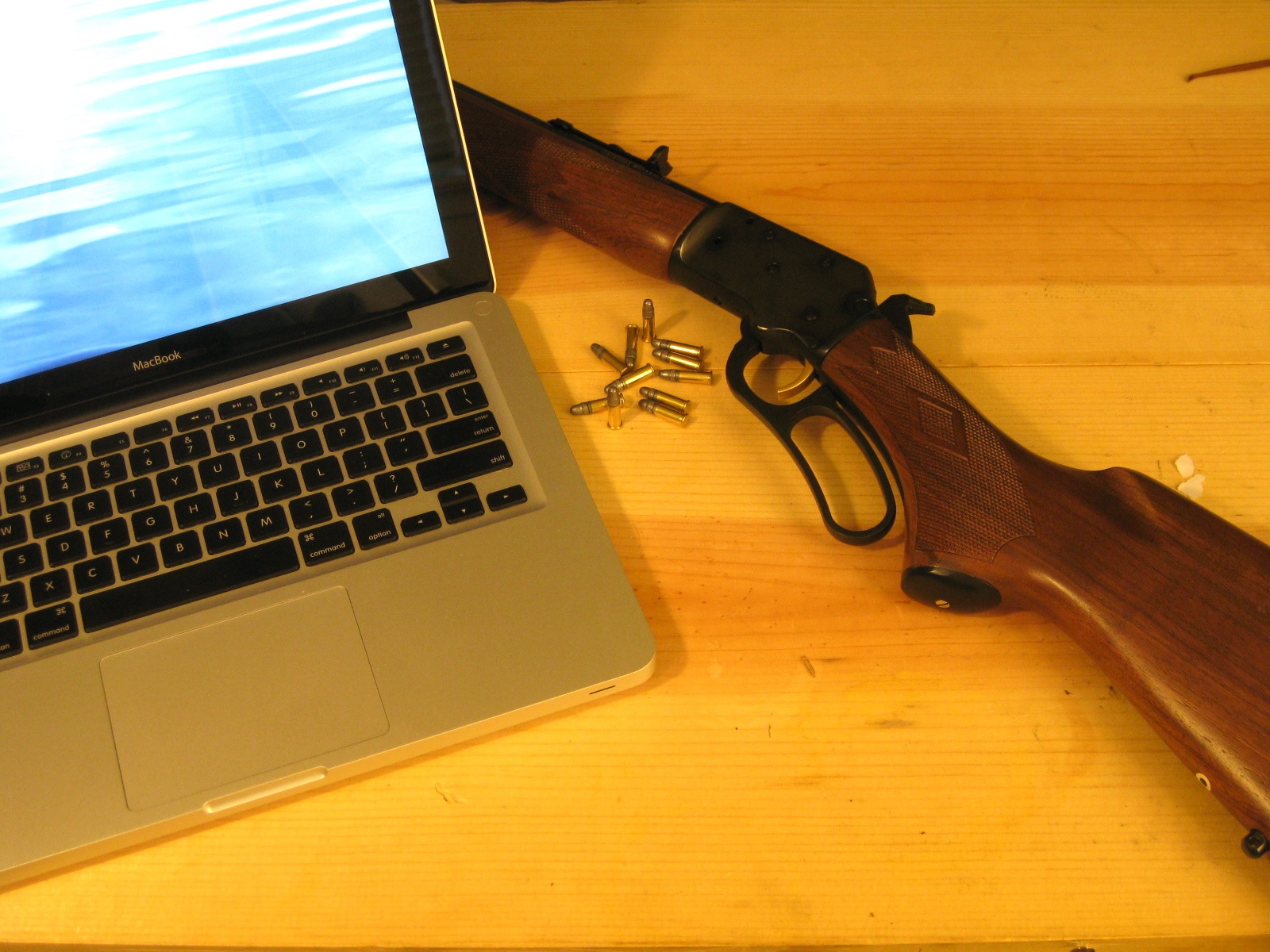
My first attempt was pretty basic: my MacBook and my Marlin 39a, an iconic lever action rifle that’s over a hundred years old in design. To fill some space, I sprinkled some 22LR ammo. As a background, I used a coffee table/trunk I built myself.

Second Version

Second Version

Although I was pretty happy with the Marlin, I decided to try the M1 Garand, another iconic rifle. The Garand was the standard military issue rifle through most of WW2 and the Korean War, and should look familiar to any war movie buff. Ultimately, I decided it conjured the wrong impression. I made a few other changes in the 2nd version, which I did end up keeping. One was a different orientation for the rifle, and the second was to display my blog on the laptop (yay recursion!), and the third was to use larger .308 Winchester rounds to fill the space.

Third Version, revision 2

Third Version, revision 2

I switched back to the Marlin, and things looked pretty good. But something didn’t feel quite right. I went out to run errands, and realized that the wood panel background was a little boring.
Final Version

Final Version

Since I had a target from a match today that I was planning on photographing for a post on my gun blog, I decided to stick that in the background. The target also added a sense of seriousness, and sportiness. I liked it. Cropping the image to fit the dimensions required by the blog’s template was somewhat challenging, but because I composed the image with cropping in mind, it turned out ok. Here’s the final product (click to see super-high-res version):

Final Version Cropped

Final Version Cropped

On Stuff

This post was written on March 16th when we were in Seattle, but I’d forgotten to publish it.

We spent most of the day walking around downtown Seattle, and going into various nifty little stores. We went to 3 or 4 book stores, a toy store, a record shop, a comic book store, a military surplus store, and one or two others that I probably can’t even remember. It was fun, but I felt a little weird to be constantly seduced by shiny merchandise, only to be jerked out of that fuzzy feeling of desire by another voice in the back of my mind.

Labels found at a used book store.  My two favorite things together!

Labels found at a used book store. My two favorite things together!

That voice is reminding me that in a few weeks, I’ll be moving out of my apartment, and will only be keeping what I could carry with me, or fit in a small storage space. In theory, this shouldn’t be hard. After all, when I arrived in Silicon Valley 4 years ago, all my earthly possessions fit in my car. But that’s since mushroomed to over a dozen car loads’ worth of stuff, and now I have to think about getting rid of things.

As it turns out, getting rid of things is hard. Sure, there’s the psychological aspect to it, what with sentimentality and all. But it’s also difficult logistically. You can’t fit a dozen car loads’ worth of stuff in the apartment dumpster. It won’t fit. You also can’t just dump it on the side of the road; that’d be illegal. Of course, there are people who will come out with a van and carry all your shit away, but they usually just take your shit to the landfill, which is far from ecological. Personally, I’m a big fan of reuse/recycling. While I could give stuff away to Goodwill or Salvation Army, I’m thinking of trying to sell as much of my stuff as possible, seeing how I’m unemployed and all.

The problem with selling stuff is that you begin to think about the monetary value of your stuff. And then, start thinking, why did I pay $200 for that bookshelf when its current market value is $20? Did I really get $180 of value out of it? Anyway, I’ve been doing that kind of ROI assessment on a lot of my stuff, and now when I think about buying anything, I can’t help but wonder how much I’d be able to sell it for, and whether I’d extract comparable value out of it.

It’s an interesting exercise, and a sobering one too. Take, for example, the MacBook I just bought. I paid $1250 and another $250 for AppleCare, for a total of $1500 (I bought it from Oregon so no sales tax). Now, in a few years, I might be able to sell it for, oh, $700. Will I get $800 in value over the next 3 years? Probably. I can do contract work using it, and even if I charged a modest $40/hour, that’s only 20 hours of work over 3 years. I’m sure I’ll get more than my money’s worth. Or that $2000 rifle I bought? Unlike laptops, rifles don’t lose value very quickly (if at all), so I could turn around and sell it for $2000, or more, if I take good care of it. But how ’bout that $17 paper back book I contemplated getting today. I’ll read it maybe once, and I’ll be lucky if I could sell it for $8.50. Will I get $8.50 worth of value out of it? Well, $8.50 is cheaper than a movie ticket, and it would keep me entertained for several hours. On the other hand, why pay $17 when I can get it used for $8.50? Or that $45 game? How much value will I get out of that?

Of course, this line of thinking can easily be taken to extremes. I mean, why pay $30 for a nice meal when I could eat at McDonalds for $3. Do I really get $27 worth of value? How exactly do you attach monetary value to, say, a tasty meal, or not eating crap? Or to traveling? Or to hobbies, or acquiring experiences and skills that aren’t immediately marketable?

The answer is, quite often, you can’t. Even if you can’t buy happiness, it’s an undeniable truth that the things that might make life worth living often cost money. The important lesson here is to remember that correlation does not equal causation. Just because the things that make you a little happier often cost money, doesn’t mean spending money makes you happier. I think it’s important to pause before opening the wallet, and ask yourself “Is this really going to make my life better?”

For instance, that $750,000 dream home you just bought, and will spend the next 30 years paying for. Will it really make you happier? I sure hope so.

Recent Book Acquisitions

We spent a lot of time in bookstores in Seattle and Portland, and I’m pretty sure we went to at least half a dozen used bookstores this trip. I managed to restrain myself, and only bought 3 books:

  • Nickel and Dimed by Barbara Ehrenreich — Part of the reason I decided to quit my job and be unemployed for a while was to think about jobs and money and such. I’ve been fortunate enough to have insanely high paying jobs, but many people in this country are less fortunate. I’m reading this book to learn more about the realities facing the working poor.
  • A Good House by Richard Manning — One of my goals this year is to buy some land and build a cabin on it. Manning did basically that, and wrote about it. I came across this book while looking for A Place of My Own by Michael Pollan (of Omnivore’s Dilemma fame), which is similar.
  • How to Put Up Your Own Post-Frame House and Cabin by Alan Roebuch — I found a used copy of this 1979 book at Powell’s in Portland. Manning’s book is long on narrative and short on technical details and howto, so this seemed like a good reference to have.

What if?

I had an unusually hard time falling sleep last night. My mind kept whirring with all sorts of things that could go wrong. What if I end up in a coma before I can elect COBRA coverage? What if I get a flat tire while going 80 miles an hour on the freeway? What if I accidentally hit a pedestrian while driving in an unfamiliar city? What if the economy totally craps out and I can’t find a job when I need to? What if, what if, what if?

These are all good questions to ask when you quit your job and decide to live off of savings for a while. On the other hand, it seemed like the anxiety I was feeling was a little blown out of proportion (seeing how I’m normally not a very anxious person). Somehow being employed gives you a sense of security, which doesn’t make much sense when you think about it. True, spending 8 hours a day in an office cubicle where all possible hazards have been removed, is probably safer than, say, spending a day outdoors. But I am just as likely to get in a car accident if I’m on the road, regardless of my employment status. The economy will or won’t tank, regardless of my employment status. I could fall ill, regardless of my employment status. Hell, you could even lose your job against your will. Life is full of risks, and there are ways to mitigate those risks, or at least make those risks tolerable, but being employed isn’t one of them. Having health insurance, is. Having auto insurance, is. Having warranties on expensive and vital stuff, is. Having a marketable skill is, and so is being wise about money. A job can help achieve all of those things, but at the end, it is merely a means, not the ends.

Laptop and a Rifle

I quit my job at Google today. The place considered to be the playground, mecca, paradise for engineers; I quit. Was it as good as they said it was? Sure, for the most part it was. But after 4 years in Silicon Valley–3.5 years at Yahoo! and another half a year at Google–I got tired of being a corporate software engineer. One day, I looked out the window, and realized there was a whole world out there. I decided I wanted to go out and experience it.

I am embarking on a journey, with a laptop and a rifle. The laptop, because it’s been my ticket to freedom, will keep me in touch with the world, and be my ticket back to civilization when I am ready. The rifle, partially because I’m passionate about guns and shooting, but also because it symbolizes the rugged individualism and deep desire for independence that burns in my heart.

So, with a laptop and a rifle, I will go. This blog is a chronicle of my journeys.