Lawlessness

Question: There are a bunch of dudes with guns in your back yard. What do you do?

For most people, the first reaction will probably be to ask, or at least wonder, why there are a bunch of dudes with guns in one’s backyard. But, to make my point, let’s assume that you don’t wonder why they’re there. In that case, perhaps the most reasonable answer to the question I posed would be something along the lines of: Call the cops.

So, you call the cops, and within minutes a police car with flashing blue and red lights pulls up in front of your house. An officer, or two, perhaps with their pistols drawn, step out to confront the armed strangers. If said armed strangers are of the particularly belligerent or dangerous types, maybe more cars with more flashing lights will show up on your front lawn, inevitably knocking over a garden gnome or two in the process. They may even be reinforced by a black van full of heavily armed SWAT agents. Helicopters buzz over head. The sprinkler turns on inexplicably. All while you’re sitting comfortably in a neighbor’s living room, sipping a cup of hot chocolate, and watching the whole ordeal on live local TV.

But, let’s suppose a bunch of dudes with guns show up on my property. They’re illegal hunters. Or illegal marijuana growers. Perhaps they’re harmless. But maybe they’re drunk, or stupid, or both. In any case, there are a bunch of dudes with loaded guns on my property. What do I do?

The answer is less simple. In theory, they are on my property, illegally. I may have signs saying “no trespassing” and “no hunting” or even “trespassers may be shot”. But they’re there, and I’m out gunned. I’d call the sheriff, except, I have no land line and no cell reception. Even if I could call them, it might be an hour before they show up. So I’m on my own. The law is on my side, but I am outside the reach of law enforcement, which renders the law, at least for the moment, unhelpful. I am on my own to confront the intruders. If they decide to just shoot me, it might be days before anybody finds me. The intruders will be long gone. There will be no witnesses. So maybe I’d better bring my biggest gun with me.

Living in the city, we tend to take the law for granted. The law seems absolute. Of course you can’t do something illegal, at least not something very illegal. And if someone tries to do you wrong, you’re protected. You call the cops. They show up. But out here, it’s practically lawless. Or at least, there are different rules at work. It’s not the rules as written in the books.

Where there is no law enforcement, it becomes more apparent that the rules which dictate human behavior, are often not the same as the rules encoded as laws. Enforcement is essentially the translator between laws and “human rules”. If we are motivated by fear of violence, by financial gain, by desire for freedom, then laws are enforced by threat of violence, financial penalty, and loss of freedom. Lacking enforcement, and the threats extended thereby, we are left with something much fuzzier, subjective and unreliable. We are left with ethics and morality, and lacking even that, something more primal and violent.

So, when I am confronting a bunch of dudes with guns on my property, that will ultimately be the question going through my mind. Out here, out of reach of law enforcement, can I count on these people to act morally? Or will they only respond to threat of violence? Will they just shoot me, burry my body and leave, free as can be? Ironically, maybe my best hope is that they will be motivated by fear of God. I may hope, even pray, that they genuinely believe that God exists, is omnipresent and fearsome, even when the sheriffs aren’t. I wonder if that’s why people in rural areas tend to be more religious than city folk. Maybe it’s true that guns and god are all there is out here to maintain order.

Addendum – Rest assured, if I were actually in the situation described above, I would not confront the dudes all on my lonesome. If I were with someone else, I’d have them a safe distance back to keep an eye on things, and if I were alone, I’d actually drive out to where I get cell reception and call the sheriffs.

Land! Part 2: What to look for in land

This is part 2 of my 3 part series about buying land. If you haven’t read Part 1, you might want to start there.

Ok, so you’ve found some listings that seem promising. How do you choose the right land? Of course, the question to that depends on what you intend to do with the land. I guess most people buy land to build their dream homes, but I actually wanted land for what is generally called “recreational use.” That includes the things I want to do like: camping, shooting things, hiking, building siege weapons, small scale gardening, illicit cabin building, being left the fuck alone, and other fun stuff like that. Regardless of your intended use, the kinds of things to look for are probably similar; the specifics of what is or isn’t acceptable may be different for you.

Quick disclaimer: Some of what I talk about below touches on legal issues. I’m not a lawyer. I’ll tell you what I think I know, but it might be flat out wrong. Consult a real lawyer if you think any of this might apply to you.

What to look for when buying land

  • Location, location, location – One of the first things to think about is where you want land. How remote do you want to be? Do you want to be near a super market, near hospitals, near a school? Or do you really want to be in the middle of nowhere? If this is recreational land, you probably don’t want it to be too far from your place of residence either. What county or town would you like to be in/near? Availability may also vary depending on location, so if you just want cheap acreage (as I did), you might have to go where nobody else wants to go.
  • Price – It used to be that price was less of an issue when buying houses, thanks to “creative” lending practices. With land, lenders never got “creative” and they certainly aren’t today. Getting financing for land is difficult and expensive. You might have to put at least 50% down, maybe more, or they might not be willing to give you a loan for vacant land at all. Some sellers are willing to carry (provide private financing), but they’ll probably still want to see about 50% down. That means the most expensive land you can buy has to cost less than, at most, double what you can put down in cash.

    In addition to affordability, price per acre is a good indicator of how desirable (or undesirable) the land is. If you look at enough listings, you get a sense of how much a particular parcel of land should cost. If a piece of land is being sold at a price that significantly deviates from the norm, it’s worth looking into. It’s particularly worth being cautious with land that is particularly cheap for reasons that aren’t obvious.

  • Access – There’s a lot of cheap acreage out there. You can even buy entire 600+ acre sections for a few hundred thousand dollars. But good luck getting to them by anything other than a helicopter or parachute. There are two parts to access: getting to the general area, and getting to the actual land. The first part is about getting to the general vicinity. Is there a highway or paved road that’ll take you to within a couple of miles (at least) of the property? How far is it from a major highway? Are the roads kept clear year around? Is the pavement so torn up that you’ll be crawling along at 5 miles per hour?

    The 2nd part is about actually getting to the property itself. In the simplest case, the land is on a public road. But a lot of cheap land isn’t directly accessible, or you might not want that because you don’t want people to easily get to your land. Either way, it’s not unusual for parcels of land (especially cheap ones) to be near a paved road, but not be directly accessible from it. Ideally, you want what is generally called deeded access or an easement1, which means there’s a legally recorded way for you to get from a public road to the property it self. There’s also something called prescriptive easement, which is a right to use someone else’s land a certain way if you’ve been doing so publicly for a certain number of years2. In the context of access to land, prescriptive easements generally manifest themselves as dirt roads that lead to your property through other people’s land. It’s not legally recorded that you can use that dirt road, but if you can prove that people have been using it to get to your land for some number of years, it could be recognized in the court of law. Downside is, because it’s not written anywhere, you may have to go to court to protect or establish your right to get to a parcel of land (or you might be able to just keep using the dirt road for ever, you never know). Also, the spirit of prescriptive easements is to allow for continued use, and as such, I found an interesting California court ruling that denied prescriptive easement to access ex-Government land (i.e. there never was an implied right to access said land by any individual, therefore no continued access is granted –is I think how the logic went). One other thing to note about dirt roads is that, they could be really rough and inaccessible unless you have a 4WD.

  • Topography – If you’ve found some cheap acreage, and miraculously enough it’s accessible, there’s a good chance it’s cheap because of its topography. I found one 80 acre parcel going for about $60k, but it was literally a mountain peak at 6000ft altitude (well, and it was also inaccessible). I’ve also seen plenty of cheap acreage in essentially a ravine, with steep inclines. It depends on what you plan on doing with the land, but if you want to build, you might want nice flat bits (although you could also build houses half-burrowed on inlines and get nice insulation). Personally, I want to shoot on my land, so I wanted something that wasn’t completely flat (so that I could use an incline as a back-stop). The best way to assess topography is to walk it with your own two feet, but tools like Google Maps and Google Earth can help you get a rough idea.
  • Vegetation – Trees are nice. They’re nice to look at, give you shade, and can be cut down for fuel and/or profit. But too many trees packed too densely, and large portions of your land might be practically unusable (or at least invisible and inaccessible) without lots of work. Find whatever balance is good for you.
  • Utilities – If you plan on building a home on your land, you might want to think about access to utilities. Actually, the most crucial and hard-to-get utility is communication (phone, internet). Electricity you can generate yourself, through solar, wind or gas. Gas, you can usually just buy by the tank. Water, I’ll get to next. But communication access is something that’s hard to make-do by yourself. Phone lines are either there or not, and if not there, you’re out of luck. Cell phone reception also tends to be spotty in most rural areas. You might be able to get internet via satellite, although it might be slow and unreliable.
  • Water may not be an issue in some parts of the country, but it is in Northern California. If you’re lucky, you’ll find land already with a well, or if you’re really lucky, a natural spring. Otherwise, you’d have to drill a well, and there’s no guarantee that you’d find much water. The local realtor might have some anecdotal information about the water table in the area, and I’m sure well drillers would too. A good rule of thumb I heard (at least for Northern California) is that if there are big trees on the land, there’s probably some water. Also, Northern California has decent annual precipitation, but it all comes down in the winter and is very dry the rest of the year. In a place like that, a cistern to collect precipitation might supply enough gray water (but not drinking water) for the dry periods. That’s something I plan on experimenting with….
  • Zoning on a particular parcel of land may prevent you from using the land the way you want to. Some zoning codes restrict building, others restrict recreational use. Zoning codes differ by county, so it is best to find out what the zoning is, and then lookup what the rights and restrictions on those zones are. On the other hand, it may also be possible to have land re-zoned. For instance, I was looking at some land that was zoned as timberland that didn’t allow for homes, but since the particular parcel had little value as actual timberland, the realtor said it might be possible to have it rezoned.
  • Neighbors – It’s worth looking around a piece of land to see who and what’s there. Satellite view on Google Maps or Google Earth might show structures near by, but nothing beats putting your boots on the ground to get a sense of human activity. If the land is near a road, you can get a sense of how much traffic it gets. If you walk on the land, you can look for signs of human activity on the ground; beer cans, shotgun shells, maybe even piles of illegally dumped trash. While on the land, don’t forget to listen, either. You might hear gun shots, dogs barking, cars, trains, and such.

    Occasionally, someone from the neighborhood might even see you and give you a holler. Talking to people who actually live in the area can be insightful and interesting. People who live in the middle of nowhere can be a little weird, but from the few interactions I had, they seem to be nice and friendly. They might tell you about potential trouble (one lady told me about illegal hunters who shot her neighbor’s cow), the presence of water and other infrastructure (“I get reception with Sprint, but not the others”), the kind of people living there (“oh yeah, that’s where that crazy church camp was”), etc. On the other hand, if you’re looking for seclusion and privacy, make sure the area isn’t crawling with humans…

  • Neighboring land – Make sure to look at parcel maps of the area, and get an idea of who owns the land around you. Generally, land adjacent to government land may be desirable, since you can just step off your land and hike or ride into public land, and you’re also assured privacy (although, the government does sell land occasionally, so it’s no guarantee). If you want to find out who owns a particular parcel of land, all you have to do is look at a parcel map to get the APN, then talk to a friendly realtor who might be able to look it up for you. Many counties also have their public tax records online, and might even let you look up tax bills by APN (which is a useful way to see the assessed value of any land –although information about the owner may not be revealed).
  • Borders – I’ll talk about this in much more detail in Part 3, but it’s worth checking the property borders. Has the property been surveyed recently, and have marked corners? Are there fences? Are those fences actually on the property borders?
  • etc, etc… I’m sure there’s a lot more to look out for that I haven’t covered. A title report may uncover some things, or it may not. In California, the seller is required to give you a hazard/environmental report, but those reports only pull from public databases, and vacant land in the middle of nowhere can be filled with surprises nobody knows about.

A lot of research on land can be done remotely. Most realtors these days can email you maps, there’s a lot of information online, and official records can be requested directly from the county. As previously mentioned, tools like Google Earth will give you a rough idea of the terrain, vegetation, etc. But at some point, you’ll want to go out there and see the land yourself, and walk around the property boundaries. Sounds simple enough, right?

Find out in Part 3.

Footnotes
1 – Legally, easements cover much more than just access. But that’s out of the scope of this post.
2 – Prescriptive easements are one of those grey areas of the law, and there are a lot of variations from state to state. Also, by nature, there’s a lot of uncertainty. It’s best to consult a lawyer if you have questions about prescriptive easements.

Land ho! (Part 1: How to look for land)

Yesterday, my offer for 60 acres of land in Northern California was accepted, which brings my nearly two year long search for land to a close, barring, of course, any issues before escrow closes.

Most of you might have some familiarity with buying or choosing houses, but probably don’t know much about buying undeveloped vacant land. When I started my search nearly two years ago, I didn’t know much about buying land either. I didn’t know where to look, how to look, what to look for, or even how to physically locate a piece of land. In the following 3 posts, I’ll share what I’ve learned in the process:

Part 1: How to look for land
Part 2: What to look for
Part 3: How to physically locate a parcel

How to look for land

Once you’ve decided you might want to buy some land, how do you go about finding land to buy? In my pursuit for land, I used 2 primary avenues: online, and directly through a realtor.

  • Finding land online is deceptively convenient, but surprisingly ineffective and unreliable. There are a lot of real-estate listings online, but many/most of them are tailored to houses, condos and apartments. They might let you search by the number of bedrooms and bathrooms you want, but not how many acres you want. I did find a couple of sites that listed a lot of land and offered search features useful for finding land, namely: LandsOfCalifornia.com and UnitedCountry. Most smaller realtors these days also have websites, but unless you know of a realtor in the area in which you’re looking for land, it’s hard/inconvenient to search in those smaller sites. And even if you know of a realtor in the area, they’ll only list a fraction of the land that’s available. So if you wanted to just look for land at a certain price point “somewhere in Northern California”, there’s no site that I’m aware of that’ll actually give you a comprehensive list.

    But let’s say you do find listings of land that seem interesting. Your troubles won’t stop there. The sites I mentioned earlier will provide a way to get in touch with a realtor for a specific listing. I’ve sent maybe 20 or so requests for information on listings, and rarely got useful responses. Some responded with brochures of property in their area that didn’t appeal to me. Some didn’t respond at all. Some snail mailed me brochures about their county. Only in 3 or 4 cases did a realtor respond to me personally, and specifically about the listing I was interested in.

  • Going through a realtor can also be ineffective/frustrating. Unlike houses, by definition, vacant land is spread out over a huge area, so it seems like realtors don’t have a very comprehensive grasp on what’s on the market. Even with access to MLS, they can’t seem to run a query like “vacant land over 40 acres for under $1k per acre in Shasta, Tehema, Lassen counties” (for reasons I don’t quite understand). And of course, many realtors don’t deal with land, so they can be completely clueless as well. On the other hand, I had a very good experience with a realtor in Burney, CA who spent an hour and a half with me looking at maps and telling me about the area, about zoning, about the market, what to look out for, etc. But she didn’t know about the land I ultimately made an offer for, even though it was only a few miles from the two she did list. In other words, they can be a treasure trove of information, but when it comes to actually finding land that matches a certain criteria, they seem ineffective despite their best intentions. Having said that, if you have a general idea of where you want land and have the time to just drive through all the towns in the area, one effective strategy might be to simply stop at every real estate office you see and inquire personally. It’s slow, and requires lots of driving, but is probably the surest way to actually get a comprehensive view of the market.

So, one way or another, you’ve gotten a list of land for sale. Now how do you decide what’s good and what’s not? I’ll talk about that in the next post.

on stability and people

On stability
I left my job and moved out of my apartment, partially to destabilize my life, and become more flexible. But I didn’t quite realize how I had compensated for stability in other ways, until I was on my own in California last weekend.

On Saturday night, I was in a motel room in Fairfield, CA, freaking out to the point of not being able to sleep, and looking out the window every few minutes. It was then that I realized for the first time how much security I derived from the two constants in my new life: Nikki and the Ryomobile. I feel safer with Nikki than I did alone, both for pragmatic reasons and purely psycho-social reasons. As for the Ryomobile, I had taken measures to make it more dependable, without even thinking much of it. I’d gotten the premium warranty extension, new tires, a premium AAA account, all in addition to plain old insurance. I did everything possible to ensure that the Ryomobile would be something I could rely on, and indeed, I had come to depend on it tremendously without even realizing it. Until, of course, I was alone in Fairfield, California with a rental.

To a large extent, my anxiousness was irrational. I had liability insurance, and I’d gotten loss and damage insurance through a 3rd party. But the thought of dealing with a damaged rental in the middle of nowhere all by myself, and having to deal with a separate insurance company in addition to the rental company, was more than I could take. I doubt I would’ve been as anxious if Nikki had been with me, or I was closer to my friends, or wasn’t going somewhere with no cell reception. I also would’ve been fine if I’d gotten LDW coverage from the rental company, or had my trusty Ryomobile with me. But that night in that motel room, I learned how I, as much as anyone else, need stability, and exactly what my sense of stability depended on.

On friends and family
Since we left the Bay Area in mid-April, Nikki and I have been drawing a tremendous level of support from our friends and family. So much so, that I feel like I have a completely different view on relationships than I used to, when I lead a more insular and independent life. This was really hammered home last weekend as well, when a series of small but potentially annoying problems were resolved thanks to the help of a few friends. Harold had been collecting my mail, but since he would be out of town, he handed it all off to Josh. Josh also gave me a ride from SFO to SJC, then offered me his couch my last night in the area. When I was driving down 101 with Nikki’s bike in the back of the car with no idea where to store it for the summer, I called Jesse and he graciously offered some space outside his house. Prior to that, Nikki and I crashed at Moomers without paying rent. Nikki’s parents are letting me park the Ryomobile in their drive way while I’m away. I can’t imagine how difficult our life would be if it weren’t for all these small but significant favors.

A part of me feels like I ought to be ashamed for relying so heavily on my friends and family. And indeed, I should do my best not to become a burden to them. But then, I don’t think there’s anything to be ashamed of, to ask for favors and be indebted to people. It’s what relationships are for. We live in an intricate web of relationships precisely because none of us can live alone. We all depend on each other, and we all need to help each other. Some times I can help others, and sometimes I need others’ help. Indeed, I feel much closer to my friends and family because my life is more intertwined with theirs, and because I feel grateful and indebted to them. I will do more for them in the future, because of what they’ve done for me.

When I learned about gift giving rituals in a social anthropology class a while ago, I didn’t get it. It seemed like yet another pointless ritual. But now I get it. If you want a society with strong inter-personal ties, you don’t want people to be independent and isolated; you want people to depend on, and be indebted to, each other. Sometimes it feels like modern American society places a little too much emphasis on independence, and we’ve forgotten that the reason why we live in herds is because life’s easier when we help each other. Especially in these hard times, I suspect that’s a lesson we could stand to remember.

Busy day

I flew to SFO on Saturday, rented a car, and headed north to look at property. Tomorrow I fly to Japan. Today was the day where somehow that gap between “being in the woods” and “flying to Japan for a wedding” had to be closed…

Here’s my day in a run on sentence: woke up at 8, boiled water for oatmeal and tea, packed up camp and hit the road at 9, then went to the realtors office and looked at maps and talked real estate for an hour and a half, then drove to Redding, went to the bank to deposit 4 checks into 2 accounts, went shopping for a clean pair of pants (because my current pair is dirty beyond recovery) and a belt (’cause my shorts are falling off), used the internet to send some emails, then drove south with another stop at the Vacaville outlet mall to look at pants, then continued south to Emeryville, to send my camping gear back to Chicago via Amtrak, then drove into SF and went straight to a Safeway to buy some food my mom asked me to bring with me to Japan, then went to Nikki’s old apartment to settle some debt and pick up her bike, then continued south, dropped off the bike at Jesse’s in Palo Alto, then headed further south into Mountain View and stopped for dinner (pho!), then continued south again to San Jose, where I’m crashing at Josh’s. And there, you have my last 14 hours and 270 miles.

Now I go to bed (couch). Tomorrow, I need to get up a 7, go to the storage unit to switch some stuff, drop off the car at SJC, then head to SFO to catch my flight to NRT.

Actually, I had a couple of thoughts during this latest excursion that I wanted to write about, but it’ll have to wait until I have more time/energy.

Residency

Being homeless and itinerant, I’m seeing for the first time how prominent of a role one’s residency plays in various aspects of our lives, and how rigid its definition is. My car insurance company wants to know where I live; my health care options vary depending on where I live; Illinois wants me to get a new Illinois driver’s license within 90 days of “moving” there; Illinois and Chicago gun laws have different requirements depending on whether or not I am an Illinois or Chicago resident vs a visitor… It’s assumed that one’s residency, where one lives, is clearly defined with no room for ambiguity. And I suspect that’s true for most people; I mean, it’s where you go home to, duh. But for me, it makes no sense. Most of my stuff is in storage in Mountain View, CA. My mail goes to a friend’s apartment in San Francisco, my ammo component shipments to another friend’s place in San Jose. I am currently in St. Louis, will be in Japan next week, but we’ll be subletting an apartment in Chicago for the summer. Oh, but the sublet agreement doesn’t have my name on it. So, somebody tell me; where do I live? And why does it matter? Even if I “lived” in California, in the traditional sense of the word, I could still drive across the country and require medical care in another state. So why should my health insurance or auto insurance company care? And if I want to possess a firearm literally 4 blocks from Obama’s house, why does it matter whether I “live” there or am merely a visitor from out of state (residents must register their firearms, while visitors don’t)?

There’s definitely a stigma against homelessness in our society, which is ironic when you consider that we’re in this economic recession because we tried to give houses to people who couldn’t afford them. But if you want to lower your living costs, going without a home is a logical choice. People often pay 30% or more of their income on rent (probably more for the working poor), and forego health insurance, or skimp on food. That doesn’t make sense. You can live a healthy life without a big static home, but you can’t live a healthy life without good food or health care. Of course, there are some practical issues with true homelessness (as opposed to the bourgeois version Nikki and I have been enjoying). For instance, it’s hard to find showers that are open to the public. Having occasional privacy is probably good for one’s mental health, and a clean bed is necessary for sanitary reasons. But I feel like these basic amenities can be provided, separately from the traditional notion of a home (or the nearest alternative, the motel) if only we, as a society, were willing to accept the possibility of a respectable, healthy, productive life without a stationary home.

Roadtrip Report

The Google Map embedded above (if you’re reading this in a feed reader and don’t see the map, read this post here) shows the route we took from San Jose (where I returned my apartment keys) to Hyde Park. According to Google’s estimates, the route spans over 2700 miles, although with the little detours we took and circles we drove around in alien towns, my odometer tells me the trip was more like 2900 miles.

somewhere in Montana or South Dakota

Hwy 212 in Montana

I have 3 impressions of this journey that stand out in my mind. The first is: this is a big fucking country. Having only flown or taken the train before for such long journeys, where you’re practically teleported from one side of the country to the other, I’d never truly internalized the scale of this country. But on this trip, I had my foot on the gas pedal for every mile of the way (except for the 400+ miles that Nikki drove). Sure, it’s nothing compared to, say, hiking or riding on horseback for long distances, but I was awake and aware for every mile of it. And now, even with the aches in my knees subsiding, I know how big this country is: It’s fucking big.

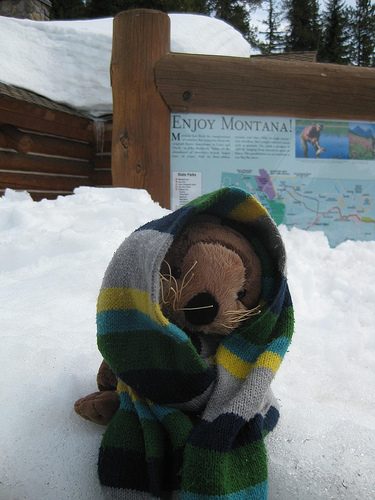
Welcome to Montana!

Welcome to Montana!

The second lasting thought I had was of unity, or maybe at least uniformity, both in good and bad ways. Having grown up in Germany where you were never a day or two’s drive (at most) away from a foreign country with a foreign language, customs and architecture, I found myself speaking slowly to people at the market or motel after crossing state lines, half expecting them to respond in a foreign tongue. But in reality, no such thing happened. We’d cross from state to state, and people would still speak the same language, the menus would have the same food, and for the most part, everything would look the same. The same chain restaurants and motels, same strip malls, same customs, same people… Sure, in some places, old men in cowboy hats may have stared at Nikki and I just a split second longer than would be considered polite in San Francisco, but with the exception of people pumping gas for us in Oregon, our experiences weren’t markedly different anywhere compared to anywhere else. Of course, this was also a bit of a disappointment. I had hoped that we’d find the country less uniform, that Idaho would be distinctly Idahoan, Montana defiantly Montanan, South Dakota surprisingly South Dakotan, and Iowa inexplicably Iowan. The only consolation was the natural beauty, or what little glimpses of it we caught, which varied somewhat from state to state. In Montana, we drove through a blizzard, and saw grassy hills with crowns of pine trees. South Dakota had rolling grasslands as far as the eye can see, albeit fragmented by roads and fences. We saw large numbers of prairie dogs and antelope in Montana, a lone mountain goat and many quail in South Dakota. But even the landscape wasn’t strikingly different to what you would see in parts of California. Except, perhaps, there was just more of it.
somewhere in Idaho

somewhere in Idaho


Throughout the whole trip, I was also struck, and saddened, by how detached we are from the land as a society. Most of the people are in cities and towns, but even the large tracts of land and open space out there is owned, fenced in, often torn up or over-grazed. Even on public lands, people are constrained to roads and prescribed trails, restricted from roaming freely as people once did. There were usually no cars within sight on the smaller interstates we mostly drove on; most other drivers were on big major interstates, where their views are obstructed by semis, bill boards and buildings that inevitably line the big highways. So even when people drove through states like Montana or South Dakota, I got the feeling that what people actually saw was often severely limited. And forget even trying to see more by going on foot or horse back as our predecessors once did; you’d be arrested (or worse) for trespassing before getting far, assuming barbed wire fencing didn’t stop you first. As someone who loves to roam in the wilderness, I was saddened by this thought, and it reaffirmed my desire to buy a large tract of land where I can be free, one with the land, unobstructed by no man.

On the road again

Just a quick update…

The last week+ has been pretty crazy. We finished packing my stuff into storage on Wednesday, which was preceded by a few days of 8am-10pm days of sorting, boxing, shredding, packing, hauling, donating, and storaging. Combined with the unusual (for this time of year) 90F weather, and it had us pretty beat. But that was just the beginning. After handing in my keys, we hit the road, and are on our way to Chicago. We spent the first night near Shasta Lake, just East of Redding in Northern California. On the 2nd day, we made a slight detour to check out a piece of property, then headed North into Eastern Oregon. After spending a frigid night at what appeared to be a closed campground at 5000ft elevation, we shook the ice (literally) off our tent and headed North East into Idaho. We’re staying at a motel in Grangeville, ID for the night, then continuing our Easterly voyage into Montana tomorrow, weather permitting. We expect to be in Chicago some time later next week.

Secure loans

Nikki and I found ourselves in a situation that is probably not all that uncommon between two people dating. Nikki incurred a lot of debt to get through college, the most egregious (though not largest) of which is her credit card debt, with its high interest rate, fees and penalties. I have some money, so I’d like to help her out, but it took us a while to find a good way to do so. The amount is large enough that, in our stage of relationship, it would be over the top for me to pay off entirely. I could lend her money at a low interest rate, she could pay off the credit card debt, then pay me back. But having that kind of debt between us would add unwanted complexity to our relationship, which could turn messy if things don’t work out between us in the long run.

We found our ideal solution in the form of secure loans. I first heard about the general concept of secure loans when I talked to Andrew and Steven of Open Produce about ways to invest in their store. They said I could put money into a CD in my name, then let them use that as collateral for a bank loan. My money would only be touched if they defaulted on the bank loan, but otherwise I keep the money and interest. That sounded like one of those win-win-win situations. The bank can give a loan with virtually no risk (since there’s collateral), my friends get a loan at a low interest rate, and I feel better about investing because I don’t have to handle the logistics (and potential mess) of collecting my money and interest. That got me thinking; maybe something like that would work for Nikki as well.

We spent the better part of a day earlier this week visiting financial institutions in the Mountain View area, to see if we could get her such a loan. Our first stop was WaMu/Chase, but due to the recent acquisition and transitionary period, they didn’t offer secure loans. We then tried Bank of America, who told us the best option would be for me to get a credit card with a low introductory rate, and lend her money directly; exactly what we didn’t want. We then tried Wells Fargo, who did offer secured loans, of the kind we were looking for. They said we could open a CD, then take out a loan of up to 90% of the amount in the CD. Unfortunately, the rates weren’t great. Right now, CDs have a pretty low interest rate, but the loan would have an interest rate of around 10%; lower than the 16% she pays for the credit card now, but it seemed high for a loan for which the bank incurs virtually no risk.

The friendly lady at WaMu/Chase had told us to also try credit unions, so after visiting 3 “real” banks, we did some research in the car using Google WiFi. Our conclusion? Credit unions are awesome. They’re like banks, but owned by its members, so they generally have lower rates. Indeed, the two credit unions we visited both offered secure loans, and had much better rates. One offered loans at 2% above the interest rate on the CD (rounded to next .5%). So if the CD has an interest rate of 2.1%, the loan would have an interest rate of 4.5%; more than 10% less than Nikki’s credit card! The other place was similar, but with rates of 2.5% above the CD rate, instead of 2%. There were other minor differences. One of the credit unions had no minimum monthly payments and the whole sum was due when the CD matured, but the other place had minimum monthly payments. One required both our names to be on the CD and loan, while the other allowed for the loan to be in her name only (which is exactly what we wanted).

At the end of the day, we felt pretty good about having found a financial mechanism that suited our needs, and one that would save her thousands of dollars over the next several years at that. I also reflected on the fact that, for millions of other Americans in debt, such financial machinations aren’t available to them, not necessarily for any fault of their own. But, that’ll have to be another post.

Scarcity gives us clarity

The title is an approximate quote I heard from one of the Google founders (or maybe it was Eric Schmidt), but it describes what I’m experiencing these days. Now that I don’t have two fat paychecks a month, it’s getting a lot easier to see what’s important and what’s not. I’ve sold three rifles so far–including the very first rifle I bought on my own–and have two more up for sale. Last night, I packed three boxes of books to sell to a used bookstore downtown–books I’ve hauled with me all the way from Chicago, and from apartment to apartment since. I’m donating a bunch of clothes, and selling my furniture.

Going to the match last weekend gave me a sense of clarity and focus as well. I know what my priority is now, and I know what I need and what I don’t need. It turns out that in order to focus on shooting, I had most of what I needed with me on that trip. The only thing I didn’t have that I’d need is my reloading equipment, but pretty much everything else (that is to say, most stuff in my apartment) is unnecessary.

On the other hand, this new clarity also threw a bit of a monkey wrench into our plans. Nikki and I were planning on spending the summer in Chicago, but Chicago is a rather inconvenient place to be if I want to shoot. Illinois, and Chicago in particular, has some stringent (though perhaps to some degree justifiable) gun laws that make things rather inconvenient for me, and there aren’t any good shooting ranges in the area either. I’m sure I’ll work something out though.

In semi-related news, I posted some pictures from this past weekend’s match.

On the 600 yard line at the California State Service Rifle Championships in Coalinga, CA

On the 600 yard line at the California State Service Rifle Championships in Coalinga, CA