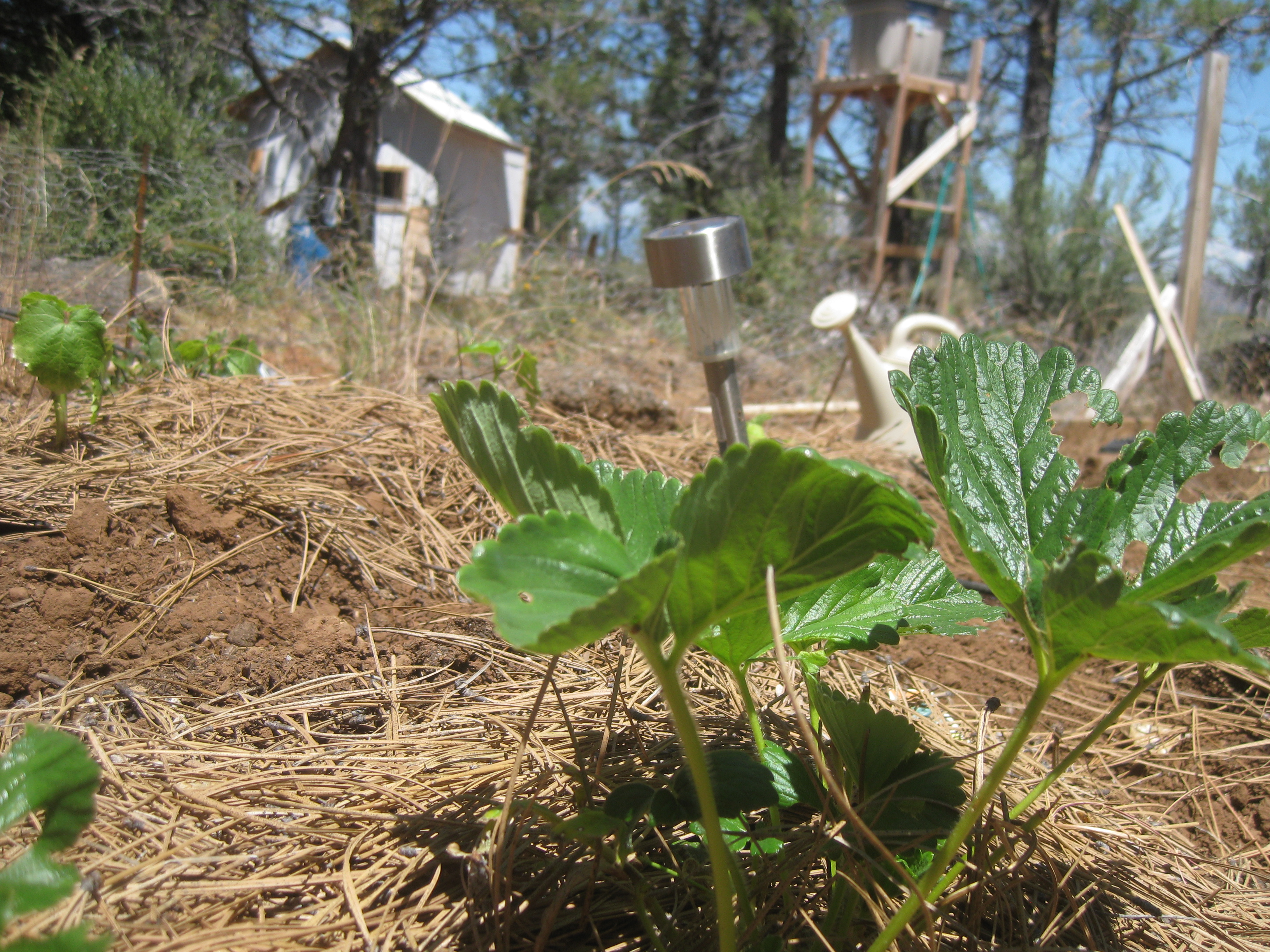
Lost in the Woods

This is an essay my girlfriend Ali wrote after an eventful visit to Serenity Valley this past winter. I thought it was a very powerful piece of writing, so I asked her to share it here on this blog. –Ryo

***
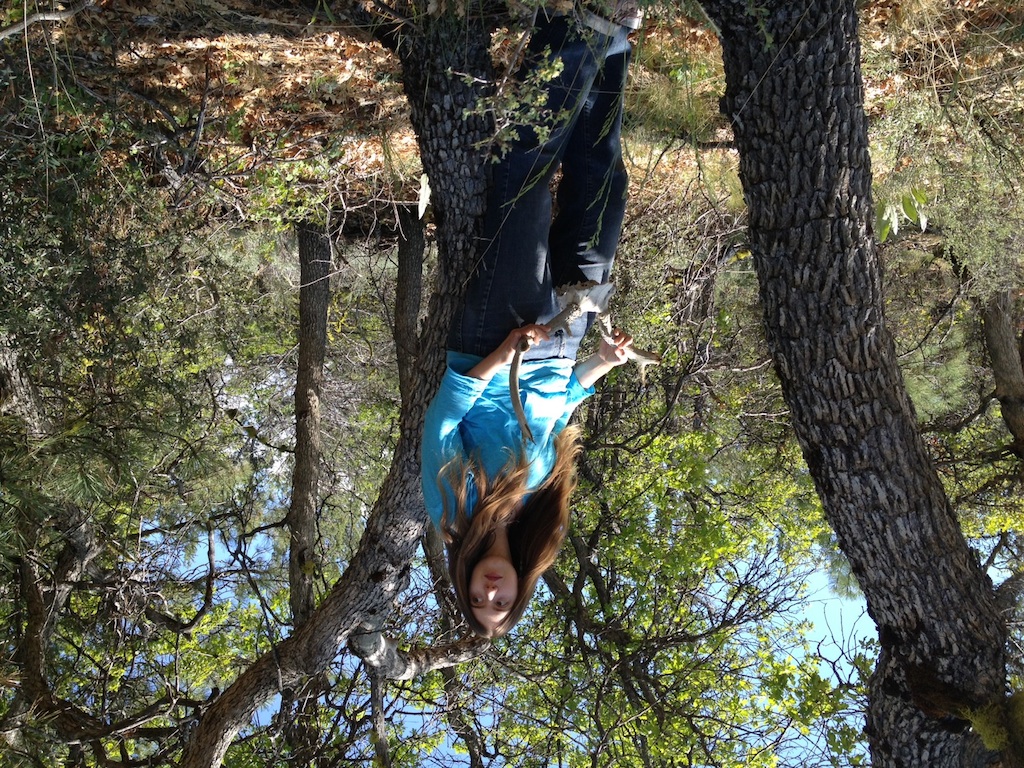
Ali in the woods

You draw us into the wilderness of our own hearts

In the quest for truth.

Enthrall us with your serenade of love:

That, turning away from shame and self deception,

We become lovers of all the world

And join the choirs of your hymn

That soothes and heals this planet.

Music of the Spheres,

One Who Touches Our Innermost Being

You are the Lyric of Love’s Song Unknown

Song of Sophia

Mary Kathleen Speedle Schmitt


I went up into the mountains to face my demons. Of course I also went to be with him, to spend time with him where he lives, not the apartment he rents in Menlo Park, but where he really lives. In the hut he built with his own hands surrounded by acre upon acre of wide open land;, trees and rocks and snow and bones, wild land, free land.

The last time I’d been there it was summer and the days were beautiful. I’d wake before him and do my morning yoga practice in the open space below the loft where he was sleeping. Then, energized and inspired, I’d grab my drum and head out into the woods and create sound. Using my voice, my hands and my sacred drum, I’d unleash from deep within the awe and the longing and the sadness too, but all of it was beautiful, or at least that’s how I remember those first days spent in Serenity Valley. When I’d return from drumming, he would be close to waking and we’d slowly move through our morning routine. He’d go outside and tend to the solar panels, check on the garden, yawn, stretch and feel the sun on his skin. Inside I’d be humming and boiling water and brainstorming on how to organize this tiny space. We’d have breakfast and then go about the day, which would be filled with chores in and around the huts, interspersed with meaningful leisure time. During my first five days with Ryo in the woods, we put in a sink and a kitchen shelf and planted butternut squash (named Fuzzy Wuzzy) and melon (Meloney) in the garden. When we weren’t working we took walks through the woods, I played the guitar while sitting on stumps beneath the fiery afternoon sun, and Ryo taught me how to use a gun at the shooting range he constructed nearby. Throughout the day, I’d tidy up the hut while he worked on the computer. We’d lay in the hammock if there was even a hint of a breeze, or retreat up to the loft to rest when it was too hot to do anything else. In the evening we’d make dinner together and eat by the glow of the solar powered lights inside the cabin, or take our food outside, feasting on fire roasted sweet potatoes, onions and squash and get lost in the changing colors of the sky as the sun settled herself down behind the mountains for the night.

There were some struggles; there was a healthy colony of mosquitoes in and around the cabin and their population was most concentrated up in the loft, which made sleeping comfortably somewhat of a challenge. I ran into the expected, minor frustrations of living away from the modern comforts I was accustomed to but for the most part it was like a dream. Ryo and I had recently grown closer and this was the first time we’d spent five consecutive days and nights together, as well as away from any other human beings.

There was a peace and rightness about life in Serenity Valley that made it easy to imagine raising children there together, away from all of the toxic, mind-numbing, soul-sapping influences of urban life. I was learning new things, like how to work in a garden, use a jigsaw and shoot a rifle. I felt closer to Ryo than ever before, and closer to myself because I was living close to the land. There was no pavement between my feet and the soft, red earth. My voice, this voice that I so often censor and stifle because I’m afraid of being misunderstood or judged or rejected or laughed at, this voice got a little taste of freedom out in the woods. Trees don’t have the capacity to misunderstand or reject you. When they laugh it is in delight at the sounds you are making, never because they don’t like you or think you are foolish or because they are afraid of what you are saying. There were no billboards or commercials poisoning my mind, planting seeds that whatever anxiety or sadness or insecurity I felt would disappear the moment I bought something: a beverage, a pill, cosmetics, clothing, electronic gadgets, so much stuff sold to separate us from our stuff. Instead, when my stuff came up, my anxiety or sadness or insecurity, I had Mother Earth, the sacred woods, to give it to in the form of song, drum, dance, walking there, sitting there, crying there, breathing there. Then, when I’d gotten it out of my system, I could go back to enjoying being me and appreciate once more the rays of light filtering in through the trees and the sight of Ryo, clad only in his khaki shorts and camo hat, up on a ladder fixing something on the hut. It was life in its simplest form, uncluttered by problems that have nothing to do with living and everything to do with trying to escape.

That was seven months ago. In the space between that trip to Serenity Valley and this most recent one, I did a lot of trying to escape; from anxiety, uncertainty, responsibility, pain. Modern life offers so many ways to do this, every one of us gets caught up in it at some point, in some form or another. So I decided to cast off some of my demons while I was up there; I’d stop drinking coffee and eating sugar. I knew these two substances had way more control over my mind and mood than I wanted and I was determined to take back that control. I thought that being out in nature, and far away from the alluring traps of coffee houses and convenient stores, I’d be able to purge myself of these two detrimental proclivities and hopefully leave the woods feeling more balanced and in control of my life. I thought that the change of scenery would also lend me a new perspective on things that I had been struggling with: confusion over which path I should be on, frustration that I keep going in circles and making the same mistakes, exhaustion over swinging back and forth between confidence and insecurity. I figured I’d feel a little uncomfortable during my first day without coffee or sugar but I expected to recover quickly, aided by the magic of the woods, the way that being in nature always smoothes out the jaggedness of my fluctuations and cravings.

Of course, things did not go as I had planned.

Perhaps it had to do with the fact that it was winter and I am less tolerant of cold than heat, so I spent less time outdoors than I had when I was there during the summer. Perhaps it had to do with the lack of space. During my first trip, we’d moved the stove out of the cabin so that I had more room to do yoga and move around and with the much needed (and appreciated!) stove inside this time, there was barely room for my mat. Perhaps it was purely neurochemical. Without the caffeine and sugar my body was accustomed to, my serotonin and endorphin levels plummeted. I felt irritable, depressed, groggy, very impatient with the hardships of a simple life and with my own mental murkiness. I frequently went into the woods, found a sympathetic log to sit on and cried. I tried to be proactive about dealing with my emotions. I kept up with my yoga practice, I journaled a lot, I exercised, I sawed wood, and I rested when I felt exhausted. These things definitely helped to take the edge off, temporarily, but the edge would quickly return. Like a thin layer of dust on a shelf, the moment I had completely wiped it away, new specks would start to accumulate, making it harder to breathe, and to see what was beneath the dust. I didn’t sing, I didn’t chant, I didn’t talk a whole lot about what was going on. Ironically, my voice felt even more constrained in Serenity Valley than it had back in San Francisco. Nothing I had been hoping for, based on my previous experience that summer, was happening for me and I was growing more despondent and frustrated by the hour.

We’d arrived Thursday evening and were planning to head out early on Monday. By that last morning my nerves were frayed. I awoke feeling anxious and angry and not really knowing why. Okay, I thought, Yoga will help, I’ll go do my practice and then I’ll feel better.

The previous morning I hadn’t started the fire before doing yoga and by the time I’d cooled down after my practice and got it going I was extremely cold. It took my fingers and toes a good forty five minutes to warm up. I remembered this and I was pissed. I just want to do yoga, goddammit I don’t want to have to start this fucking fire first. I grabbed some logs from outside and some smaller sticks for kindling and balled up some magazine paper. I cleaned out the grill and placed the paper, twigs and wood into the fireplace and grabbed the matches. I rubbed the head of the match the way that Ryo had showed me, to warm it up, and then struck it against the box and attempted to light the fire. It wouldn’t light. I’d only done this a couple of times on my own and I was irritated and groggy so it seemed really hard to get it going. I went through half a dozen matches and moved things around angrily and made some frustrated grunts. That woke Ryo and he peeked his head over the edge of the loft and asked if I had enough paper in the stove.

Never mind!” I muttered, “It’s not that cold.” With that I pulled on my boots, coat, hat and my stretchy pink gloves and left the hut. The frustration had become rage inside my body and it had reached its peak. I knew I was on the edge of a major explosion, and I am not the type of person who has major explosions. My skin was crawling, my jaw was clenched, my heart hurt from the anger. I only had one thought in my mind. Run.

I began to go in the direction I normally go, into a part of the property I nicknamed “Skinny Tree Forest,” in honor of an imaginary land my sister and I had created as kids. Then I immediately turned to the left and headed south, into a part of the woods I didn’t know as well. I didn’t run very far, my lungs and heart hurt and the pain was sharp and it stopped me. The hut was still within my sightline when I stopped running and I was still pulsating with fury that was about so much more than not lighting the fire. I sat down on a rock and had a good cry. Or maybe it was a bad cry, I’d had a few of those over the past couple of days, the kind that go on too long so that rather than purge the toxic emotion, the cry just exacerbates it and gives one a splitting headache and a swollen face. Whichever kind of cry it was, it stopped when I saw something move in the brush a short distance away from me. The something was gray and about the size of a large rabbit or a fox. My attention was immediately refocused on that spot, on the fact that there was another living being near me, a mammal, with red blood coursing through its veins just like mine, a being I had never met and would probably never encounter again. Then I began to look at what was around me. Snow had fallen during the night, coating all of the branches of the trees, the skinny and spindly and the thick and sturdy, with white dust, and some of it was sparkling in the bits of sun that were peaking through the clouds. This is amazing. Its absolutely beautiful and alive and every bit of it is conscious.

I felt pulled to the spot where I’d seen the animal, although I was sure it was gone by now. I stood, kneeled and crouched in that area that was an open circle and felt like sacred ground. Something about that moment was different than any other moment since we‘d arrived. After days feeling foggy minded, frustrated and lethargic, I was suddenly pulsating with energy. The woods had breathed life into me and I was delighted by all there was to see and feel there. I felt soothed by this circle of wood, earth and snow around and beneath me, and by the soft, muted sun above me.

My focus shifted from my own misery and was redirected out to the living, breathing woods and what it was telling me. Stories I knew I’d never be able to relay, wisdom I couldn’t translate into words. It showed me the folly of being caught up in misery by revealing itself to me and making me feel how connected to it, all of it, the land, the snow, the air, the trees, I really am.

I noticed two tall pine trees a short distance away. They were standing very close together, almost touching at the bottom and spaced further apart at the top so that they formed a “V.” I felt my body moving towards them.

As I approached them, they told me, in the space of one breath, their story. The pine trees were like Ryo and I, so close to one another yet unable to touch, never fully merging into one tree but growing strong and tall, side by side. Even though they seemed to move away from one another as they grew taller, there really was nothing either one of them was closer too, other than the dirt that gave birth to their roots. And they complemented each other. The tree to the left was wider and slightly taller and appeared to be stronger while the tree to the right seemed more intricate and delicate, gentler, more feminine. I stood between the two trees, my back against the stronger one and my gaze fixed on the softer one. I got lost in her patterns and the layering of her bark, at least as intricate as my own mind, and I was comforted by the sturdiness of the one I was leaning on. I gave these two together-trees my loneliness, my gaping, bleeding sense of separate-ness, and they took it, breathed it in as I breathed it out, and I felt the serenity this valley is named for. As a child, I’d befriended the trees on the playground when I felt like I didn’t fit in with the other kids. I’d created in them entities who mirrored my struggles and gave me what I needed. As a child, I’d imagined, or created, or perhaps received, solace. Where does projecting end and receiving begin? Are they really two separate poles or is give interspersed with take, create interwoven with consume?

I looked back from the direction I’d come from and my eyes saw the brown siding of the hut peeking between the trees. Another constellation of trees drew me further in, or maybe it was one tree that caught my eye, or perhaps just a single branch, bent like a wise old woman’s finger, beckoning me nearer. I moved away from the together-trees and did some more exploring, some more imagining, some more listening. The next time I looked back towards where I’d come from, I couldn’t see Ryo’s cabin anymore, nor could I pick out the two together-trees or the brush where I’d seen the gray or white rabbit.

I knew, generally, which direction I’d come from, or at least I thought I did. There were trees and branches and clusters of dead bushes and snow all around me and none of it looked familiar or at all distinguishable from the rest. I had lost my way and that I wasn’t sure how to get back.

I set off in the direction I thought the hut was hiding and tried to find my footprints in the snow. That should be easy, just follow my footprints back the way I had come. When I tried to do this, the prints just led me back in a circle to the spot where I discovered I was lost. I don’t know how to account for this.

For a moment I thought I spotted the hut again, but I quickly saw that it was dead leaves peeking through trees. I realized what I had thought was the hut the last time I’d looked probably was not, and I was further away than I initially thought. I felt the panic that had been gathering around my edges all of a sudden go deep into my center. I’m lost!

I had heard more times than I could recall that the best thing to do when you’re lost is to stay put, avoid getting more lost, and wait for someone to find you. The woods are very extensive, they go on for miles, it would not be hard to get very far away from Ryo’s property without realizing it. I knew I’d gotten myself into a pickle, a potentially very dangerous pickle, and I also knew that I couldn’t stay still for too long in the cold. I decided to head back in the direction I thought I had come from, even though I couldn‘t find my footprints. I had lost all sense of direction and I could not figure out which way I had actually come from.

I was not equipped to be out there. Running into the woods in a moment of blind and overwhelming frustration might very well be the stupidest thing I’ve ever done. I was so angry at myself. I had been safe. Nothing had actually been wrong that couldn’t have been fixed right there in that hut. In a matter of moments I mindlessly forfeited my security and my power and put myself, and by extension Ryo, into a state of extreme vulnerability. He prides himself on being self sufficient, on doing what he’s doing without needing any help, certainly without needing anyone to come in and rescue him, or his emotionally unbalanced girlfriend. What would it mean for him, and for our relationship, if he had to call for help to find me? So bitter was the remorse I felt for the situation I’d created, and biting like the cold that began to cut into my skin if I stayed still too long. This desperate, pathetic longing to be able to just undo it all hampered my sensibilities. It had been over an hour since I’d run into the woods and I was wandering aimlessly, getting myself more lost, maybe, I couldn’t even tell anymore.

It was as though the woods had swallowed me. I’d come up against the edge of my self and fallen over and no trace of me was left. I walked and I walked and I walked. Before long I found myself in very unfamiliar terrain. I found a stump to sit down and as I did the desire to just give up overtook me. I’d gone past the flesh and bone of hopelessness and I was into the marrow now. I don’t know where I am. Who is going to help me? How will I ever get out?

In the midst of the hysterical chatter of my mind, a voice came into my head that distinctly different than my own. It was the voice of a wise yogi who left this Earth years ago after bringing hope and healing to many. I’d never felt much of a personal connection to this particular guru although I’d trained with yogis who very nearly worshipped him. There’s a lot of controversy around this man, some say he’s a saint, some say he’s a criminal. I don’t claim to know the truth about him but I know what he meant to me in that moment. My brain chose him to offer guidance because he is known for not putting up with anybody’s crap and not sugar coating anything or coddling anyone, and I knew that self pity would get me absolutely nowhere in my current situation. So, from somewhere deep within my mind, or maybe even slightly beyond it, I heard Yogi Bhajan’s voice.

You create your own hell. Now walk in it.

The first line was not new information. I’ve long understood there to be no separate hell below or heaven above, it’s all here on earth, its all our individual and collective creation. I knew, during the months before this trip to the mountains, that I was making myself miserable by not doing my practice, by reaching for sweets to alleviate anxiety and coffee to give me the energy I was wasting by swallowing down the things I needed to say. I was allowing my emotions to control me rather than just give them a little attention and love and move past them. Ending up exactly where I was in that moment was the natural manifestation of everything I’d been creating in my head. My tangible, physical situation had become an extension of my mind. I’ve felt lost for awhile now and I’d been avoiding dealing with it. I was doing everything in my power not to confront the massive uncertainty surrounding where my life is going, how I’ll get there, if I’ll be all right. Before I knew it I’d forgotten my power to choose a path that will lead me where I want to go. This mental action needed to find a much larger form or else I’d keep running around in the same small circles, getting smaller and smaller, decaying, rotting, forgetting. Losing my way forced me to look at how I had abandoned the way I know to keep myself healthy and strong.

Things were going unsaid between Ryo and I. I’d been secretly wanting him to be exactly who I needed him to be so that I could feel safe being myself. My uncertainty and insecurity about who I am in his eyes, in his mind and in his heart had led me to build walls of silence and avoidance between us. I’d been feeling powerless in my life and this contributed to the persistent, irrational desire to have him take care of things for me. To take care of me. I felt like I needed him to make me to speak when I couldn‘t (which, of course, he never would), to teach me everything I don’t know (which, of course, he never could) and, when its too hard for me to learn things, to do them for me. What this desire says about me as an individual, as a woman, was too much to confront and so I ran from it. I ran right into woods where I couldn‘t run from it anymore. It was all here now, bigger than me, bigger than us, as big as the woods and I had no idea how big they really were.

Now walk in it.

I have experienced the concept of karma, and I know, logically and intuitively, that we have to deal with the messes we make. Either we clean them up or we drown in them. I know that no one is going to do any of this for me. But for awhile now, I’ve been wanting someone to. This fantasy of the knight-in- shining-armor or the prince on the white horse with the castle in the clouds takes on many forms. Ryo can do a lot of things that I can’t, at a very crucial level, he knows how to survive out here and I don’t. I’m able to have experiences with him that I can’t have on my own and I think that this activated the damsel-in-distress/helpless maiden stereotype that I was fed as a child watching Disney movies and listening to fairy tales. If he is strong, that must mean I’m weak. If I can’t do something and he can then he is more diligent, more creative, smarter, better than me and I’d better do anything I can to keep him. I’d better hide how deficient I am and not tell him when I feel weak or else he will find out he’s too good for me and leave.

But maybe one tree isn’t stronger than the other. Perhaps the tree I’d been leaning against was actually no stronger than the one I was facing. If I had stopped looking at what I thought was me and leaned against my own image for a moment, what might I have seen in the tree I’d had my back to? That he is vulnerable too, that he makes mistakes too, that he has doubts and insecurities too? If I had simply turned around and allowed that which was holding my gaze to hold my body, would I have felt my own strength supporting me? Would I have found my way back to the hut then?

You created your own hell. Now walk in it.

Hell. My hell, was entirely psychological. Nothing was happening to my body. I got a fabulous workout and a couple blisters on my toes. I knew enough to keep moving so that my fingers and toes didn’t get cold and to eat just enough snow to stay hydrated but not take in too many potential pollutants. My hell was in my mind. Everything I hate about myself, everything I hide from myself and from others was there to meet me in the woods, it was all out in the open and couldn’t possibly be hidden anymore. I fucked up so bad this time. There is no good way out of this. The best case scenario is that Ryo will be able to find me, and then he’ll certainly break up with me. This time I went too far. He couldn’t possibly be with me after having to clean up a mess this big.

Walk

I called out for Ryo. I yelled his name into the trees and they swallowed my voice, the same way they’d swallowed me.

I walked and I walked and I walked. After about an hour and a half of wandering through the woods, I found a dirt road, covered in snow, not driven on in at least several days, and certainly not the one we had driven in on. I followed it down a steep incline and then stopped because it seemed, from the view of the mountains in the distance, that I was getting further away from where I knew the hut was. I turned around and went up the road instead and when I got to the road there was a fence and beyond the fence were railroad tracks. Technically, I was out of the woods, but I still had no idea where I was.

I remembered that Ryo had mentioned walking all the way down to the fence and the railroad tracks on occasion so I knew I couldn’t be that far from his cabin. I decided to walk along the fence and call out for him, thinking that if he was still near home, and not off someplace else looking for me, then he would be able to hear me and come find me. I would periodically walk a short distance into the woods, keeping the fence in sight, to call out. I climbed a tree, trying to spot the hut from way up high but it was all branches, snow and dead leaves. I’d debated climbing trees at intervals but decided against it since my boots were in bad condition and I knew it was unwise to risk falling and injuring myself.

I walked along the fence for awhile and then came to a point where it turned, and then kept going and going and going. I was pretty sure that the side of the fence I’d started out at was due south of the hut but I couldn’t be certain. I walked back to the road again, down a little ways, a little further then before, and then back up again, back to the fence, walking, calling, hoping I’d be found, fearing I would not. In between moments of franticness or determination or hopelessness, I’d crouch down close to the earth, and I’d pray.

Hail Goddess, Full of Grace

Blessed are you and blessed are all the fruits of your womb

For you are the Mother of Us All

Hear Us Now

And In All Our Need

Oh Blessed Be, Oh Blessed Be

Amen

This prayer is a liberated version of the “Hail Mary,” a Catholic prayer I knew as a child. The meter is the same, the words are more inclusive. It was a gateway that led me to speak directly to Her, to say how scared I was and to ask for the strength and wisdom that had one missing inside of me.

No Divine Force From Beyond, no God, or Goddess, was going to intervene. It was the act of calling out to Her that saved me. Since childhood, whenever I’ve needed help or been really scared I’ve always asked God to save me, even after I stopped believing in him. This time, it was not the Father Above, but the Mother Within, whose presence I invoked. Even though I felt like I was entreating a loving, compassionate mothergoddess far beyond me, what I actually did was call upon the my own power, the power of the creative feminine, She Who Knows the Way.

But I wavered a lot too, I tried to invoke her, invoke my own power, but my mind kept telling me it was hopeless to try to find my way out on my own, that I was lost and would always be lost out there. In addition to squatting near the earth and calling on the Goddess, I prayed to Ryo as well. Crouching in the snow I spoke to him, as though he were right in front of me, and told him I needed his help.

Come to the fence. You have to come to the fence, this is the only way because I cannot get home on my own. Ryo, come to the fence, come to the fence by the railroad tracks.

I affirmed again and again, that I needed him to save me, that I couldn’t do it on my own. And I kept going back and forth between the fence and the road, between Hail Goddess and Ryo Please Find Me. My experience walking the fence went in waves. I’d get a burst of confidence, of trust in my self, or trust in the Self-from-which-All-Selves-Spring. I’d decide to head one way and keep going, as far as I could, see what was there. But I’d get only so far and then turn around and head back in the direction I’d come from. I was stuck.

Hear us now and in all our need…

My voice started to loosen in the woods near that fence. Praying and yelling out to Ryo again and again began to open me up, to bring me so fully into my experience of needing him and everything that means. Thinking he can do it better than me (drive the car, cut the onions, start the fire, build our home), or knowing that, in many cases, he actually can do something better than I can, somehow morphed into my needing him to do it all for me. This need is the gaping wound of self mistrust. The only way to begin to heal such a wound is to be thrown into a situation where you have to trust yourself in order to survive.

At one point, after calling for Ryo, I just had to scream. I screamed loud, not to be found or even to be heard, but to let loose the anger, the childish frustration and remorse, the deep, dark fear about my own survival. So much raw emotion came out in that scream, emotion that has no label or category or flavor, that was neither anger nor joy, grief nor bliss, simply the intense experience of being human. It was human emotion unfiltered by mind, uncluttered by chemical modifiers and not held down by reason or fear. Such pure emotion has enormous transformative power. When it was kept inside it stayed stuck in the form of fear and shame but the moment it found voice it became my power again. Life let loose when I screamed and in that moment I was free.

I remembered Ryo talking about a road leading to the neighbor’s property, and now and again, during my fence walking, I had thought I recalled him saying that dirt road started at the fence. But I quickly wrote off this memory as fantasy, as something I was making up because I wanted to believe I could get home. Suddenly, it seemed ridiculous not to at least try it, to take that road down as far as it would go and if it led me nowhere, I could always come back to the fence. Ryo had showed me his neighbor’s property the other day and I had wondered, at the time, why he had done this. The neighbors weren’t there and I thought there were probably more interesting spots in the woods to visit that a chunk of land with some trailers, a guardian angel statue and a bright orange fireplace.

I began walking back down that snow covered road, seeing all the familiar landmarks; the overturned tree stump that looked like a piece of machinery from the distance, the point where the road bent to give a better view of the mountains in the north. This time I went past the point I’d gone before and started to see different trees, different piles of snow and sticks, a different angle of the sky above. I kept walking and I started feeling a cheerful. The little voice inside me warned not to get my hopes up, to brace myself for disappointment and a long, steep climb back up to the fence. The big voice inside me said, Screw the little voice, we’re going the right way, you‘re going to get home.

After a bit, I came upon an enormous water tank, far bigger than the 305 gallon one we’d strapped to the roof of the car and drove from Redding to the hut a few days before. Near the water tank were posted private property signs. I knew I was on somebody’s land now, but I didn’t know whose.

I kept walking and soon I saw some trailers. Are these the ones I saw yesterday? Probably not, but could they be? I couldn’t be sure. I kept walking. Then a beam of light hit my eye, blinding me for a fraction of a moment as a streak of sun emerged from behind a thick wall of clouds and landed right on that bright orange fireplace. That was when I knew, without a shadow of a doubt, that I wasn’t lost anymore.

Ali and the fireplace

Ali and the orange fire place that showed her way home…

From there I took off towards the dirt road that leads up to Ryo’s land. I flew so fast that I missed the guardian angel figurine but I don’t think she missed me. She was there as I turned onto that familiar red dirt road and saw the tracks of the car and the chain and lock I’d unfastened to let us onto the land a few days ago. Then I saw our footprints in the snow. Shivers scurried up my spine and my chest began to feel warm and wide. Seeing our footprints was almost like seeing Ryo himself, it was a physical sign that we were both alive and had been walking together, and would be soon again. I started running and calling out for Ryo, unaware that he had just been calling out to me, I guess we were still too far apart to hear one another. He was about to set out a second time to look for me as I dragged myself up the final stretch of hill and we saw one another at last. I ran towards the biggest smile I’ve ever seen and the warmest arms I’ve ever known. I’d made my way back, back to Ryo, but not rescued by him. I had brought me home.

Through this experience, I was able to put a chink in Prince Charming’s armor. The learned helplessness and lack of self trust that many women learn at an early age has not been entirely vanquished. The helpless maiden is still a part of me and maybe she lives in all of us for a reason. She is often who we believe we have to be in order to be loved, cared for and protected by our fathers, and later on our lovers. She is part of our heritage, she is who our grandmothers had to be to survive patriarchal oppression and she is still the only acceptable female form for millions of women around the world. We are them and they are us and until we are all free, that image of the feminine will remain within us. But there are other archetypes that live in all of us too. During my three and a half hours wandering in the woods I struggled to find my own strength. And through the action of walking through my creation, my hell, as it were, and through the act of deciding to find my own way back I embodied Diana, the fierce warrior princess, confident, capable, self-sufficient and strong, goddess of the trees, huntress of the elusive love within.

I learned that self reliance is a state of mind before it becomes an action. Running into the woods was a reckless and dangerous thing to do and if I had known how to compute my direction from the angle of the sun, if I’d been able to find my footprints, if I’d brought a GPS or a whistle or a map of the area then I would have found my way back sooner. If I’d continued to wander aimlessly I might have gone much further away from the area and not found my way out (or have been found) before night fell, and then my chances for survival would have been slim. In this particular situation, I had all of the information I needed to get back home stored in my memory and I was never that far away. I remained lost because I believed I was lost and that my mistakes doomed me to suffer. As soon as I decided to use what I information I had, and to risk being wrong, and to forget about feeling helpless for a minute, I found my own way out of those woods.

I was fortunate. The risks out there are very real. But so are the risks in here. Every self defeating thought we give our attention to paves the way for disaster. Its only a matter of time before we create the negativity we perpetuate in our minds. This experience was a wake up call. I was reminded how lucky I am to be alive, and that I have a responsibility to walk my path and not let fear keep me stuck in one place for too long.

The morning after I found my way out of the woods, back at home in San Francisco in the warmth and safety of my own bed, I awoke with the words of mystic poet Rumi running through my head. “People are going back and forth across the doorsill where the two worlds touch. The door is round and open. Don’t go back to sleep.”
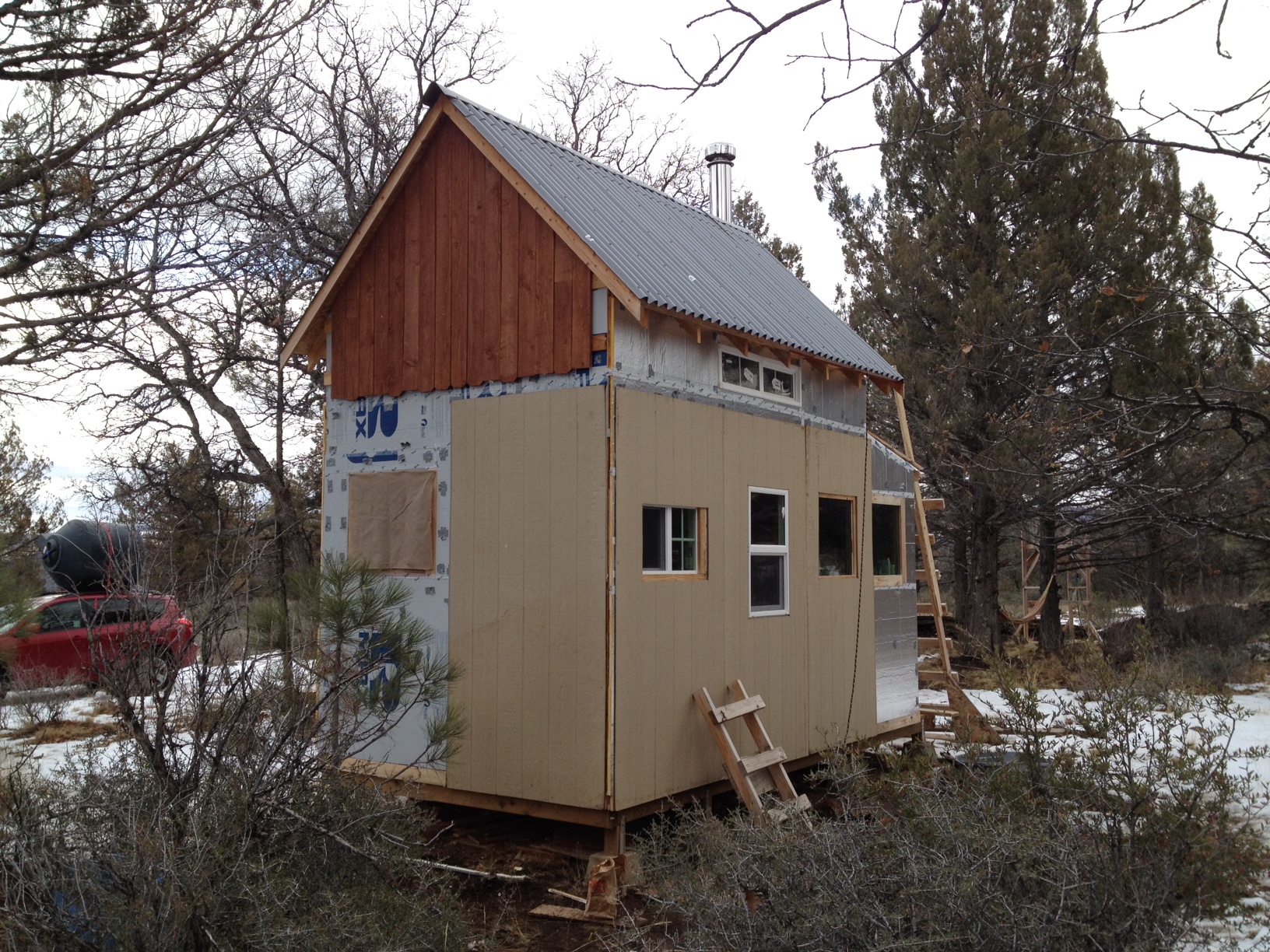
BootstrapSolar needs your support!

In my previous post, I mentioned that I was working on a solar power pack. I’ve since completed the prototype and tested it, so I’m almost ready for production. But in order to get there, I could use some help…

My solar power pack contains a 6000mAh LiPoly battery, big enough to recharge an iPhone four times over (or an iPad up to about 70%). It has two USB ports, of which one is configured to support Apple devices with output up to 1000mA (that’s equivalent to the iPhone’s AC adapter). The kit also comes with a 5W monocrystalline solar panel which can generate enough power to completely recharge an iPhone in two hours. Furthermore, the power packs can support up to 10W of solar panels for heavy users (or cloudy days). And it’s enclosed in a bamboo enclosure, which is a much more sustainable material than the plastics commonly used.

Basically, I built what I wanted for myself. It’s the kit I wish I had in Japan. It’s the kit I wish folks had in Japan in the days that followed the earthquake and tsunami when the power was out. I took this kit with me to Burning Man, and wished everybody had one.

Right now, I’m in the process of raising funds to pay for a small production run. The Kickstarter campaign that I started two days ago already has over $3000 in pledges, though I need $7500 for the campaign to finish successfully and to start production. If you’re interested in a kit, you can “reserve” one by pledging $90 or above, which is substantially less than what the final retail price will probably be (or how much you’d pay for a similar commercial product). Of course, even if you’re not interested in a kit for yourself, I’d appreciate any help getting the word out as well. Also, if this kit succeeds, it’ll give me the funds to work on other kits, so you’ll be supporting a larger project that aims to make solar technology available and accessible to more people. So, any support would be greatly appreciated, whether it’s a pledge on Kickstarter, or a simple “Like”.

Thanks!

Back…

I apologize for the long hiatus on this blog… There are a couple of reasons for the long silence. The first reason is that when I got from Japan back in mid-June, I felt like I should write a post wrapping up my experiences there, yet somehow I couldn’t quite find the words so I kept putting it off. So, I’m giving up (for now), and will simply point you at this talk I did at Google’s Tokyo office that does a decent job of summarizing my experiences. The second reason for the long silence is that I’ve been seeing someone else… I mean, I’ve been blogging elsewhere. But I’ll get to that in a bit.

When I got back to my property in June, I was obviously anxious to see what state my property and huts would be in after such a long absence. Out here in the country, anything can happen. Fortunately, nothing did happen, and I found my property more or less as I’d left it. Of course, it was warmer, as temperatures were still dipping below freezing when I left for Japan. From what I heard, Spring this year was wetter and longer than most years, and my property was particularly lush and green even in late June. Wild grasses seemed thicker and taller this year than in past years, and they covered up my normally rocky ground to give my clearings a more meadowy look.

I’m not doing a whole lot on/with my property this year. I pretty much have everything I need/want to live comfortably, and as far as I’m concerned, I’ve achieved my goal of establishing “minimalist comfort.” I did, however, plant a small garden again, though I missed planting season so I’m not sure how productive it will be. When I got back in June, I was surprised to see my strawberry plants sprouting out through the pine needles I’d covered them with for the winter. They’ve since continued to grow, so I planted a few more strawberry plants. They seem like the only plants that thrive on my property, through the cold winters and hot summers. Maybe I’ll just give up on growing other vegetables and have a strawberry patch…

One thing I may try to do this year, if I can afford it, is to set up a rain catchment system. I was skeptical about rain/snow harvesting before, but after spending a winter up here (including a month during which I lived off of snowmelt), I’ve been convinced that it’s worth doing. I’d like to start with a 300 gallon tank, which I could probably fill up with run-off from Hut 2.0’s roof, and would go a long ways towards keeping my strawberry patch watered next year.

Other than that, I’ve been focusing a lot of my attention and energy on my new project: Bootstrap Solar. In short, I’ve been developing an affordable yet powerful solar power pack for powering smart phones, iPads, and other small devices. The project was inspired by the earthquake/tsunami in Japan back in March, when I realized how crucial yet difficult it was to keep phones charged in a disaster (or, even in ordinary times if you spend a lot of time away from power sockets). I’m hoping to start selling them in kit form as early as next month, if I can raise enough funds. In any case, I’ll probably occasionally cross-post here as well, but follow BootstrapSolar.com for regular updates.

Anyway, that’s it for today. I’ll try to post again… hopefully sooner next time.

What I’ve been up to

It’s astonishing how quickly time has gone by. I originally started drafting this post a month ago, though it feels like just the other day. Time just takes on a different property here; the first 3 days felt like a week, yet the last 3 weeks feel like a blur… Next thing I know, I’ve got 2 weeks left in my tour of duty.

A week or so after I got here, I started leading teams on “gutting” projects. I wrote fairly extensively on the topic over on the official All Hands blog, if you’re interested. Basically, we’re helping speed up the recovery process by doing relatively simple work that, under ordinary circumstances, would be done by carpenters, who are currently simply overwhelmed and stretched too thinly. It’s fairly delicate work, especially in individual homes that were built by master carpenters, but it’s nothing most people can’t learn to do with a bit of guidance. It’s also quite gratifying to see a “gutted” home that’s been stripped of damaged materials, and cleaned down to its skeletal structure. When the job’s well done, gutted homes look less like tsunami-damaged homes, and more like homes that are simply under construction.

At a personal level, it’s also been very rewarding to work closely with carpenters, and to be able to see these homes up close. The work we’re doing gives us a great deal of insight into how the homes are built. Having worked on at least a dozen homes by now, I’ve come across a variety of building materials and construction methods, and am even starting to get some idea into what works and what doesn’t. As we remove wall panels (usually gypsum boards or a native cement wall that’s applied), we can see the posts, studs and braces that are normally hidden away. I’ve seen a few different floor systems, some of which have faired well, and some of which have collapsed. I’ve also become intimately familiar with the few different methods used in traditional ceilings, and have had the chance to study the beams and joinery hidden above them. It’s been quite inspiring to say the least, and though what little I’ve learned of Japanese building methods barely scratches the surface of all there is to know, I’m looking forward to going back to my property to reinforce my cabin, and build another structure or two employing methods I’ve seen here.

About 10 days ago, I got sent off on a “satellite” project in another community called Yamada, located about an hour and a half’s drive from our main base in Ofunato. Yamada is a much smaller town, but was hit hard by the tsunami and fires that raged on for 24 hours after the waves struck. Over half the homes in the town were damaged or destroyed, and the main part of town has been washed away or burnt out, leaving behind a ghost town. Curretly, our project there consists of two job sites: one is a beach-side shrine, and the other is the shaman’s home. The latter site also serves as our base, where we’re camping out in tents. Other than spring water that comes out of a faucet, there’s no infrastructure there, but fortunately I’m quite used to being in such environments. The other volunteers rotate in and out on 4 day shifts, but as the team leader, I spent two full rotations there, and will be going back up with a 3rd rotation.

Between leading gutting teams in Ofunato and leading the satellite project, I’ve been taking on leadership roles for most of the time here, which is somewhat ironic seeing how I was living a life of solitude until I came to Japan. Leading teams isn’t anything new to me since I’ve somehow found myself in such roles on numerous occasions ever since I was a kid, but it still doesn’t feel natural to me either. I’m not particularly assertive, or dominant, or decisive, or intimidating, or strong, or hard working, or skilled, or possess any of the other traits one may associate with the alpha dog. So I’m genuinely baffled whenever I’m asked to lead, but it keeps happening, which probably means I’ve got whatever is being demanded. Here, though, leading teams has been easy because everybody works hard, and many of the volunteers are far more skilled than I am. In reality, I don’t feel like I’m actually “leading” as much as I’m coordinating. All I do is understand the job, know the team, decide how to apply the team to the tasks, then let them go at it and do whatever I can to support and assist them. On one day during the satellite project when I had 8 people working in the house in 3 sub-teams, everything was humming along at around 3pm, so I decided that the best way to make myself useful was to cook the crew dinner (while occasionally answering questions from the kitchen) so that hot chow would be ready the minute they finished for the day. A lot got done that day, and everybody seemed reasonably happy even though I’d worked them an hour longer than usual. I guess what I lack for in innate leadership qualities, I make up for with what I’ve learned from bosses and managers I’ve had in the past. In short, I try not to replicate behavior I didn’t like about my ex-bosses, and that seems to work okay, even if I can’t exactly explain what it is that I do do.

To be brutally honest, though, I do miss the quiet and carefree solitary life in the woods. The weight of command is burdensome, even if I’m willing to serve that role for a while when asked…

Photo by Eric Zdenek for All Hands Volunteers

Answers!

(These are answers to questions asked in response to my last post. Please note that, while I am volunteering with All Hands Volunteers, opinions and observations expressed here are my own, and do not represent those of the organization I am with.)

How has your time in solitude in the mountains influenced your decision to go and your presence there?

Interestingly, after Project 31 ended, I decided that while I was perfectly happy being alone, my life was starting to feel stagnant. Even before this volunteer opportunity popped up, I was starting to think about how it’d be nice to be and work among people again. After spending months mostly alone, I’d come to see my own limitations; I realized that I’m not good at challenging myself, and that I like having other people around to challenge, inspire, and motivate me. On the other hand, I had no idea what that meant. I didn’t want to go back to work in an office, but I couldn’t think of anything else I was qualified to do. Until, that is, this volunteer project came up. I feel like I was meant to do this, and it just happened to be the perfect “job” at the perfect time.

What’s the infrastructure like?

It varies quite significantly depending on the area. Most infrastructure has recovered in areas that hadn’t been hit by the tsunami, excepting some train services (like the shinkansen bullet train). In Ofunato city, water, power, gas, and communications are back up in areas that weren’t hit too badly by the tsunami, though some parts still have no physical infrastructure. Many businesses are still closed or are open for fewer hours. A Lawsons convenience store nearby is only open until 6pm (it’s normally open 24 hours) and have half-empty shelves. Our meal ladies buy supplies at another supermarket that’s better stocked, though we’ve also been given boxes of vegetables that had been sent here as relief supplies. I’ve heard that neighboring prefectures that weren’t affected by the earthquake or tsunami actually have more supply issues, because so much stuff is being sent to the “front lines” (i.e. the coastal tsunami disaster areas). Many towns and cities are far worse off than Ofunato. Neighboring Rikuzentakata basically has ceased to exist, so infrastructure is virtually non-existent. Even if there are supplies, they aren’t necessarily being distributed well, so there could be food rotting in a warehouse (or school) while people live off of instant noodles. In some areas, it’ll takes months to a year to repair water and power infrastructure, and many people still rely on water distributed by the JSDF, or are trying to use/recover local wells.

How are you getting your basics (water, food, shelter)?

Our base has running water, and food is available in the city we’re in. Shelter is a bigger issue, however. Our current base can only house a few more people, and we have another 50-70 volunteers showing up over the next week or two. We’d initially secured a campground to serve as our base where volunteers can sleep in tents, but the prefecture decided to build temporary housing there (which is great… temporary housing is a priority). In general, there are so many evacuees needing housing that “proper” housing is basically unavailable for volunteers. Fortunately, we’re willing to endure more basic living conditions than most people, so we can be more creative in finding solutions.

How do you guys find projects?

Believe it or not, finding projects has been a huge challenge. Getting word out about our activities has been somewhat challenging, but the bigger issue is cultural. As outsiders (and foreigners at that), it’s been difficult to gain enough trust to be allowed into individual homes and business. Furthermore, Japanese people are still unaccustomed to the kind of assistance we provide, and many people seemed to not believe that we actually provided services for free (though, to be fair, there are scammers who go around “volunteering” then send a bill later). I think Japanese people are also self-sufficient, and just used to dealing with their own problems without relying on others. So, we’ve faced a number of obstacles.

The All Hands assessment team (the first of whom arrived a few days after the earthquake) and early volunteers did a great job of establishing local political support. Many of our projects have come through a single local leader who’s introduced us to residents and businesses in his local area of influence. From there, we’ve been able to slowly grow our operations. The press has been covering us pretty extensively (we had 3 camera crews filming us this past week), and it’s a lot easier to gain trust if we can show a newspaper clipping with our name in it.

Ultimately, we have to let our work speak for itself. I’ve started leading a few “gutting” projects (removing drywall and floor boards), and one thing I stress to everybody (my team members, the leadership, the locals) is how important it is that we do work that meets local standards, and how high those standards are. If we do sub-par work, the locals will simply wait until professional carpenters can do the work, since they’d rather have the work done properly later, than to have it done poorly now. On the other hand, if we do good work, that’ll go a long ways towards earning trust, and it’ll become much easier to find new projects. Fortunately, I’m working with some incredible people, so doing work that we can be proud of hasn’t been too difficult.

These projects seem to be more often community buildings than individual homes, is that the case?

Actually, most of the “projects” we’ve worked on have been individual homes. The project at the high school I’ve been helping coordinate is actually our first major project in a public building. It seems the All Hands staff are interested in finding more of those, since it impacts more people at a time. Having said that, we’re here to help, and we’ll do whatever and go where ever help is most in demand.

Who provides your lunch bento boxes?

A local bento shop delivers them to our base, and then a hired driver delivers them to work sites. There aren’t too many bento shops open yet, so it’s not uncommon for our volunteers to be eating nicer lunches than the residents that we’re helping. Whenever I can, I offer the same bentos to residents at our worksites, but that’s a custom that hasn’t been adopted as widely as I’d like (mostly because the bentos are expensive).

How are the survivors doing psychologically? Is there any help in this regard? There are possibly cultural differences of which we aren’t aware – such as the Japanese people being very resilient or fatalistic.

Many of the older people I’ve talked to remember the tsunami triggered by the 1960 Chile earthquake, which killed hundreds here. In general, the Japanese are used to hardship. In fact, I’ve come to realize recently that the culture almost seems to have been defined by hardship. Traits like “endurance”, “resilience”, “self-reliance” are highly valued here, and those qualities help people overcome hardships. We’ve seen old men and women, perhaps over 90 years old, bent over piles of rubble, clearing debris a tiny handful at a time. When asked if they need help, they would smile, and tell us that they’re doing just fine. It’s obvious to everybody that they won’t clear the mountain of rubble that surrounds their home in their life times, but that’s besides the point. If all you can do is move the mountain one handful at a time, then that’s what you do. That’s the attitude people have here.

Having said that, not everybody lives up to those ideals, and to no fault of their own. The losses are overwhelming. The tasks at hand are overwhelming. Many people are overwhelmed. We’ve been able to help some of those people, but there are many, many others who haven’t received much help. Those who’ve lost only material positions probably consider themselves fairly lucky. Many have lost loved ones. One of our volunteer translators went to Rikuzentakata, which has had a much higher death toll than Ofunato. She told us about how, when she offered condolences to a local official when she learned that he’d lost his wife, he replied “We don’t do that any more. Everybody’s lost somebody, so we just tell each other, ‘ganbarou’ (let’s work hard).”

I haven’t been involved in any psychological relief efforts, but I’ve heard that volunteers (both professionals and ordinary people) are being sent into evacuation centers to talk to people, and to provide emotional care. I’ve also seen an ad-hoc kitten-petting-zoo-on-wheels visiting an evacuation center, to give kids a bit of fuzzy cute relief. Overall, though, I think there’s tremendous need for mental care and support (especially for kids and the elderly), and that need is not being met as adequately as I’m sure everybody would like.

I’m curious if you’ve seen any looting or stealing in the wake of the disaster.

I haven’t heard of much looting, but there’s definitely a lot of theft. In fact, I saw one house today that had a cardboard sign up on the window. It indicated that the residents were living at an evacuation center, and at the bottom of the sign, it read “Please do not burglarize.” Later, though, the resident at our worksite told me about how his tools had been stolen. At the end, humans are humans.

Ryo, my question would be about the total devastation you’re witnessing. It just seems so overwhelming. How do you deal with that, and how long for Japan to get back on their collective feet?

It is overwhelming. Fortunately, it’s too overwhelming to really be affected by it. All I see, most of the time, is rubble. It’s just bits of wood, metal, plastic, cars, boats etc. It’s stuff. It doesn’t affect me too much, because it’s difficult to actually mentally and emotionally tie all that rubble to human suffering.

But, we also witness suffering. One evening, a bunch of us watched a YouTube video of the tsunami engulfing this city we’re in. After the video ended, one of the local volunteers muttered “my friend’s house was in that video.” When someone asked him if the friend had made it out in time, he shook his head. In another instance, a local volunteer told us that he’d miss a day of work the next day because it was a day of mourning for an uncle who’d died in the tsunami. Until then, we didn’t know he’d lost a family member. Today, a local supporter of ours spontaneously gave me and another volunteer a tour of a temple. Inside the main building, in a dark corner, were neat rows of boxes containing the cremated remains of perhaps 20-30 tsunami victims.

How do we deal with it? All Hands requires volunteers staying for over a month to take at least 3 days’ break every month. I’m sure that’ll help, but I haven’t quite decided how I’ll deal with it. I can feel the sadness and pain accumulating in myself, somewhere in my soul. Someday I’ll find a way to process it, or maybe I’ll reach a limit of some sort, but I’m ok for now. I think the best way we deal with it is by working hard. We deal with it by working hard, and doing good work, so that we can see the locals smile. Every time someone tells us that we’ve brought them a step closer to recovering their lives, it also eases our souls and fills our hearts.

How is the local radiation and type of contamination being monitored and dealt with?

There are a number of organizations, both Japanese and international, monitoring radiation levels in Japan. We also may have a dosimeter donated to us, though, frankly, I’d rather see that money spent on more power tools. I’m slightly more concerned about bacteria and asbestos. We inhale a lot of dust, and who knows what’s in that dust. I do have a P100 respirator, though I normally just use a N95 face mask, if anything at all. It’s probably not enough, but it’s hard to be too worried about it when there’s so much to do. I’m not trying to sound brave or cavalier, but it’s just the reality. Fortunately, the locals are more concerned about our health than we are, and they’ll usually bring us masks (and goggles) if they see one of us working without one.

I read your comment regarding those who lost everything need your (volunteers) help the most, yet you felt there was little or nothing you could do for them. Have you come up with a solution or fix to that conundrum yet?

Sadly, no. At least, not directly. The labor that we’re providing should be saving people a lot of money, which means more money should become available to those who need it more. Also, by off-loading work from carpenters, they should be able to spend more time building temporary homes and fixing houses. But, that’s too nebulous to really feel like we’re “helping.”

I see all the rubble in the picture above, and I think hmmm with some re-milling a lot of that material could be reused. Bigger beams and boards cut smaller. Or small boards laminated into bigger beams. Metal and plastics to be recycled. Is anyone doing this?

A carpenter told me that 50% of Japan’s plywood production capacity got wiped out by the tsunami. So, yes, between constrained supply and huge demand, stocks of building supplies are quickly dwindling (or already depleted). What little is available is all going towards temporary housing, so carpenters don’t have enough materials to start repairing homes.

However, I’m guessing mills that are operational would rather keep processing logs, rather than have to retool and adjust to dealing with irregularly shaped and sized debris. Using lumber that’s been soaked in salt water may not be a great idea in the first place. In Ofunato, there’s talk of burning wood for fuel at the local cement plant, but otherwise, I haven’t heard much talk about recycling. However, considering how high metal prices are these days, I’d be surprised if at least some metal weren’t being recycled or sold.

What do you do with the trash/rubble? I have a hard time imagining a landfill big enough.

These decisions are made way above and outside my organization. From my personal perspective, all I see is that whatever we dump on the streets get hauled away. From what I understand, the rubble gets collected in one place, then sorted, and disposed of somehow. I read an article that in some places, they might haul them up into the mountains to be dumped into valleys and gullies. I worry about the long-term environmental effects, but, unfortunately, the priority is to clear out the rubble so that rebuilding can begin.

Do they have “Tsunami insurance” in Japan?

In our assessments, we ask home owners whether they had tsunami insurance. Most of the time, the answer is “no”. Many of the people whose homes were flooded but not destroyed lived far enough away from the ocean that they didn’t think a tsunami could possibly reach them. I don’t blame them. It’s possible that people who lived in areas that got flooded in the 1960 Chile earthquake tsunami had insurance, but I haven’t talked to those people too extensively since we have no services we can offer them. I think the general attitude is that tsunamis are so rare and tsunami insurance so expensive, that most people couldn’t afford it, or didn’t consider it to be worthwhile.

How are YOU doing. We sometimes forget how traumatic it is for the people doing the helping. Seeing all the devastation, and the devastated people, knowing there is only so much you can do can take it’s toll.

Thanks for asking. I’m doing pretty well. It’s not easy being here and doing what I do, but it is also tremendously rewarding. I think the hardest part is not being able to talk to my friends back in the US because of the time difference. But, I’m surrounded by amazing people, and that makes things a little easier. I’ve also only been here for 10 days, and I think I’m still adjusting. We’ll see how things go in the coming weeks (and perhaps, months).

What type of construction withstood the earthquake and tsunami? Likely nothing close to the coast, but further in you should start to see structures that are still standing.

Steel-framed buildings did well, but when it comes to houses, those built using the traditional method seemed to have faired best. The traditional method employs lots of wood, including nice big fat posts and beams with intricate joints, as well as sturdy diagonal braces in many/most walls.

What is being communicated to the Japanese people regarding recovery, relief, planning, etc. How is the message sent to them?

“Japanese people” is a bit broad, but the media here is still actively reporting on the disaster, from what I can tell. More locally, newspapers, radios, flyers, and the internet offer more relevant and specific information.

Are you seeing anything spontaneous develop among the people? Entertainment? Work details? Child care sharing? Anything that wouldn’t happen under normal conditions?

I haven’t seen large or concerted efforts (and I simply don’t have much visibility into other organizations), but from what I’ve seen and heard, there are pockets of grassroots activity here and there. After the 1995 Kobe earthquake, volunteering became a social phenomenon for the first time in Japan. In this earthquake, local governments were fairly quick in setting up basic support for volunteers, but volunteerism and NPOs are still a relatively nascent phenomenon here. Hopefully this disaster will act as a catalyst to empower and embolden those organizations and add momentum to this trend.

I’m thinking of volunteering with All Hands. Wondering what it has/or will cost you total for travel/passports and such?

As for travel costs, it’s the price of a round-trip flight to/from Tokyo, plus another 100USD or so to get to/from our base in Ofunato, Iwate. I think a passport was a bit over 100USD the last time I got it (expedited). You might perhaps need to buy some gear as well. Once here, you’ll be fed and sheltered.

However, we’re only accepting volunteers through mid-July, and we’ve had an overwhelming number of applicants. If you’d really like to try and come here, apply via the All Hands website. Alternatively, you can donate money, and that’ll be appreciated quite a bit too.

Has seeing what you have of the aftermath and the effect of this disaster given you a new appreciation for life and living?

I think I’ve always had a healthy appreciation of life and living :-), but I certainly feel fortunate to be here, and to have been given the opportunity to do what I’m doing. If anything, I think I’ve a new appreciation for people and society. I spend my days with some amazing people, both volunteers and locals, and I’ve received heartfelt support from friends (and strangers) back home. I think disasters bring out the best in people, and that’s what makes this worth doing despite all the challenges.

Questions?

Judging by the feedback to my last post, it seems like there’s a fair amount of interest in what I’m doing and what it’s like here in the disaster zone. It’s hard to summarize my experiences and observations, but I was thinking I could get more information out if people asked me questions.

So, if there’s anything you’d like to hear more about, leave a question in the comments below. I’ll follow up with answers in another post. Questions can be about my specific experiences, or general questions about the conditions in the disaster area, as long as they are fairly specific.

A Letter from the Disaster Area

(This post was adapted from a letter I sent to a friend…)

Over all, I’m doing great. I’m really glad I came here, and I’m having an incredible time. Although it feels weird to say I’m having fun, I’d be lying if I claimed otherwise. It’s generally a very intense experience. It’s challenging, stimulating, interesting, exhausting, stinky, heart breaking, heart warming, fulfilling, stressful, and rewarding all at the same time.

We’re housed in a mostly unused commerce building that has a couple of big rooms, a tiny kitchen, and a co-ed bathroom with two squat toilets. There’s no hot water (or showers) in the building, but it’s otherwise quite comfortable. There are about a dozen of us sleeping in sleeping bags in one of the bigger rooms that has tatami mats. A group of ladies from the neighborhood have volunteered to cook us dinner, and they do an amazing job every night. We also get bento boxes delivered to our work sites for lunch, so we’re eating well, and eating a lot.

I’ve been doing a wide variety of things, which is really cool. I’ve done some physical labor like clearing debris and shoveling silt. But I’ve also had a chance to visit evacuation centers to talk to evacuees, go on assessments of devastated areas to see what we could do, and negotiate with officials for a potential clean-up project at a high school. It’s the kind of work I’ve never done before, but it makes it that much more interesting and challenging. If nothing else, I feel like I’ve been able use my language skills and cultural knowledge to good use. I’ve also spent some time talking to a local carpenter to learn about how to dry out water-logged homes, and my cabin-building experiences have certainly been useful in those conversations. Tomorrow, I’m leading a team to do a couple of jobs, and we’ll be accompanied by a local carpenter, which I’m quite looking forward to.

The destruction here is simply beyond words. The parts that weren’t hit too badly have mostly been cleaned up, but the worst hit areas are still full of rubble. We drive through those areas on our way to various work sites every morning, and see extraordinary things. Big fishing vessels lying between homes a mile away from the ocean. Trucks on top of buildings. Houses overturned like toys. And entire city blocks (or cities) crushed into piles of rubble. To some degree, the devastation is so immense that it is somehow incomprehensible. But it still hits you at odd moments. I almost cried, for some reason, when I saw a wounded cat laying in front of a collapsed house. In my mind, the pile of rubble behind the cat was once its home, and the cat’s owners had been killed. With nowhere to go, the cat continues to sleep outside what was once its home, clinging to what little familiarity and comfort it finds there. This narrative may have all been a fabrication in my mind, but somehow it put the destruction in a more human (or feline) scale; a scale which I could comprehend and therefore be emotionally affected by. I also felt heartbroken when I wrote my mom an email, and told her about my trip to the evacuation centers. We were going around asking evacuees one by one whether they had anything we could help with. Many of their homes had been washed away, right off their foundations, and had nothing for us to do. At the time, we felt disappointed by the lack of work in those cases, but afterwards, it finally hit me that those were the people who needed help the most, and we couldn’t do anything for them.

One Week in Ofunato

I got here a week ago tonight, though it feels like it must’ve been ages ago. I’ve seen and experienced so much in such a short period of time, and with so much to do, it’s been difficult to find the time to write blog posts. If you’re interested in following what I’m doing here, I’ve been posting short snippets on my Facebook page, and I’ve posted some pictures on my Flickr stream as well (though, our internet access is limited, so I’m falling behind with my uploads). Anyway, it looks like I’ll be here for a while, and things may calm down a bit in the weeks ahead (or not), so I’ll try to gradually get more content up when I can.

Onwards! (to Japan… and beyond)

It’s funny how sometimes life just happens to you… But let me back up.

I was down in Coalinga CA for 4 days of shooting last week, including at the State Service Rifle Championships (in case you’re wondering, I shot a new personal best on day 2, won 3 minor awards, then got my ass thoroughly kicked by placing dead last on the 4th day). On the long drive up and down, and in the days since returning to Serenity Valley again, I’ve been thinking about what I want to do next.

As I mentioned in the previous post, this is Year 3. I’m burning through my backup backup funds now, and when that’s gone, play time will be over, and I’ll have to head back to work (probably in a cubicle, as a code monkey). So, this is a make or break year for me. Not that going back to work would be horrible, but to a large extent, this is the year in which I figure out how to stay on the path less traveled, or admit defeat and join the traffic jam over on the well traveled superhighway.

So, after much contemplation and deliberation, I hatched a plan. I decided that this summer, I’ll try to enroll in an EMT (Emergency Medical Technician) class at a community college in Chico. Chico’s 3 hours from Serenity Valley, and classes are Mondays through Thursdays, so I’ll be able to come up on weekends to tend to my garden and such. If I could get an EMT certificate, that would at least give me another marketable skill, and it might help me avoid the cubicle farm later on.

Of course, as they say, plans are there to fall apart.

Earlier this afternoon, an email I’d been waiting for –but had half given up on– finally arrived. It was from All Hands, the volunteer disaster relief organization I’d been hoping to join. The email had been sent to a small subset of registered volunteers, as they are (in their words) trying “to quickly assemble a core volunteer team with depth and variety of skills to help us get started in the first few weeks” in the earthquake and tsunami disaster area in North-eastern Japan. They describe the work ahead thusly:

Our programs are still in development; flexibility will be key. Days may be long, stop and start, with inevitable pauses and frustrations. We hope to work alongside many local residents and volunteers. Our communal living arrangements could range from something as simple as tent camping with portable toilets to our more typical dormitory style accommodations. We need volunteers who can help to build up our base infrastructure, so that others can join us and we can multiply our work and our impact. We continue to experience aftershocks and tsunami warnings.

Flexibility, primitive living conditions, setup infrastructure… in a dangerous environment? And where I speak the language? That’s got my name written all over it!

But… my plan! My shiny new plan! I contemplated my options for what felt like minutes, but was probably more like 10 seconds. Sometimes, opportunities fall in your lap. You can take it, or it leaves you. I decided to take it. They said participation depended on another questionnaire and that responding sooner would be more likely to guarantee a spot on the team. My response was sent 18 minutes after the first email hit my inbox.

Then, I had to wait.

I was so excited I couldn’t sit still, so I went for a walk in the woods (by which I mean, I stepped outside and walked around).

By the time I got back, there was another email waiting for me, saying they were excited to have me in Japan as soon as possible. As soon as possible! Yikes!

Right now, I’m trying to leave open the option of continuing with my Plan. One thing I need to do before leaving for Japan is to take a Healthcare Provider level CPR class, which is a prerequisite for the EMT class I’m hoping to take. Just in case I don’t have time to take it between when I get back from Japan and when classes start, I’m going to try and take it before I leave (and besides, that’s probably a valuable skill to have, heading into a disaster zone).

Next, I need to book a flight (which shouldn’t be a problem since nobody else is going to Japan right now), and pack. I’m waiting to get more information about conditions on the ground, but this packing list should be interesting. From what I understand, power and water is still out in the worst hit parts (i.e. where we’re going), and as the first project members on the ground, we’ll probably be expected to work largely autonomously. I’ll need to prepare for all kinds of work, from programming (they might need custom software/databases) to rubble removal, to construction, to… who knows.

Anyway, I’m super excited, and all geared up to go kick some ass… at helping people, or whatever it is I’ll end up doing.