Chimney!

I finally got the chimney up a couple of days ago. After all these months of agonizing over the location and configuration of the chimney, suddenly everything fell into place. Mostly, I found the one right place to put the stove, and the rest followed from there.

Let me go back to my fancy ASCII-art to illustrate the chimney saga. Below, you’ll see the rough floor plan of my hut (imagine looking down from straight above). To the left of the vertical line is the extension (so the 2’s are in the extension), and to the right is the main section. In the main section, the line of l’s indicate where the loft is. As you can see, the loft doesn’t cover the entire main section, and there are gaps on both ends.

+----+----------------+        S
|2   |  l         l  1|        ^
|    |S l         l  L|    E --|-- W
|2   |  l         l \ |        |
+----+---------------\+        N

My original plan was to put the stove where the ‘1’ is. This was mostly a fine plan, the only issue being that the roof overhangs there by several inches, and I didn’t want to cut a hole in that. Also, once I took down the scaffolding there, it became very difficult to do any work high up on that side of the cabin, since much of the work would have to happen higher than my ladder would go. The next plan was to put the stove in the extension, marked by the two 2’s. Since the roof of the extension isn’t completely done yet, I was more willing to open up holes and such there. The problem with 2′ is that it’s close to an oak tree just outside, and to safely clear that, I would’ve needed a lot of chimney sections, which would’ve been expensive. Also, all that chimney above the roof would’ve needed some support pieces, which the store didn’t have in stock. That left 2, in the south-eastern corner as a viable option. The problem with that was that, the stove would take up a large portion of the extension, which seemed like a waste of space. Also, it didn’t seem like an effective place for the stove, since the heat would rise, hit the low extension roof, before making its way to the main section of the cabin.

At the end, I put the stove where the ‘S’ is, in a pretty central location. This turned out to be the optimal solution in all ways. First, it leaves the extension completely open for use (I’m planning on putting the bathroom, sink and kitchen in there). Secondly, it’s a more central location, and the heat would spread more evenly. Since the loft isn’t covering that spot, I could have a nice long stove pipe extending above the loft level, for better heat exchange. Lastly, unlike the other side (where ‘1’ is), the extension roof provided a decent platform from which to do the external work. The last decision was on which chimney support kit to use: a wall-support kit (which goes out the wall and up), or a cathedral kit (which goes straight up through the roof). At the end, I chose the wall-support, which was more expensive, but had all the parts I needed (the cathedral kit didn’t come with the flashing, which seemed like a rather important piece).

All in all, the work took about 3 afternoons, going at my usual leisurely pace. The first day, I got the stove pipe sections together — all 9ft of them. It took a while to figure out how to assemble them, but after the first two, the rest went pretty easily. The next day, I cut a hole in the gables, and attached the outside portion of the thimble. Cutting the hole was the scariest part, since I had to make sure everything lined up properly. While a chimney that goes straight up through the roof only needs to align in 2 dimensions (the height being adjustable later), I had to make sure the hole lined up with the end of the stovepipe elbow in 3 dimensions, the height being particularly important since the stovepipes have a set height, and it’s difficult to adjust (i.e. I’d have to either cut the stovepipe, or move the stove itself up or down). Fortunately, the alignment worked out perfectly (seen above) to my huge relief. The rest of the work happened on the 3rd afternoon, and as you can see in the video below, the last piece went up right around dusk…

As I climbed up onto the ridge of my roof to attach the final piece of my chimney, the rain cap, I couldn’t help but feel as if I’d reached the summit of a mountain, after a long arduous climb. Indeed, protruding 3ft above my ridge, the rain cap is the highest point of my cabin, which also makes it the highest man-made item on my property. But, beyond the mere physical sense of height, this was, in many ways, a crowning achievement, literally as the rain cap closely resembles a crown, but also because completing the chimney represented the final step in my conquest over the last remaining challenge.

Though I bought this property with no particular plan in mind, it wasn’t long before I found myself engulfed in the challenges of making this little patch of wilderness habitable. Food, water, shelter. The basics weren’t too hard, at first. Then came the necessities of a more civilized life: sewage, electricity, and communications. I found solutions for each. The last basic need, heating, had however eluded me. Until today. But now I have that too, and I am ready to declare my part of the woods habitable, through all weathers, and all seasons.

Of course, there’s plenty more work to do on Hut 2.1, and in general, but I feel like most of the more challenging problems are behind me. At the very least, as I head into Project 31, I know that my major needs will be met: food, water, warmth. I’ll come out alive. The rest is a matter of comfort, and that’s a trivial luxury compared to the other challenges.

Quick update: January 22, 2011

Quick update: Finished insulating north-side, mostly covered up the south-side. Installed new window on the east-face (seen above). Wired up the new batteries, for a total capacity of 335Ah (of which probably half is usable). Tried out the new propane refill “kit”, which worked great once I read the directions and realized I was supposed to open the valve after flipping it upside down (duh). Played with fire some more. The idea has promise, but perhaps not this time around. I’ll be using the stove after all, and should have the chimney up by the next time I update.

All in all, life’s been great. The weather continues to be sunny and warm, but that only makes me worried that next month (when I’ll be holed up for Project 31) might end up being extra cold and snowy… But then, Hut 2.1 is coming along, slowly but surely. I’m not terribly worried.

Journal: January 16-19

January 17th

It feels good to be back on my property. I got back yesterday shortly before sunset, after a month-long absence. If I’m not mistaken, it’s the longest I’ve been away from Serenity Valley since my return last Spring. As is usual after such a long time away, I felt slightly anxious to find what kind of condition my camp would be in. Would both huts still be up, despite the snow? How much snow would there be on the ground, in the first place? Would vandals or animals have caused any damage? Would I find a squatter in my camp?

Fortunately, my camp survived my absence (again) with few ill effects, excluding a couple of minor exceptions. I found a trash bag I’d left behind torn apart, with its contents strewn and blown about. And I did indeed find a squatter in Hut 1.0, or at least the signs of one. The squatter, likely a puff of fur no larger than the palm of my hand, had gotten into some of my food stores, leaving in exchange black grainy droppings all over the place. He likely slept in a nest he had made in a folded blanket on my chair, complete with his own tiny stash of food scraps. This squatter, though, seems to have been polite enough to vacate my home before I returned, or perhaps more likely, himself became dinner for a hungry coyote.

I decided to give myself a day off to get re-acclimatized, after spending weeks in the cities. The weather cooperated for once, blessing me with 50-degree temperatures and even some sunlight, instead of the frigid darkness that I’d left behind in December. After a late breakfast of greens, eggs, tortillas, and coffee, I spent some time doing chores around camp. I started by getting my 100W solar panel out of my hut, where I’d locked it up while away, and got it re-mounted on my tracker and wired to my batteries. I then spent some time gathering the trash, some of which had been blown nearly a 100 yards away. I also cleaned up some of my cups and bowls, which contained tiny black gifts left behind by my rodent squatter. Later in the afternoon, I went for a long walk circling roughly half my property. I headed east from my cabin, then south along the western boundary, then south-east down a ravine that cuts across my property, and back north along the eastern border. Most of the ground is exposed at this point, the snow having melted away in relatively warm temperatures, though the surface is so full of moisture that the mud noticeably compresses under each step. The rough terrain and effects of altitude had me breathing pretty hard, and with the air cool but not too cold, I found myself enjoying the unexpectedly rigorous stroll through the woods. It was nice to be alone, finally, among my trees.

***

January 19th

Today, I came out to the City for a supply run. Things I have in my car right now: four 2x4s, four 1x4s, two cinder blocks, 10lb of charcoal, one 4’x8′ rigid foam insulation board, one tube of silicone caulk, two 12ft coils of 10-gauge wire, a deadbolt, a can of foam insulation, wood-cutting blades for a reciprocating saw, one 24″x24″ window, two 115Ah deep-cycle batteries, 15lb canister of propane, 45W solar panel kit, a mouse trap, some targets, and a bag of groceries (carrots, mushrooms, mixed greens, a lemon, tortillas, sausage, eggs, chunk-o-pork, ready-to-eat indian food, a bar of chocolate, dried milk).

With the exception of shooting targets, everything I bought today relates in one way or another to the essentials of life: food, water, and warmth (and electricity). These days, I hardly ever buy anything that doesn’t relate to one of those essentials, though, that still adds up to a lot of money…

The last few days — or, my first few days back on Serenity Valley in 2011 — have been great. The weather continues to be gorgeous, with highs up in the 50s, and lows in the high 20s. In fact, the weather’s been so nice that I’ve been having a hard time working on Hut 2.1 during the day. Instead, I find myself wandering in the woods for hours on end, futzing with my solar panels, or doing anything that would keep me outside and among trees. But then, the whole reason I left behind my desk-job for this life was precisely so that I could wander around in the woods when the weather’s nice. So, in some ways, I’m doing exactly what I should be doing, though by other measures, what I should be doing is finishing Hut 2.1…

To appease my socially-instilled compulsion towards productivity, I redirected some of my woods-wandering energies towards wood gathering. Days of sunny warm weather have melted away almost all the snow, leaving relatively dry tinder exposed for collection. My stove is technically a coal stove, so the opening for feeding fuel is only about 3 inches high, meaning, it would be most convenient for me to gather wood that’s about 3-inches wide. Fortunately, there’s a lot of dry dead tinder in the surrounding woods that fit that criteria. The easiest to collect, is this unidentified shrub/tree (close-up of leaves) which seems to keel over and die when it reaches a certain size. That size, conveniently enough, is when the main branches are roughly 2-3inches in diameter. For what looks like a shrub, the wood is surprisingly dense and hard, so I’m hoping I’ll get decent BTUs out of those. Also readily available are dead Juniper branches, which are also fairly dense, though they tend to give off a black smoke when not completely seasoned. I also have a lot of Oregon white oak, which burns easily and quickly, making for good kindling but with relatively low energy density. About the only other trees I have are ponderosa pines, which I hear are prized as lumber, but isn’t readily accessible to me as firewood as they grow tall and straight, and have relatively few low-hanging branches (unlike Junipers, which have branches, usually dead, starting at the ground up).

That’s not to say that I haven’t made any progress on Hut 2.1 either. I finished getting the North-facing wall completely insulated, and the the South-face is also mostly insulated. But, that’s about it, and there’s much more to do…

Last night, as I was inside Hut 2.1, my mind wandered back to the issue of the chimney…. again. If you’ve been following my progress, you probably remember that the chimney issue has been plaguing me for months. Well, last night, it came back to haunt me again. There I was, looking around inside the still-empty interior of Hut 2.1, when I suddenly realized that I could’ve put the stove on the south-west corner after all, if I’d only thought of having the chimney go up the south-facing wall instead of the west-facing wall. But, I’d since decided to put the toilet in that corner, and installed a window on the south-facing wall of that window. On the other hand, it’s not like I’m happy with the new location for the stove in the extension on the north-east corner of the structure. Putting the stove in that corner is suboptimal for a number of reasons. For one, the chimney would be precariously close to a tree, posing a potential fire hazard. Also, the extension’s ceiling is only a bit over 6ft high, so some of the chimney support structures would have to be placed just a few feet above the stove, which could also be a potential fire hazard. Since the stove is tiny and I don’t plan on getting it too hot, I don’t think the risks are unmanageable, but there’s still the simple fact that having the stove in that corner simply doesn’t feel right, perhaps because the stove would be competing for space with the kitchen, which is also supposed to go in the extension.

As these thoughts criss-crossed my mind, I came to a flustering impasse. To move the stove & chimney back to the south-west corner, I’d have to rip out that window, then shell out over $700 in chimney supplies. Putting the stove & chimney in the north-east corner in the extension would only cost $400 and won’t require me to rip out any windows, as long as I could live with the other concerns.

Then, I became frustrated with the whole thing. I became annoyed at myself for not having thought through this whole chimney issue in the initial design phase. But then, I realized that a book I’d referred to hadn’t even mentioned chimneys (the word “chimney” doesn’t even appear in the index), even though it seems like a rather crucial component of a stove-heated home, and one which also heavily influences the general design. Besides, this is only my second structure ever, and the first to include (potentially) a chimney. The whole point of this crazy exercise is to make mistakes and learn. Once I remembered that, I felt better.

Then, another question popped into my head: how much do I really need a stupid stove? I’ve done fine so far without any heating, even when it got down into the low-20s. Sure, I might want some additional heat if it got colder, but I have a 1500BTU catalytic propane heater. The only reason I’m trying to get this stove going is so that I could burn wood instead of propane for heating and cooking. As much as I like the idea of using local wood, is it really practical? Does it really make sense to sacrifice 10% of my total living space to a stove, when I don’t even need it most of the time? Is it really rational to spend $700 on a chimney, when the same amount of money would buy me 600lb of propane — enough to keep me warm through many winters?

I ended with more questions than answers. But it seemed that I had enough questions to defer the chimney issue, yet again. One thing that did become clear to me, though, was that I didn’t want to put the stove in the north-east corner. I’d rather put the bathroom there, and if I do decide to keep the stove, I’ll figure out a way to put it in the south-west corner, even if it means I have to rip out a window and even if I have to shell out extra cash. If the stove is worth it, it’s worth doing right and putting it where I want to. If it’s not, then it’s not worth half-assing either.

In the mean time, I will continue to investigate alternatives. One idea I had was to use a hibachi like they used to in Japan. A hibachi is basically a giant ceramic pot filled with ash, in which people used to burn charcoal for heat. While burning charcoal indoors could kill you if you don’t have adequate ventilation, decent ventilation backed up with carbon monoxide detectors shoulder render this option reasonably safe. Though, when I tested it out (see pic below) with charcoal briquets, I got a lot of acrid smoke. For this to work, I need to turn the entire structure into a chimney, allowing smoke to rise and exit out through vents in the gables. I also need real charcoal that doesn’t release noxious fumes. I bought some hickory charcoal today to continue the experiment, and if that works, I’ll look into making charcoal myself, which would allow me to burn local wood without using a stove. It’s a long shot, but we’ll see.

Heading Back to Serenity Valley

I apologize for the somewhat lackluster blogging activity these past few weeks. But, vacation is over! I’m on my way back to Serenity Valley right now, and am looking forward to sleeping in my own bed and resuming work on Hut 2.1. For the next few weeks, I’ll be pretty busy preparing for my next Big Adventure which means I should have plenty of stuff to talk about here 🙂

LED Light Bulbs, the numbers

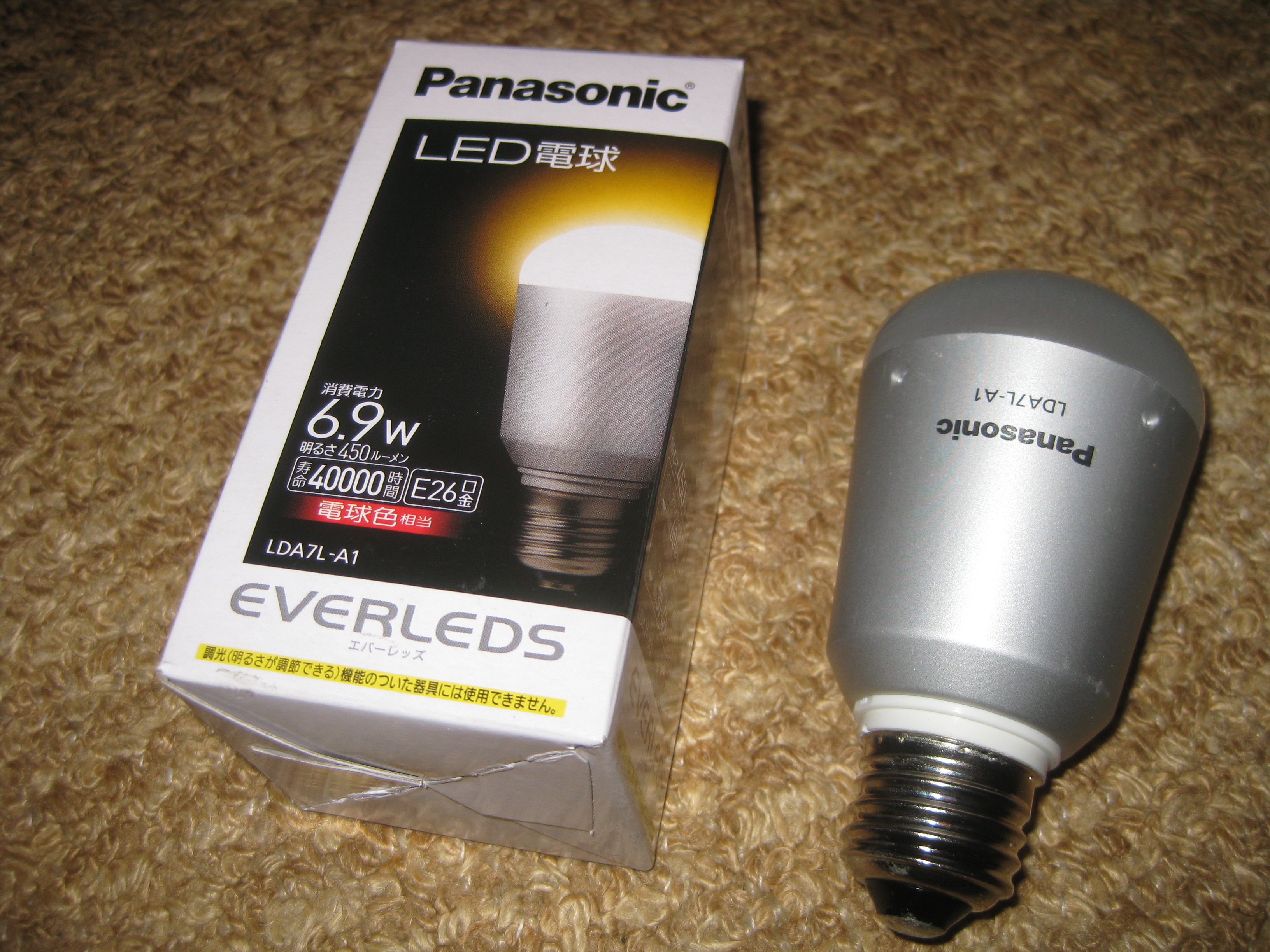
I recently picked up a couple of LED light bulbs that are starting to become more popular in Japan. After comparing a few different options from various major manufacturers, I settled on the “40 Watt” (450 lumen) bulbs made by Panasonic. The main draws for me were the relatively high efficiency (more lumens per watt) compared to other LED bulbs, and the fact that they emit a warmer orange color rather than the harsh bluish light typical in CFLs. Another draw was the fact that these bulbs are rated to last 40000 hours, or about 5x as long as CFL bulbs, which could reduce waste.

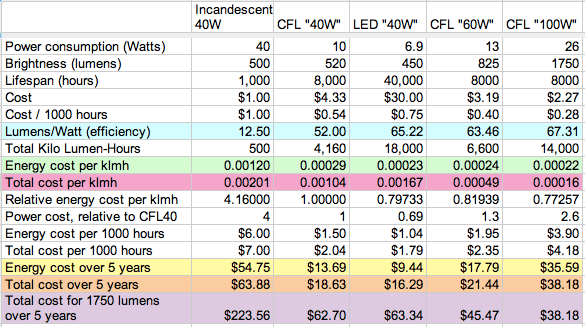
On the other hand, at around $30 a pop (2380JPY, to be exact), they’re pretty expensive as far as light bulbs go. Are they worth it? I decided to run some numbers, comparing the LED bulb I got to a traditional incandescent 40w light bulb, as well as “40W”, “60W” and “100W” CFL bulbs. The results are in this spreadsheet below (see the original document on Google Docs).

Notes:

  • klmh – “klmh” stands for “kilo lumen hours”, and can be thought of as the total amount of light emitted, if it were possible to gather light over time and put it in a box. One klmh equals the amount of light emitted by a 1000 lumen lamp over 1 hour, or a 1 lumen lamp over 1000 hours. Technically, a lux is a better unit with which to measure total light emission, but that information wasn’t available (while lumens were) so I used Kilo-Lumen-Hours to compare bulbs of different brightnesses.
  • Power costs – I used $0.15 per kWh. Actual energy costs vary from around $0.10 to $0.20 in the US. See prices for September 2010. Calculating the cost of energy for off-grid systems is much, much harder, and would vary widely from system to system, so that is left as an exercise for another day.
  • Annual usage – To calculate “costs over 5 years”, I assumed an average 5 hours of usage per day, or 9125 total hours of usage.
  • Total costs – The “total cost” calculations combine the amortized cost of the bulb with estimated energy costs (again, at $0.15/kWh).

I tried to compare the bulbs from a wide range of perspectives, and ended up with all sorts of numbers. I’ve highlighted the ones that I think are relatively informative, but, as you can see, some bulbs do better in some comparisons, and do worse in others. In other words, there’s no clear all-around winner.

Efficiency – In terms of efficiency, the “40W” LED bulb (65.22lm/W) was bested only by the “100W” CFL bulb (67.33lm/W). In reality, the LED might perform a little worse, because LED lamps have more directed lighting patterns, so despite what the lumen rating is, the actual total amount emitted may be less than CFL bulbs. As a side note, it was also interesting to see that the efficiency of CFL bulbs improved with increase in wattage. I think this is because fluorescent lights become more efficient the longer they are, and higher wattage CFLs simply have longer tubes.

Cost – If all you care about is having a light bulb –any light bulb regardless of brightness– in a socket, LED is by far the cheapest option. Even though the upfront cost of the bulb is considerably higher than the alternatives, the additional expense is offset by the bulb’s long lifespan and low energy usage.

On the other hand, LED bulbs are relatively dim compared to the brightest CFLs, and if you must have lots of light, CFLs are cheaper for the amount of light you get. This last point is important. Even though a 26W CFL bulb has 1/10 the cost of a 6.9W LED for the same amount of light, the simple fact that it uses more than 3.5 times as much electricity can not be overcome. Having a 26W (“100W”) CFL in that socket will cost you more than twice as much as using a 6.9W (“40W”) LED bulb. But if you must have that much light, it is cheaper to use one “100W” CFL bulb than to use multiple “40W” LED bulbs.

More is more, less is less
Retailers often try to get consumers to buy more stuff by offering lower per-unit costs when purchased in bulk. While buying in bulk may lead to real savings, such deals can also be a pitfall that leads to excessive consumption and spending. The question to ask is, “Do I have to alter my behavior, in order to take advantage of this deal?” If the answer is “yes”, it is best to stay away from bulk purchases. For example, let’s say a grocery store has a deal on ice cream, such that if you buy 2, you get 1 free. The question is “Would I eat more ice cream if I bought 3?” If the answer is “yes” (and let’s be honest now), just buy one, because one is still cheaper than two, in absolute terms. On the other hand, if you’re dealing with something like toilet paper where abundance probably won’t lead to higher consumption, buying in bulk might actually save you money.

The same applies for lighting. If you can get away with less lighting, it will save power and money. Don’t let the illusion of better “value” trick you into consuming more unless that is really what you want, because you will pay more for it. Using one “100W” CFL bulb for 5 hours a day over 5 years will cost an estimated $38.18, while a “40W” LED bulb used for the same duration will only cost $16.29, even when factoring in the cost of the bulbs. Yes, you get less lighting, but you get less for less, while more costs more.

Lighting accounts for 12% of domestic electricity consumption in the US, and I would argue that that makes it a ripe target for reduction. While current trends are towards improving efficiency, Jevon’s paradox warns us that efficiency may in fact increase consumption. If that is true, it seems to me that the true path to reduction is, well, to reduce. That is, rather than merely swapping 60W incandescent bulbs with “60W” CFL bulbs, consider using “40W” bulbs. Instead of having area lighting consisting of 5 or 6 bulbs, consider having 5 or 6 individual lamps located strategically, so that only localized areas that actually need lighting are lit at any given time. Or, for that matter, turn those lights off entirely, and go to bed early. Artificial lighting can interrupt our natural circadian rhythm, leading to sleeping disorders and other maladies. So going to bed early and getting some extra sleep can save your health and the planet. Now that’s what I call a good deal.

The Cost of Convenience

21.42. That’s how many pounds of propane I’ve burned in the last year or so. I know because I’ve kept every single one of the 1.02lb propane canisters I’ve used. I’ve thought about switching to the bigger 20lb tanks, to save money and reduce waste, but the one thing I like about the little canisters is that it helps me internalize how much gas I’m burning.

Internalizing quantities is something we have a hard time with, yet, if we are to have any hopes of reducing emissions, it’s something we’re going to have to get better at. Unfortunately, in modern society, most of our energy consumption is abstracted away from us. When you pump gas into a car, all you see is a number on the screen, and you probably don’t even know how big, physically, your gas tank is. At home, the power and gas meters are conveniently hidden away. So, understandably, it’s difficult for us to even realize how much energy we’re using even in an abstract sense, much less in any tangible way.

I remember one time while I was pumping gas, I tried to visualize the quantity of that volatile liquid I was going to burn, by picturing all the gas being in 1 gallon milk jugs. Then, I pictured 12 of those jugs and imagined lighting it all on fire. In my mind’s eye I saw a giant ball of flame, and thought for a second that blowing up 12 gallons of gasoline might actually be more fun than using it to drive about 300 miles.

A rechargeable AA battery, at 1.2V, might contain about 1.5 Amp-hours, or a theoretical 3.3 Watt-hours of power. In practice, the voltage would drop too low to be usable after a while, so let’s say, generously, that you’d get 2 Watt-hours. An “efficient” CFL bulb might use 13 Watts, so if you left it on, you’d be using enough energy to drain more than 6 rechargeable AA batteries every hour. Fortunately, if you live in the city, all that power gets delivered to you with the flick of a switch. But next time you do, pretend you’re draining an AA battery every 10 minutes, and it might help you remember to turn lights off when you don’t need them.

In any case, I’m trying to reduce propane usage on my property. Right now, I use propane for my cooking stove (at a rate of about 1lb per week), and my lamp, which also doubles as a heater (which burns about 2lb a week). So far, I’ve had two separate offers from readers to buy me a propane shower, but I’ve resisted. Once Hut 2.1 is done, I’d like to switch to electrical lighting (charged by solar, and perhaps also wind), burn wood for heating and some cooking, and only use propane for the kind of cooking that can’t be done on my wood stove.

Some people argue that wood stoves aren’t so “green.” Burning wood can be rather dirty, especially in old stoves that are inefficient and don’t have catalytic converters. This is true. But, I don’t think it’s realistic to treat all wood burning equally. First of all, when you burn fossil fuels (which include “natural” gas and propane, as well as coal), you’re burning carbon that was taken out of the atmosphere millions of years ago, and then re-releasing it into the atmosphere now, when, if left in the ground, it may not have been re-released anytime soon. When you burn wood, you’re releasing carbon that was absorbed in the last hundred years or so. And –here’s the important part– around here, if I don’t burn the dry tinder, it would eventually be burning anyway in the not-too-distant future. This isn’t true everywhere. As far as I know, forest fires aren’t part of the natural ecosystem in rain forests, and so felling and burning those trees artificially adds emissions. But, around here, it is almost a guarantee that, if left to nature, any patch of forest would burn once every hundred years or so. So, when I pick up some dead dried branches from the woods around me and burn it, I am releasing the carbon trapped in it the way it would’ve anyway. Granted, some of it may have eventually rotted away, or otherwise have gotten broken down biologically (via termites, and other organisms), so I may be boosting emissions slightly, but not by much. On the other hand, if I can clear the forest and minimize the risk of uncontrolled natural forest fires, I may help reduce emissions that way, thus balancing my footprint (though, perhaps not, because the way to clear forests is to –surprise surprise!– do controlled burns).

Of course, CO2 is CO2, regardless of whether it comes from burning wood or burning propane. So, arguably, the two may be considered to be comparable. The difference, though, is that propane is so much more convenient, and so much denser in energy, that it’s much easier to burn in excess when compared to wood, which, by virtue of being less energy dense than propane, takes more effort to move, even if you don’t do the chopping and splitting yourself. A 20lb canister of propane contains roughly the same amount of energy as 60 to 80lb of seasoned firewood. But which would you rather move? Which would you be more willing to go buy more of? When less is more (or better), taking the less convenient route can allow us to be more conscious of our consumption habits, and in turn, moderate such behaviors. If I rely on wood for heat, I’ll need to exert more effort into gathering fuel than if I burned propane. So, I’ll naturally want to burn less of it, and therefore reduce my overall emissions.

Moral to the story? Convenience has a cost, usually in financial terms, but also in environmental terms and even health. Cooking your own meals might be less convenient than eating out, but may be cheaper and healthier. Walking or biking to work may be less convenient than driving, but will be cheaper, healthier, and more environmentally healthy. In typical modern lifestyles, it’s not difficult to find ways to do good, by enduring –nay, by enjoying— just a little bit of inconvenience. So, next time you have a chance to chose inconvenience over convenience, give inconvenience a shot. Your wallet, your body, and your environment will thank you for it.

Insulating Hut 2.1

I posted some thoughts on insulation a while back, but now that I’m actually in the process of insulating Hut 2.1, I figured I’d do another post talking about what I’ve ended up doing.

As you can see in the photo above, I’m using R-5 3/4″ thick polyisocyanurate rigid foam insulation boards on the exterior. If you recall, I used that stuff on the roof as well, so basically the whole structure, save for the windows, door, and floor, will be encased in those boards. Normally, insulation goes inside the wall cavities, but I first thought of putting insulation on the outside while working on Hut 1.0, and implemented the idea in Hut 2.0. The reasons for doing so are manyfold:

  1. Putting insulation on the outside leaves the wall cavities available for use. I’ve filled in some of the walls with “shelves”, but I also have the option of filling them in with batt insulation if the rigid boards on the outside prove to be insufficient. The same applies for the space between my rafters, which I may fill with batt insulation later.
  2. Instead of using a traditional air barrier, I’m taping the seams between the insulation panels together so that the insulation panels themselves form an air barrier. The boards on the roof also act as a waterproof layer, in the event that moisture leaks through the roofing panels. This cuts down on building materials, which lowers the financial cost as well as the total environmental footprint.
  3. By wrapping the entire structure in insulation, I am increasing the thermal mass within the thermal envelope. That is, all the posts and beams and OSB sheathing inside the insulation act as a thermal mass, which can absorb heat and release it slowly. Obviously, wood isn’t as effective of a thermal mass as, say, a concrete slab, but I think it counts for something. The downside is that, if I’m heating the structure from a dead cold, it takes longer to warm up, because, for a while, the structure itself is going to be absorbing some of that heat.
  4. Covering every square inch of the exterior in insulation (again, except for windows and doors) prevents thermal bridging. Thermal bridging, in the context of structures, is when heat conducts through structural members, bypassing insulation. For instance, in a traditional 2×4 stud wall construction, only the space between studs typically have insulation, so the studs themselves can conduct heat in or out. While that may not seem like much, if studs are spaced 16″ apart, that’s 1.5″ out of every 16″, or close to 10% of the surface area that’s left uninsulated.

When I first thought of the idea, I thought it was all new and radical, but I’ve since learned that this exterior insulation thing is… well, a thing. For instance, a related and somewhat similar concept is SIP –or Structured Insulated Panel— construction, which is a fancy way to say “insulation boards sandwiched between structural sheathing.” The one interesting thing about SIP is that the insulation boards are glued to the sheathing, thus increasing rigidity and eliminating any gaps. Gaps in insulation are bad, because it could allow for air circulation, which can render insulation moot by carrying heat in or out. For Hut 2.1, I originally tried using a spray-on glue to attach the polyiso boards to the underlying OSB sheathing, but the glue I got didn’t stick too well. So, instead, I’ve been nailing the boards onto the sheathing, and, where possible, through to the 4×4 posts (the gray patches of duct tape in the photo above are where I’ve put in nails). That doesn’t eliminate the gaps, but, in my case, I’m not terribly concerned because those gaps will be inside the thermal envelope, and as I mentioned above, the foam boards should, in theory, form a mostly air-tight enclosure and relatively little of that heat should escape outside.

For the floor, I’m thinking of doing something different as well. Normally, batt insulation would be stuffed in the spaces between the floor joists. But, I don’t like fiberglass, and ever since I saw those cubes of recycled cellulose blow-in insulation at the hardware store (pictured below), I’ve been wanting to use them. The stuff is made of recycled materials, supposedly uses far less energy to manufacture than traditional alternatives, and is pretty cheap ($8 per bag), so it sounds pretty awesome all around. The current plan is to lay down more 2×4 “joists” on top of the existing floor (though running perpendicularly to the existing joists for strength), then put another layer of OSB on top of that, and fill in the 3.5″ tall gaps with the blow-in insulation, which should give me about R-13. Since the insulation will be sandwiched between two layers of OSB, I also won’t have to worry (as much) about critters getting in there or stealing my insulation, which I hear are concerns for the more typical exposed under-the-floor batt insulation.

So, that’s basically the plan so far. I’m considering getting some batt insulation that’s made of recycled materials, similar to the blow-in insulation I got, to stuff in between my rafters. But, I think I’ll hold off on that until I get my stove going, and see how well the existing insulation works (or doesn’t work).

Journal: December 19th, 2010

It started snowing last night, so I moved the car about a 3rd of the way back down the dirt road, past the worst bits where I got stuck last time. Later in the evening, a warm front moved in, and the snow turned to rain, accompanied by strong gusty winds. The storm kept me up for a while, as the winds rattled the loose Tyvek on the extension roof. Rain, sleet and hail peppered the south-facing wall and windows. Out in the woods, you can hear wind approaching from a mile away, like an oncoming freight train. The sounds –which travel faster than the wind itself– of air rushing by trees, move ahead of the actual pressure wave, and as I lay in the dark hut, under my blankets, could do nothing but to cringe as wave after wave of air tore through the woods and crashed upon my untested cabin. Hut 2.1, with its broad and high wall that faces prevailing winds, has a high wind profile, and that’s always been a concern to me, especially since the structure isn’t anchored to the ground. Fortunately, the hut withstood each assault with barely a shudder. Eventually, I drifted off, as I gained confidence in my dwelling, and the rattling of the Tyvek, and the pattering of the rain, and the roaring of the wind lost that threatening edge, turning instead to a calming lullaby, just another soundtrack of a life in a cabin in the woods. My last thoughts before falling asleep were “Man, if I had a wind generator, they’d be cranking out mad Amps right about now…”

Then, I almost got myself killed on the way out today. It had started snowing heavily just as I was leaving. Though the temperature was a few degrees above freezing, the heavy sticky snow accumulated quickly, and by the time I made it a few miles down the paved county road, the pavement was covered in half an inch of slush. Coming out of a gentle right-hand turn, I felt the car sliding as I tried to straighten out. I turned the wheel farther to the left, then suddenly the tires caught traction, catapulting me into the opposing lane and towards the hillside. With the car’s slip indicator beeping rapidly and franticly –as if I didn’t notice what was happening– I gave full right rudder, as the car straightened out with the left wheels rumbling on the gravel shoulder off the opposing lane. I slid, straight, half on and half off the pavement, as the side half-off the pavement tried to pull me farther off to the left, while the front wheels tried desperately and futilely to pull me back on to the right. After what seemed like minutes, but probably no more than 3 seconds, the car finally shuddered to a halt. I quickly scooted back to my side of the road, and pulled over on the shoulder with the emergency lights blinking. It was a close call. I’d scraped a bush off the side of the road, and my laptop had flown off the passenger side seat where it had been charging contentedly, but there was no discernible damage to car, contents, or person.

As I got back on the road, I reflected on what had happened. In my rush to get out before the snow got worse, I’d failed to notice the rapidly changing surface conditions — which had been wet, but not snowy, just a few minutes and a couple of miles prior. I was going way too fast for the conditions. The treads on my front tire are also worn down almost to nothing (need to get new tires, or at least rotate the back tires forward). I’d also braked too hard, though I’m not sure what the car’s fancy electronic safety systems were doing during that whole ordeal. I was also fortunate there was no oncoming traffic — that could’ve ended catastrophically.

Conditions got better as I got down into the valley, with the snow turning to sleet, then rain. But to get out of the area, I still had to go over a mountain pass at 4300ft elevation. There was at least an inch or two of accumulation on the road surface, with heavy snow falling steadily. I thought about waiting for a plough to come through and following it, but it was 3pm –an hour before sunset– with the thermometer showing 34F. That close to dusk, it’d get colder soon, and then icy. I decided to just take it slowly. Fortunately I made it up over the pass and back down to less snowy conditions without having to pull out my chains.

Normally, I’d just wait out a storm, since I have plenty of supplies, and usually, nowhere to be. But, I’m heading out of town in a few days to go spend the holidays with my parents, so I was actually on a schedule for once. It looks like I got out just in the nick of time, other than that brief sledding adventure.

So, that’s it from Serenity Valley for 2010. I’ll be back in January, but rest assured, I have blog posts lined up for the interim period as well. I also have a big-ish announcement possibly coming up, so stay tuned for that as well.

Update: After posting this, I realized that, while it’s just past midnight in Serenity Valley Time, and therefore the 19th, it’s actually December 18th local time. Thought I’d add an explanation in case anyone was wondering why the post is from the future…

Hut 2.1 video

I felt like making a quick video of Hut 2.1, so here it is. It’s not a terribly exciting video, and I wasn’t feeling particularly perky that day, but I figured it might still be of interest to some of you. You can watch it below, or in HD on YouTube.

Donations

I’ve set up a Donations page on the blog, which describes all the different ways you can contribute. You can now setup a PayPal subscription, for instance, which will automatically charge periodically, starting with $5/month on the low end. I also have a list of some physical things I could use, if you’d rather donate stuff instead of money. And I’ve listed a few ways you could help for FREE as well…

I’ll be honest, money is tight. I returned hundreds of dollars worth of chimney for a refund, and sold a couple of guns I don’t need. Combined, that raised enough cash to get me through the month. Next month, I’m planning on taking out an early disbursement from my 401k account. Obviously, that’s not ideal, but I’d rather do that than go back to the cubicle farm. But once that’s gone, and I haven’t come up with a better plan, the cubicle farm it’ll have to be.

I want to keep doing what I’m doing. I want to keep living off the beaten path. And I want to keep blogging, to share my story and the lessons I’m learning. Obviously, I haven’t figured everything out. But life’s short, and I’m not going to waste my days doing something I don’t care about.

If you can, please help.