Journal: June 15th, 2010

I worked on the garden some more today. I finished double digging the last of it in the morning, and moved on to spreading and mixing compost. Yesterday, I bought a total of 14 cubic feet of 3 different kinds of compost (“soil builder”, manure compost, “good for vegetables” compost), and since I have a total of 72 square feet, that comes out to a little over 2 inches per square foot. I decided to spread 12 cubic feet (exactly 2 inches per square foot, in theory), and keep a 2 cubic foot bag of compost in reserve for strategic deployment later. But would 2 inches per square foot be enough? I’m not sure. After mixing in all 12 cubic feet, I felt like the soil could use more help, so I went into town to buy more compost. Unfortunately, the hardware store had already closed (though I got more water, so the trip wasn’t completely for naught) so I might just start planting tomorrow, unless I feel like going into town again (it takes right about 30 minutes, so it’s not exactly trivial to do so).

The other challenge has been to figure out how to fit everything into my garden bed. I guess you’re supposed to figure that out before hand, but I’m not the planning sort and I just like to do things and wing it. It usually works out ok, even if not optimally. In any case, the patch of ground I picked out for my garden bed turned out to be 6ft by 12ft (totally not planned… didn’t even measure it until after it was all dug up). And I’ve got these plants, and some seeds, and they just need to go in that patch of ground, right? Boy. Who woulda thought that plants could be so picky? Well, I sure didn’t. It’s like trying to come up with a seating chart for a wedding party. The egg plants like to be in a group, the strawberries want some afternoon shade, the corn has to be in a block with at least 4 rows, the tomatoes hate everybody, corn likes to hang out with beans, but actually so do the strawberries, and one kind of squash is fine in the shade, while the zucchini want both sun and shade. And then I have to take into consideration the fact that my arms are only so long, and my hips only so forgiving, and ensure everything is accessible with those constraints in mind.

I invested quite a bit of time reading about the compatibility of plants, and running through numerous permutations of possible layouts in my mind. At the end, I decided the tomatoes were going to have to go somewhere else. But other than that, I think I’ve come up with a layout that fits most of the things I have, and in a way that the plants themselves will (hopefully) find satisfactory. A section on the southern end will contain strawberries, egg plants, and bell peppers, with a line of corn down half the southern edge, just to provide shade. The rest of the bed to the north will contain 4 rows of corn, oriented east-west. In between rows one and two, and three and four will be zucchini on the eastern edge (to catch some morning rays), yellow squash on the western edge, with beans in between. The space between rows two and three will be left clear for access.

Quick Update

I’m parked outside a pizza parlor in town, mooching their internet connection. In the back of my car is my purpose for this trip into town: 8 big bags of soil and fertilizer, along with 23 gallons of water. So this update’ll be quick…

First, my excuse for the long silence on this blog. I was in Japan for the last half of May visiting my parents, and then the first week of this month, I spontaneously went to Beijing for several days. Awesome times were had, though that’s a whole ‘nother post, and for now, I’ll simply refer your to the copious photographs I took.

Now, I’m back on Serenity Valley. It’s finally warmed up, and you wouldn’t think that it had snowed just 2-3 weeks ago. The temperature’s up in the 80s (in the shade) during the day, with lows comfortably in the 40s or so. It’s great to be back outside in the sun, getting my creaky old body going again. I’ve been helping my neighbor smooth out the dirt (erm, and rock) road, which is only fair since he bought a few truck loads of gravel to cover it all up.

I’ve also been working on my garden bed, which is a lot of hard work. There’s a hard clay layer about 16-20″ down (and about 3-6 inches thick), and I’ve had to get down on my knees to pound in my spading fork with a mini-sledge hammer to break it up (I guess a pickaxe would’ve also worked, but I don’t have one of those). Fortunately, unlike last time, the plants I brought with me have not died, so I’m hopeful. I’m starting to realize that the soil is probably too nutrient poor, hence this trip to buy soil and compost (I did get the organic stuff, at least). Keeping the garden watered is going to be a challenge, but I found a free source of water in town, so for now, I’ll probably continue to just truck wanter onto my property.

I’ve also been thinking about the next iteration of my hut. The big question on my mind is whether to expand/improve my current hut, or to start on an entirely new one and do it right (or at least, better) from the beginning. But that’s a whole other post too… For now, I’m actually back to sleeping in my car, because it has more windows, more headroom, and better ventilation than the loft-cot in my hut. Until my hut improvements are done, I might go back to sleeping in a tent, though, maybe I’ll at least get a cot this time. In a few weeks, it might even be warm enough to sleep outside in a hammock, though there’s always the risk of getting eaten alive (by mosquitos, or bigger things)…

Anyway, the adventures continue. I’ll try to post more in coming weeks.

NFSV Episode 8: Chores

Latest news from Serenity Valley. In this episode: cleaning in and around the hut, picking up trash left by other people, putting up signs, and clearing dead branches in preparation for fire season. View in HD on YouTube.

NFSV Episode 7: Inside the hut…

I shot this inside my hut last week. It’s a little dark, but you can get a sense of what it looks like inside at night. Watch it on YouTube in HD, if you want to see my grainy underexposed face fill your screen. I also uploaded photos I took last week to Flickr, so check those out too, if you haven’t already.

I’m heading back up there tomorrow, hopefully to start a garden, so expect more interesting news next week…

On Guns

When I started this blog, I assumed that the few people who would read it would be my friends. My friends know me for who I am first, and for them, the part of me who is a gun-owner and a woods-dweller is only a relatively small part of a larger whole. While I consider myself fortunate to have picked up a few readers who haven’t met me in person, I suspect that those of you who don’t know me well may make assumptions about who I am based on what little you see and read on this blog. For instance, a few of you picked up on that short scene in the last video where I was loading shells into my shotgun, and commented on the potential use of force on my land. While you’re free to think of me as you wish, as a gun-owner-blogger, I feel a certain responsibility to articulate my views on guns as clearly as I can. So, here we go…

Unlike many of my city-dwelling friends, I grew up around guns. My father was an avid marksman, and shot competitively for as long as I can remember. There were guns in our house when we lived in Los Angeles in the 80s, and my dad shot air guns competitively when we lived in Germany in the 90s. We even had a 10m indoor “shooting range” setup in our basement, where I often shot air guns as well. I didn’t get into shooting competitively myself until I moved to the Bay Area after college and joined a local club, where we shoot matches similar to NRA Highpower matches (and CMP Service Rifle matches). I started off shooting about 40% of maximum points, and have gotten to the point where I can score about 90%. So I’m not great at it, but it’s something I take seriously.

Though I primarily consider myself to be first and foremost a competitive marksman, gun owners are actually a pretty diverse group. Even within competitive shooters, there are various disciplines that are very different. Some are more “practical” and simulate the challenges of tactical scenarios, while “benchrest” shooters clamp down their guns and compete based on their ability to tune their guns and ammunition and read wind accurately. However, there are tens of millions of gun owners in the US, and most of them don’t even compete at all. Many of them have guns tucked away in the closet “just in case” and rarely actually shoot. Some shoot casually at shooting ranges. Many hunt, for food or leisure. Some have permits to carry concealed handguns. And while the stereotypical gun owner might be a white conservative man living in a small town, some are like me; well-educated, young, socially liberal, reasonably affluent, and/or living in the suburbs or cities. Even in the San Francisco area, known for its liberal population, there’s a thriving community of gun owners, gun shops, and shooting ranges if you know where to look. So, while the label “gun owner” has a certain stigma (and set of assumptions) attached to it these days, stereotyping us is as misleading as stereotyping any other group of people in this diverse country.

Now, with that aside, let me talk a little bit about why I carry a gun on my property. First of all, I’m not certain that there aren’t bears or wild pigs around, and both can be quite dangerous. If a pig were to charge at me, I wouldn’t hesitate to shoot it (mmm… free pork). But when it comes to humans, the short answer is, deterrence. Out there, there’s a good chance that anyone who is illegally on my property is also armed. Maybe they are illegal loggers or hunters. Maybe they are illegal marijuana growers. Whoever they may be, by being on my land illegally, I would consider them to be people of questionable moral character. And the reality is, if someone wanted to shoot me and leave me for dead, they could. They’d be far, far away before anyone even noticed I was missing. I carry a gun not because I think I can win in a gun fight, but because it’ll hopefully make someone think twice before shooting at me. If I am unarmed, the equation is simple: if they shoot me, they can get away free. Even if they miss and I call the sheriffs (which I currently can’t since my phone doesn’t work up there), it’ll be an hour before they show up. In fact, there may be more incentive to actually just kill me to avoid the hassle of potentially being identified later (since there won’t be any other witnesses). But, if I am armed, there is more uncertainty: if they try to shoot me, I might shoot back. It’s very, very unlikely I’ll ever get shot at, but anything that makes it even less likely for me to get shot at is a good thing.

Now, I’m a pretty chill dude and do not wish to do anyone harm unless they threaten me with imminent danger. That’s fortunate for me because state law prohibits me from using force in pretty much any other circumstance. I can’t shoot someone for merely trespassing (nor would I wish to). I can’t shoot someone even if I catch them in the act of burning down my hut (nor would I wish to). I can’t shoot them even if they are armed and shoot a hole into my solar panels with a shotgun (nor would I wish to). In fact, I won’t point my gun at another person unless they’ve shot at me or I feel they are about to, and even then, only if I think they can actually hit me (most people can’t shoot worth a damn), and only if I don’t think I can safely retreat.

If I came across someone vandalizing my property, how can I be sure that in my rage I won’t shoot them even though I have no legal basis to do so? I can’t. But I have faith in myself. I believe I am a good person, and that I won’t cause unnecessary bodily harm in another person. Like I said, I’m a pretty chill dude. While we’re on the topic of safety, I should also note that I exercise extreme caution with my firearms. When I carry guns on my property, I leave the chamber empty. That means I can disengage the safety and pull the trigger and nothing will happen. I have to load a round into the chamber, which is a clear and deliberate act that gives me an additional moment to reflect on what I am doing, or about to do.

For me, gun ownership is about more than what the 2nd Amendment says or doesn’t say. It’s about freedom, individual accountability, and faith in humanity. It’s about what kind of society I want to live in. Personally, I want to live in a society where people can do whatever the hell they want, as long as they don’t harm others. And if they do do harm, then they should be held accountable. But as long as I don’t actually do harm, it shouldn’t be anyone else’s business what I might do. I also want to believe that most people are good, and want others to believe that I am good too. I’d like to live in a society where I’m not assumed to be violent or dangerous just because I own a device that could conceivably be used for violent and destructive purposes. In other words, judge me by what I do, not by what I own. And trust me, for I am good.

I hope this clarifies my view on guns, gun ownership, and the use of force. As always, leave a comment if you have any questions or thoughts…

News from Serenity Valley – Episode 6: Return to Serenity Valley

Latest episode of NFSV about my return to Serenity Valley after being away for the winter. Can my new car make it up the dirt road? Will my hut still be standing? What state will my camp be in? Watch to find out.

Wish List. Department of Defense, Serenity Valley

Photobucket

I just came across this for-sale ad for this piece of artillery. From the seller’s description:

This is a half-scale Napoleon cannon with a just under 1 3/4″ bore… sized for golfballs !!! The wheels are 30″ diameter and designed for live fire cannon use… they won’t be shaking apart anytime soon. The barrel is double sleeved with seamless tubing. It was originally a 2 1/4″ bore and then reduced down to take golfballs. It is approximately 36″ long, just over 5″ diameter at the breech and just over 4″ diameter at the muzzle. Barrel and carriage combined weigh approximately 475 pounds. Comes with everything you need…. powder, ball, fuse, all required implements for loading and cleaning, bore gauge etc. Even comes with a mold for making up 1 pound round shot from lead or wheelweight !!!

At $2750, it sounds like a pretty good deal. If I had that kinda money lying around, I’d totally get this and set it up on my property and lay siege on… I dunno, the other end of my property. Or maybe load it up with grapeshot and go huntin’.

SPOT GPS Messenger

After spending a month and a half staying with friends, I decided to settle down for a bit and started renting a room in San Francisco. So far, things have been great, BUT that’s not the purpose of this post… In a strange coincidence, I found out that my roommate works for a company that produces a perfect solution to a problem I had/have when I’m up on my property alone.

The Problem
One of the things that worried me most about being alone on my property, and particularly at my camp, half a mile from the road and miles from any other human settlement, was the risk of injury. Out there, even an injury or condition that could be solved by a simple trip to the ER could’ve become a huge issue, simply because I might not have been able to get to the ER or call for help. For instance, if I were working on the roof of my hut, fell off, and broke my legs, that would’ve been mighty inconvenient. I would’ve had to drag myself over to my trailer, dig out the first aid kit and survival manual, read up on what to do, stabilize myself, then drag my broken legs down the hill to the road. There, I could wait for a car to come by and flag it down, or try to drive to the nearest house.

And that’s the best case scenario, assuming I am still mobile and mostly stable. If I suffered a bad compound fracture, I might lose blood too fast, or move too slowly. If I were immobilized, without a way to contact the outside world, it’d be days, or over a week, before my friends came to find me, and there’s a decent chance I’d have died of dehydration or hypothermia by then. Other than trying to signal air craft (who wouldn’t even be looking for me) the only way to attraction attention would’ve been with my handgun. I’d have 16 rounds of ammo; that’s five sets of three shots (a distress signal, if anyone happened to hear it and recognize it as such), with one bullet left over…

(In case you’re wondering, yes, I thought about all this when I was out there. I went anyway, because the things worth doing in life are worth doing even if it kills you. But that’s another post…)

The solution
Well, it turns out that the company my roommate works for has the perfect solution for crazy people like me!

The SPOT GPS Messenger is a simple device that has a number of basic but useful features. There’s an SOS button you can push, which sends your location to a dispatch center, which will then direct the nearest emergency unit to your location, no matter where in the world you are. There’s also a less urgent “help” button, an “I’m ok” button, as well as a tracking functionality so your friends and family can see where you are (if you’re sailing around the world or backpacking across the wilderness, instead of sitting in a hut like I was). Since both the positioning and communication is done via satellite, it works even where cell phones don’t have reception (though, it’s worth noting that GPS’s don’t work in some terrain, depending on the quality of the receiver). My roommate let me handle the demo unit he carries around, and while not tiny, it’s small enough to carry around, and seems pretty rugged. I obviously didn’t try the SOS functionality, so I can’t tell you whether it actually works, but he said several hundred people have been rescued after using it…

The only downside I can think of is cost. The actual unit costs $150, but the service costs $100+/year. Granted, for a device that can literally save your life, that’s not much. Next time I go out there, I’ll almost certainly bring one of these with me (especially since I can get a discount through my roomie 🙂 ). Even if you don’t go on crazy outdoor adventures, it might be worth having one of these next to your bed if you live in an earthquake-prone area. When your house comes crumbling down around you, one of these might be handy to let people know you’re down there… It also might be good for the elderly; I’ve heard of old people who lived alone who died after a simple fall, because they couldn’t get to a phone to call for help.

Land! Part 3 – Physically locating parcels of land

(Disclaimer: I am not a land surveyor, a registered civil engineer, a real estate agent, or a real estate lawyer. I bought land. I figured out where it was. This is what I learned, but I make absolutely no guarantees about the accuracy of the information I provide below. If you have questions, consult a professional, and do your own research.)

This is the long over-due Part 3 on my series about buying land (see Part 1, and Part 2). In this section, I’ll talk about how to physically locate parcels of land on the surface of the Earth (specifically, in the US). The fact that this topic warrants an entire blog post (and more!) might come as a surprise to some. After all, if you buy a house or a condo, physically locating it is usually the easiest part; just type the address into Google Maps, and follow the directions. Easy! The problem is, remote vacant land often won’t have street addresses that mapping services would recognize.

Wait. No street addresses? Then how is land described or identified? Glad you asked. Here are a few of the ways land can be described:

  • Driving directions – Real estate listings for land often will include directions you can follow to get to the land… or at least, close to it. As far as the real estate agent knows. Which might not be accurate. In any case, it’s usually of the “Go east on Highway 123, then turn left on county road 4 approximately 2 miles past the cafe in Tinytowne, drive roughly 10 miles until you see a dirt road (see attached picture)…” variety. Yeah. Fun. The problem is, when you’re talking about acres of land, getting there is only the beginning. You then want to know where the property boundaries are and such. So, directions like these, while useful, only give you a part of the picture. Instead, you should ask for…
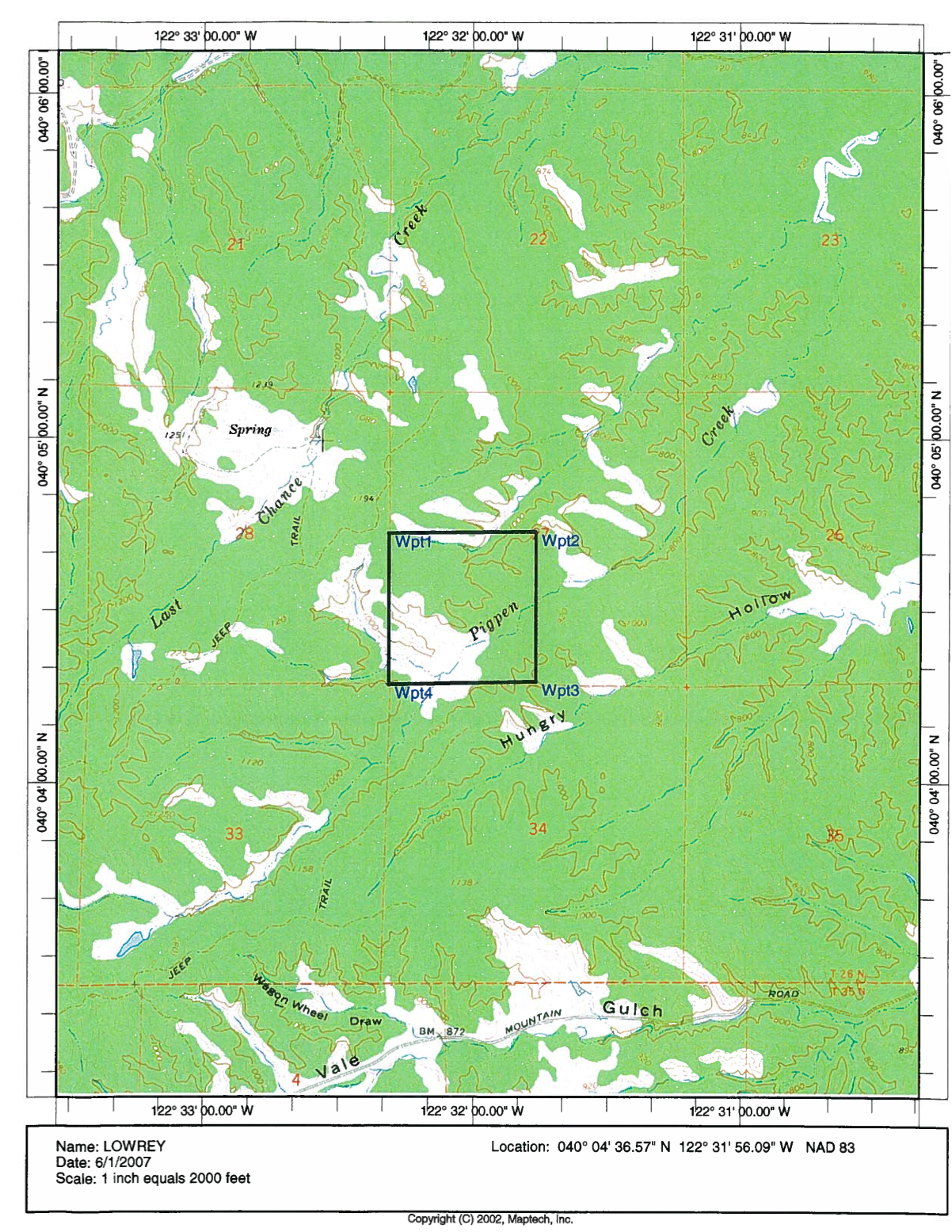
  • Topo maps – Some of the more technically savvy realtors will use GIS software to plot the approximate property boundaries onto a topographical map. If you’re not familiar with topo maps, they’re detailed maps that show not only roads and such, but also represent the terrain, vegetation, bodies of water, and other useful information. I believe they are made by the USGS, and copies are available online (I’ve used Digital-Topo-Maps.com), or at BLM offices. If your realtor is savvy enough to use GIS, they should also be able to give you approximate GPS coordinates of the property corners. Sounds great, right? Well, note how I’ve used the word approximate a couple of times… Yeah. So, when I first got a topo map representing the property I ended up buying, they got it horribly wrong. If I’d gone by that, I’d think I owned tens of acres of someone else’s land, and thought I’d have road frontage when I didn’t. In most cases, they’ll be accurate to within, oh, tens of feet, but still, that could be quite significant, and to make matters worse, consumer-grade GPS units are often only accurate to within tens of feet, which means, combined, you could be off by 50-100ft!
  • Parcel maps – These are usually maps filed at the county recorder’s office, and contain less information than topo maps about the nature of the land, but more accurate information about the parcel’s borders. These are usually drawn up by Land Surveyors (LS) or Registered Civil Engineers (RCE), and might contain information such as the precise length of a border, the location of surveyor’s pins and other markers, and easements. Parcel maps come pretty close to being the source of truth, but, they are not the source of truth. They can be wrong, or outdated and superseded by newer parcel maps that for some reason your realtor isn’t aware of, but contains relevant (and potentially conflicting/overriding) information. Another big problem with parcel maps is that they don’t necessarily tell you where your property is on the surface of the planet. Take a look at the example map above. Given such a map, how would you find the property corners? There aren’t any GPS coordinates on the map, and it’s entirely likely that there aren’t any physical markers (fences, surveyor’s pins, etc) on the ground. I’ll describe how this works later in this post…
  • Legal description – The source of truth is actually what’s called the legal description. It is a textual description of a parcel of land written down on the deed. You might think you’re buying land, with trees, dirt, rocks… but no, actually, when you buy land, you’re buying a piece of paper with text on it. So, what does this text look like? I’m sure there are a wide variety of descriptions, but personally, I’m aware of four different patterns:
    • Parcel 3 in the map on Page 42, Book 78 filed in the County of Snarfle on January 25th, 1962.” (The precise language might sound more official or legalese, but you get the idea)
    • From the North West corner of Section 27 of Township 26 North, Range 6 West, Mount Diablo Meridian, go due south 2603.4ft to the starting point. Thence due East 2612ft, then due South 2609.2ft, due West 2611ft then due North 2605ft back to the starting point.” This description is based on the PLSS, which I’ll describe below. (Again, in reality, it’ll sound slightly more official and legal than that, but you get the idea.)
    • East half of South West Quarter of Section 27, T26N R6W, MDM” This is also based on PLSS.
    • beginning with a corner at the intersection of two stone walls near an apple tree on the north side of Muddy Creek road one mile above the junction of Muddy and Indian Creeks, north for 150 rods to the end of the stone wall bordering the road, then northwest along a line to a large standing rock on the corner of John Smith’s place, thence west 150 rods to the corner of a barn near a large oak tree, thence south to Muddy Creek road, thence down the side of the creek road to the starting point.“(src) This system uses an old British system called Metes and Bounds.

If you buy land, sooner or later, it’s likely you’ll end up with all of the above. Or, at least, I did. Then, you drive out there, put on your hiking boots, and you walk. And don’t forget to bring a snack and some water too, ’cause you might be out there for a while… But before you do that, it’ll help to understand how the aforementioned Public Land Survey System works, since most land in a large portion of the US (excepting large swaths on the East Coast, mostly in the original 13 Colonies) will have descriptions based on that system.

The Public Land Survey System

If you’re really interested, go read this page and skip my explanation. For those of you only mildly interested, I’ll try to summarize the basic idea:

So, the Brits, being ass-backwards as they are, used what’s known as Metes and Bounds. Their system basically used physical landmarks, directions and distances to describe land. So you’d start at a rock, then head towards that tree, then along this stream… so on and so forth. The problem is, these physical landmarks can move or disappear over time, creating ambiguity. But in the US, we had Thomas Jefferson. In case you didn’t know, Thomas Jefferson was pretty bad ass. He was like the Chuck Norris of his time. But smarter. Anyway, I digress… where was I? Right. Thomas Jefferson came up with a more rational system based on a grid. In the PLSS, most of the US is divided into a neat grid, of 6 mile by 6 mile boxes called Townships. Each Township is further divided into a 6 by 6 grid of Sections that are one mile square. Except, I lied. I said a grid, but in reality, there are many grids. Let’s look at the example I mentioned in one of the legal descriptions above: Township 26 North, Range 6 West, Mount Diablo Meridian or abbreviated T26N, R6W, MDM. What that basically says is, starting at the origin of the Mount Diablo Meridian grid (presumably somewhere near Mount Diablo in central California), you go North 26 townships, then West 6 townships, and that’s the one we’re talking about (columns of townships are called Ranges, hence Range 6 West). Within townships, sections are numbered left to right, top to bottom, so Section 27 would be 5 rows down, and 3 columns over.

So… ok, if you’re confused, go read the article I linked to in the first place. The illustrations there might do a better job than my rambling. Though it won’t tell you how kickass Thomas Jefferson was. Kickass, I say.

Incidentally, a Section, the one mile by one mile box at the lowest levels of the PLSS grid, is approximately 640 acres. A quarter of a Section is 160 acres. A quarter of a quarter of a Section is 40 acres. Ever heard the phrase “40 acres and a mule”? Yep. Now you know why it’s 40 acres and not 30 or 50 or a 100.

Finding Section Boundaries

If you’re buying large acreage (i.e. a multiple of 20), there’s a good chance you’ll be buying a neat fraction (half, quarter, etc) of a Section. In fact, your property may even be in the corner of a section, and have a legal description that originates at that section corner. If so, you might want to know where the section corners are. There are websites that’ll take Township, Range and Section codes and crank out GPS coordinates. But, really, the source of truth is a marker on the ground. If you’re unlucky, like me, your Township was last (and first) surveyed by the General Land Office in 1880. They conveniently erected a pile of volcanic rock to mark the section corner… in a field strewn with volcanic rocks. Do you know what a 130 year old pile of volcanic rocks in a field full of volcanic rocks looks like? I don’t. But, that’s why we have RCEs and LSs.

Finding Property Boundaries

So, I hope you enjoyed reading all that information above, because in reality, most of it is interesting but useless background knowledge. In reality, here’s how you locate a parcel of land:

  1. Get all relevant maps and legal descriptions from your realtor, or better, the county recorder’s office
  2. Look at all the maps of the parcel that have been filed at the county, which were drawn up by an LS or RCE. Look for indications of surveyor’s markers or pins (usually tiny circles).
  3. Go to the property, and look for those markers or pins. Usually they are numbered plastic or brass discs or tags attached to something permanent. They may be attached to trees, but I believe they are often on steel pipes pounded into the ground. However, they might only stick out of the ground about 6 inches, and unless you’re practically on top of it, you might not see it. But having approximate GPS coordinates will help you constrain your search area. At least, that’s how I found my markers (one of which is pictured to the right).
  4. If there is any ambiguity, consult a LS or RCE (though this may cost money)

And, really, that’s it. One thing to keep in mind is that fences are not a source of truth. There are fences between my property and neighboring public lands, but once I found all the surveyor’s pins marking my property corners, I realized that the fences are not actually on the boundaries. Now, if legal disputes were to ever arise, fences may mean something in court, especially if they’ve been there a while. But, I’m not a lawyer, and you should consult a real real estate lawyer about such issues.